The Syrian interim government and the Kurdish-led Syrian Democratic Forces (SDF) have reached a landmark agreement formalising Kurdish political recognition, institutional integration, and a nationwide ceasefire. This accord, initially reported by Syria’s state news agency SANA on 10 March, represents a critical juncture in Syria’s post-conflict reconfiguration, positioning Kurdish self-administration within the broader national governance framework. Implications of the agreement extend beyond Kurdish rights, constituting a foundational shift toward an inclusive, decentralised political model in the post-Assad era. The Autonomous Administration of North and East Syria (AANES), the SDF and prominent figures of the region have issued official statements and interviews elaborating on the deal’s specifics.
This agreement emerges amid increasing scrutiny of al-Sharaa’s administration, particularly concerning accusations of massacres and crimes against humanity in Syria’s Alawite coastal region. The interim presidency of Ahmed al-Sharaa (al-Julani) has been marred by reports of targeted violence and systemic persecution, intensifying the urgency of a broader political settlement.
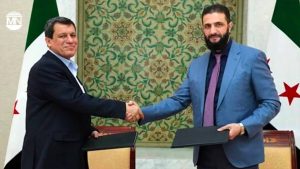
Signed by SDF Commander-in-Chief Mazloum Abdi and al-Sharaa, the deal constitutes the first formal recognition of Kurdish political and cultural identity within the framework of the Syrian state, establishing a precedent for federalist governance. While initially centred on Kurdish rights, it is now seen as a transformative step toward institutional inclusively and security for all of Syria’s diverse populations, including Druze, Christians, and Alawites. By enshrining guarantees for political representation, cultural recognition, and collective security, the deal establishes a framework that could lay the groundwork for a more pluralistic and decentralised governance model across Syria.
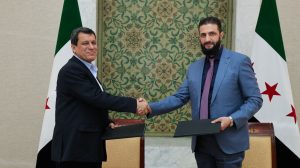
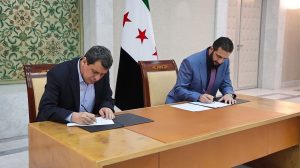
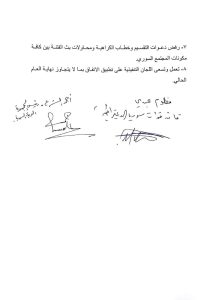
The Syrian interim government and the Kurdish-led Syrian Democratic Forces (SDF) reached a landmark agreement formalising Kurdish political recognition, institutional integration, and a nationwide ceasefire on 10 March.
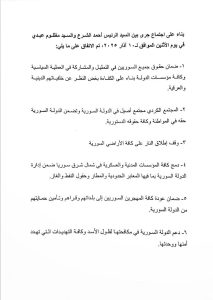
Structural and institutional provisions of the agreement:
Inclusive political representation: The agreement mandates equitable political participation across all ethnic and religious groups, ensuring representation in governance based on administrative competence rather than sectarian or ethnic affiliation.
Recognition of Kurdish identity: The Kurdish community is explicitly acknowledged as an indigenous component of Syria, with constitutional guarantees for citizenship, linguistic rights, and cultural recognition.
Comprehensive ceasefire: The accord implements a nationwide cessation of hostilities, fostering conditions conducive to political stabilisation and economic recovery.
Institutional integration: Civil and military structures in northeastern Syria will be incorporated into the Syrian state’s governance apparatus, including jurisdiction over border crossings, airports, and hydrocarbon resources.
Facilitation of refugee return: The agreement outlines mechanisms for the reintegration and security of displaced persons, ensuring their right to return under state protection.
Unified counterterrorism and security doctrine: The accord commits all signatories to a collective security framework, including efforts to neutralise paramilitary threats and remnants of the former regime while countering sectarian fragmentation.
Implementation and oversight mechanisms: Executive Committees are to be established to oversee the gradual execution of these provisions, with full implementation expected by the end of 2025.
Commander Abdi characterised the agreement as a seminal moment in Syria’s trajectory toward pluralistic governance, stating:
“In this sensitive period, we are working together to ensure a transitional phase that reflects our people’s aspirations for justice and stability. We are committed to building a better future that guarantees the rights of all Syrians and fulfils their aspirations for peace and dignity. We consider this agreement a real opportunity to build a new Syria that embraces all its components and ensures good neighbourliness.”
The agreement, according to AANES and the Syrian Democratic Council (SDC), extends beyond Kurdish representation, serving as a prototype for an inclusive, multi-ethnic governance structure. Analysts suggest that ratification of the agreement may reconfigure Syria’s administrative landscape, moving toward a decentralised model incorporating federalist principles.
Salih Muslim, PYD Foreign Relations Spokesperson, underscored the transformative nature of this accord, asserting:
“This agreement is not just about the Kurds; it is about a democratic Syria where all peoples can participate equally. For the first time, we are witnessing the institutional acknowledgement of a governance model that has been constructed and maintained in northeastern Syria.”
He confirmed that executive committees tasked with implementing governance reforms and military coordination will oversee the agreement’s execution, with an expectation of full implementation within the stipulated timeframe.
The agreement introduces a model of shared governance over border crossings, economic infrastructure, and security apparatuses, establishing collaborative management structures rather than direct state consolidation. Given persistent hostilities in northern Syria, the agreement explicitly designates unilateral military actions outside of state-sanctioned operations as violations of international law. Kurdish officials assert that this provision serves to deter Turkish military incursions and ensure regional stability. Additionally, the agreement’s structure leaves open the possibility of engagement with international actors, particularly as the United States and Arab Gulf states have indicated their endorsement of the accord.
SDF Press Spokesperson Farhad Shami clarified that the agreement does not disrupt existing anti-ISIS operations or alter resource distribution but enhances institutional cohesion between Kurdish-led forces and central state structures. He further noted that US mediation played a crucial role in the negotiation process. Discussions concerning the reintegration of displaced communities, particularly those from regions occupied by Turkish-backed forces, are ongoing.
The accord has catalysed widespread public celebrations in Qamishli (Qamişlo), Hasakah (Hasekê), and other Kurdish-majority urban centres, where thousands gathered to mark what many consider a historic milestone. Public squares were filled with celebratory rallies, music, and political slogans, flags of AANES, and imprisoned Kurdish leader Abdullah Öcalan’s images with supporters hailing the agreement as “the long-overdue recognition of a people’s struggle”. Prominent Kurdish artists, academics, and civil society figures have publicly endorsed the agreement, framing it as a crucial step toward lasting political reconciliation.
Arab states, including Saudi Arabia and Qatar, have formally welcomed the agreement, recognising its potential for stabilising Syria and reintegrating the country into broader regional diplomatic efforts. The Saudi Foreign Ministry issued a statement affirming that the agreement represents a crucial step toward peace-building, while Qatar has suggested that this could serve as a model for resolving other long-standing intra-Syrian conflicts.
Despite its far-reaching implications, the agreement remains polarising, particularly within Turkey. Turkish nationalist politicians have condemned the accord as a “betrayal” that legitimises Kurdish self-administration under Damascus. State-controlled Turkish media have sought to frame the agreement as signalling “the demise of Kurdish aspirations for autonomy” by characterising it as a concession to central authority.
Kurdish and AANES officials, however, have categorically rejected these interpretations, asserting:
“This agreement does not signal a surrender of Kurdish identity; rather, it establishes the foundation of a new democratic Syria where Kurdish cultural and political rights are institutionalised.”
Ankara’s official silence suggests a period of strategic recalibration, as Turkish policymakers assess the agreement’s ramifications for their military and geopolitical objectives in northern Syria. While some pro-government Turkish media narratives align the deal with broader reconciliation initiatives following Öcalan’s recent overtures, Turkish nationalist factions continue to denounce the accord as a capitulation to the Syrian state. The diplomatic consequences of the agreement remain to be fully realised, particularly regarding its impact on Turkey’s military posture and its broader strategy toward Kurdish self-administration in Syria.
As Syria navigates a new political trajectory, this agreement stands as a defining moment in shaping an inclusive governance structure. Its implementation will be critical in determining the feasibility of a multi-ethnic, decentralised governance framework, and whether it will serve as a foundation for Syria’s post-Assad political reconstitution.