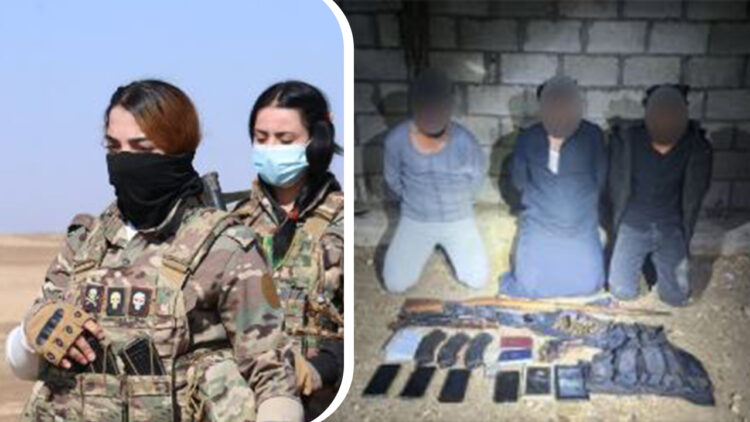
Joint forces in Syria’s al-Hol Camp, led by the Kurdish-led Women’s Protection Units (YPJ) and Syrian Democratic Forces (SDF) with international coalition support, launched an operation dubbed ‘Lasting Security’ on Thursday 7 November to detain suspected Islamic State (ISIS) members. The operation resulted in one ISIS member killed after an attempted attack on the security forces, while another 15 suspects were captured.
The operation, initiated in the early morning, aims to dismantle ISIS cells suspected of operating within the camp. A YPJ Media Centre statement revealed that significant military equipment had been seized from the suspects, while “dozens of ISIS members” have been apprehended in the ongoing operation.
An SDF statement said that the move was aimed at securing “the camp and its surroundings, pursuing the ISIS cells and their collaborators in the camp, and securing the rural areas.”
The joint initiative was launched off the back of information and confessions from arrested ISIS, indicating the activation of ISIS sleeper cells in the Badia region, and plans to carry out attacks.
Farhad Shami, SDF spokesperson, spoke to Al-Anba news agency regarding the scale of the current operation. He emphasised that goal is to address the security gaps in the broader Al-Hol region. He stated, “In addition to securing the Al-Hawl camp, we must extend our control over more than 100 villages in the surrounding desert areas, as ISIS members remain hidden within these vast regions.”
The SDF pointed to the increase in ISIS movements, and of operations against the internal security forces, known as ‘Asayish’, which are affiliated with the SDF. On 26 September, three SDF members were killed in an ISIS attack on the al-Hawl-al-Shaddadah road.
In related news, the Yazidi Rescue Office announced the return of a Yazidi woman to her family, who had been kidnapped by the ISIS along with thousands of other women and girls, during ISIS’ attack on the district of Shengal, in Northern Iraq, ten years ago.
Al-Hol Camp, which houses thousands of displaced people as well as families of former ISIS fighters, has been a security focal point for authorities, who face repeated issues with violence and unrest among camp inhabitants. When it was first established, the camp included about 50,000 Syrians and Iraqis, most of whom were women and children, and more than ten thousand foreigners from about 60 other countries