

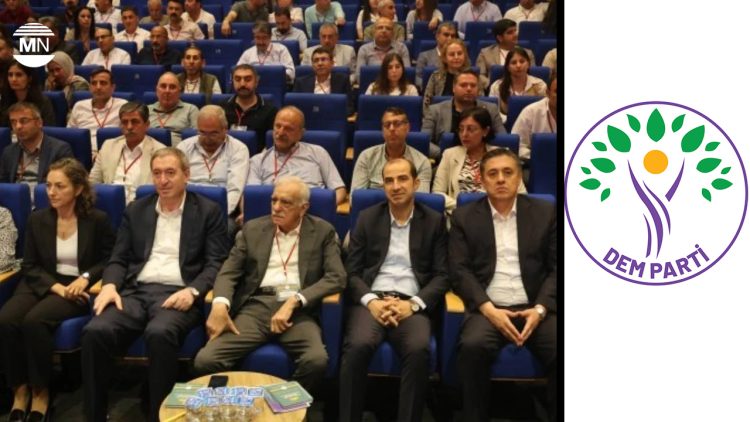
Turkey’s pro-Kurdish Peoples’ Equality and Democracy (DEM) Party has accused the government of attempting to undermine local democracy by continuing to replace elected mayors with state-appointed trustees, and urged immediate legal reforms to protect the will of the electorate.
The statement came at the conclusion of the DEM Party’s interim meeting of the Democratic Local Governments Council held from 25 to 26 May, which assessed the political situation and outlined the party’s strategy for expanding democratic governance. The meeting was dedicated to the memory of Sırrı Süreyya Önder, a prominent member of the İmralı Delegation, who passed away on 3 May.
The DEM Party said that the 31 March local elections marked a turning point for the restoration of civic rule after nearly eight years of widespread trustee appointments. The party won 78 municipalities under its co-leadership model, which ensures equal representation of women and men in leadership positions.
However, since the elections, trustees have already been installed in 10 municipalities won by the party — a move the DEM Party described as a manifestation of the ruling bloc’s political crisis.
“From day one, we have defended local democracy against centralised, authoritarian rule,” the party said in its final declaration. “We will not take a single step back in defending the people’s will.”
Turkey’s government has repeatedly removed elected Kurdish mayors, claiming links to outlawed Kurdish groups — accusations strongly denied by the party. DEM Party leaders say the practice amounts to collective punishment and violates democratic principles.
The party demanded the repeal of the legal basis for these appointments — Article 45 of Law No. 5393 on Municipalities — and called for amendments to safeguard elected officials from arbitrary dismissal.
“Without a strong public outcry, these anti-democratic practices may soon spread to western Turkey as well,” the declaration warned, suggesting that silence over Kurdish-majority areas would enable the erosion of democracy across the country.
The DEM Party also urged for formal recognition of its gender-equal co-leadership system in the Municipalities Law, echoing similar provisions in the Political Parties Law.
“The one-man model of governance is inherently patriarchal,” the party said. “We will resist all attempts to undermine the co-leadership system, which is a victory of the women’s freedom struggle and a model for radical democracy.”
The party pledged to expand its participatory governance practices, including neighbourhood assemblies, city councils, and village communes, to bring citizens directly into the decision-making process.
The DEM Party positions itself within a decades-old tradition of “communal municipalism”, beginning with three municipalities in 1979 and evolving into a widespread network after 1999. The party says it aims to expand this legacy through ecologically sensitive, feminist, and multilingual governance.
Referring to the broader goal of building a “democratic society”, the DEM Party renewed its call for structural reforms to reshape the Republic’s second century. It cited jailed Kurdish leader Abdullah Öcalan’s call on 27 February for a pluralist “democratic nation” framework as a path toward lasting peace.
In this context, the party listed seven immediate demands:
– The return of all municipalities to their elected mayors.
– Legal reform of the Municipalities Law to block future trustee appointments.
– Legal recognition of the co-leadership model.
– Removal of administrative and financial oversight by the central government over local authorities.
– Constitutional protection of grassroots democratic assemblies.
– Reform of all laws limiting local autonomy.
– Lifting Turkey’s reservations on the European Charter of Local Self-Government.
The DEM Party concluded by stating that democracy, justice, and equality are non-negotiable pillars for Turkey’s future. “We will continue to fight relentlessly until people of all identities, genders, languages, and beliefs live freely and equally in a democratic society,” it said.
The party’s call is likely to intensify ongoing debates in Turkey over local autonomy, political representation, and the boundaries of state control — issues that have defined the country’s domestic tensions for the past decade.
Related articles
Turkey removes Van’s elected mayors, fuelling fears over democracyKurdish MP condemns Turkey’s trustee appointments as continuation of century of oppression of KurdsTurkey: Hundreds clash with police in Mersin over arrests, trustee appointmentsTurkey’s trustee policy linked to gender inequality, violence in Kurdish-majority areas


