

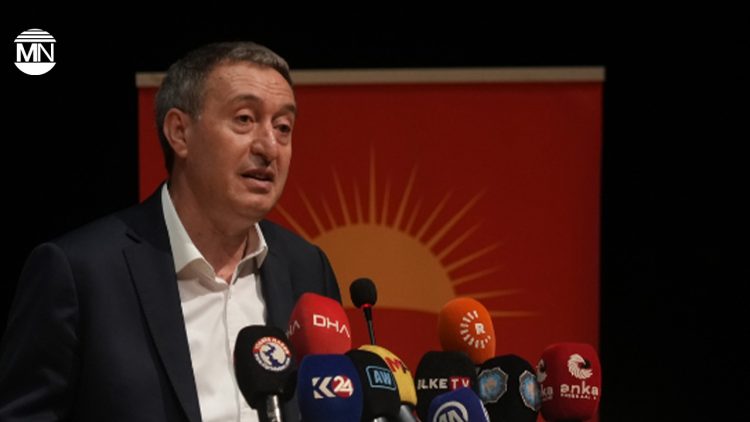
A new political era in Turkey must be built on local democracy, equality and a legally grounded social contract*, pro-Kurdish Peoples’ Equality and Democracy (DEM) Party Co-Chair Tuncer Bakırhan said on Sunday, as he called for an end to the government’s practice of replacing elected Kurdish mayors with state-appointed trustees.
Speaking at a Democratic Local Governance Interim Meeting, Bakırhan framed local administrations as the “centre of a new social contract,” arguing that true reconciliation between Kurds and Turks must begin at the grassroots.
“We support a Turkey in which Turks and Kurds establish their own social peace,” he said. “Real reconciliation must start in Mardin (Mêrdîn), in Van (Wan) where the will of the people was usurped, and in Hakkari (Colemêrg) where it was imprisoned.”
The trustee policy, whereby the Turkish government replaces elected Kurdish officials with appointed bureaucrats known as trustees, continues to be a flashpoint. “How can we speak of a social contract to someone in Siirt (Sêrt), when their elected mayor is in prison and a trustee occupies their place?” Bakırhan asked. “This policy must end. The trustees must be withdrawn, and our co-mayors must be released immediately.”
Bakırhan also named a number of political prisoners, including Mehmet Sıddık Akış, Nuriye Aslan, Hoşyar Sarıyıldız and Selçuk Mızraklı, sending them “love and respect” and promising, “We will deliver the flag they entrusted to us. We promise to set them free.”
He stressed that a genuine resolution of the Kurdish issue requires a legal framework: “The essence of the Kurdish question is the lack of mutual agreement and its absence from legal documentation. Parliament must be the site of this legal process.”
Referring to Abdullah Öcalan’s concept of a “brotherhood law ” and a “new social contract,” Bakırhan said, “Brotherhood law means the law of equality. A new social contract means a strong and united Turkey built on this foundation.”
Bakırhan warned of growing authoritarianism globally and regionally. “Never in history have international agreements become so meaningless. They’ve become scraps of paper,” he said, referencing the role of hegemonic powers in global crises. “In many parts of the world, democracy is retreating, and authoritarian regimes are growing stronger.”
Turning to the Turkish media, he criticised the polarising language used by pro-government outlets. “The language used in the government’s media is deeply disturbing. It undermines social peace,” he said. “We reject this language. Peace must be constructed with words that unify rather than divide.”
Looking ahead, Bakırhan said the party would adopt a more inclusive political language: “We are entering a new period, and it will not resemble the past. We will move away from the language of columnists or advisers who use lofty words but speak from narrow perspectives.”
He concluded with a call for renewed commitment: “If we worked yesterday, if we made a visit, if we touched someone, we need to do two, three or five times as much today. The future of the peace process depends on our actions.”
(*) When Bakırhan talks about a “new social contract” or “brotherhood law”, he is essentially calling for a legally grounded and mutually agreed democratic framework that recognises and protects the rights of Kurds and other minorities; guarantees local democracy, such as the right to elect and retain mayors without state interference; ensures equality before the law; and lays the foundation for peace and coexistence. So in plain terms, the “social contract” is about rewriting the rules of the political game in Turkey so that all groups, including Kurds, feel represented, protected and equal — ideally through constitutional or legal reform.


