

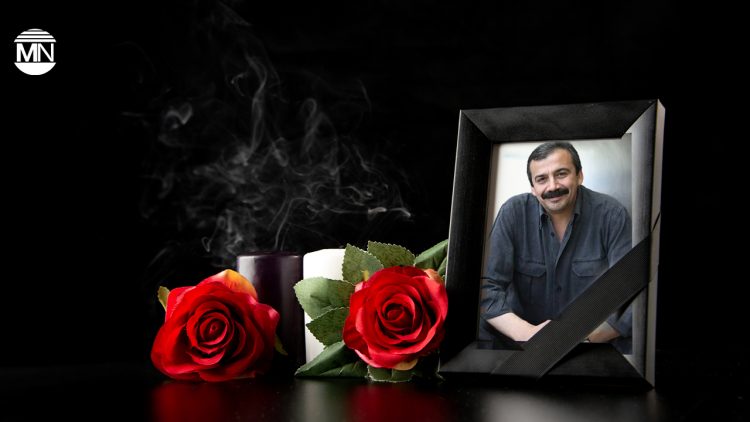
Sırrı Süreyya Önder, a pro-Kurdish politician, film director and former political prisoner who helped mediate peace efforts between the Turkish state and Kurdish guerilla, died in İstanbul at the age of 62 after 18 days in intensive care following heart surgery, the Florence Nightengale Hospital confirmed on 3 May.
The veteran parliamentarian suffered a sudden cardiac arrest on 15 April and was rushed to hospital in Istanbul. Doctors diagnosed a catastrophic Type 1 aortic dissection — a rupture in the main artery leaving his heart. He was revived after two cardiac arrests and underwent nearly 12 hours of emergency surgery before succumbing to complications in intensive care.
A sitting Deputy Speaker of the Turkish Parliament and a member of the pro-Kurdish Peoples’ Equality and Democracy (DEM) Party, Önder was best known for his central role in Turkey’s stalled peace process with the outlawed Kurdistan Workers’ Party (PKK). From 2013 to 2015, he was part of the so-called “İmralı Delegation” that held indirect talks with the PKK’s imprisoned leader, Abdullah Öcalan, in a historic attempt to end a decades-long conflict that has claimed over 40,000 lives.
Born in 1962 in the southeastern city of Adıyaman, Önder came of age in a politically active household. His father, a barber and petition writer, was a local founder of the socialist Workers’ Party of Turkey (TİP). After losing his father at the age of eight, Önder worked as a child apprentice at a photography studio and later as a seasonal health worker.
He was first arrested as a teenager in 1978 for protesting the Maraş Massacre and was again detained during Turkey’s 1980 military coup. Held in Ankara’s notorious police interrogation centre and imprisoned for seven years, Önder’s experience behind bars would later shape both his politics and art.
After studying political science at Ankara University, he went on to become an influential cultural figure. His 2006 film Beynelmilel, which depicted the absurdities of martial law in a small Turkish town through the eyes of local musicians, won critical acclaim and multiple international awards.
Önder entered parliament in 2011 as an independent backed by the Peace and Democracy Party (BDP), a predecessor to the DEM Party. Known for his wit, oratory skills and sharp critiques of power, he became one of the most recognisable faces of the pro-Kurdish movement in Turkey. He also ran as the Peoples’ Democratic Party’s (HDP) mayoral candidate for İstanbul in 2014 and served as MP for both İstanbul and Ankara.
Beyond his legislative work, Önder was seen as a bridge between Turkey’s polarised political camps. His unique background — part intellectual, part artist, part revolutionary — enabled him to communicate across ideological divides, especially during the short-lived peace process. That process collapsed in 2015 amid renewed violence, and Önder was later imprisoned in 2018 over a speech he delivered during Newroz celebrations.
Following his release in 2019, he returned to public life and was re-elected to parliament in 2023, later becoming Deputy Speaker. His last years were marked by continued advocacy for peace, justice and dialogue, even as the Kurdish issue remained unresolved and Öcalan’s prison isolation deepened.
Related Articles:
Pro-Kurdish MP Sırrı Süreyya Önder remains in critical condition, says hospital
Support grows across political spectrum as Sırrı Süreyya Önder remains in critical condition
Kurdish leader Öcalan voices support from prison for ailing DEM Party MP Önder
Sırrı Süreyya Önder’s condition worsens as neurological risks persist
His death prompted an outpouring of support from across Turkey’s sharply divided political spectrum. President Recep Tayyip Erdoğan reportedly called DEM Party MP Pervin Buldan twice during Önder’s hospitalisation, offering to ensure the “best doctors” were available. Messages of concern and condolences followed from the leaders of the Republican People’s Party (CHP), Nationalist Movement Party (MHP), Good Party, Democracy and Progress (DEVA) Party, Felicity Party, and others.
Colleagues, former cellmates, cultural figures and thousands of supporters gathered at the hospital or sent tributes online.
Önder’s legacy as a dissident, a mediator, and a man of letters continues to resonate far beyond parliament. In a country marked by deep divisions, his voice — poetic, bold and unflinching — often reminded citizens of the possibility of peace in the most unlikely of times.


