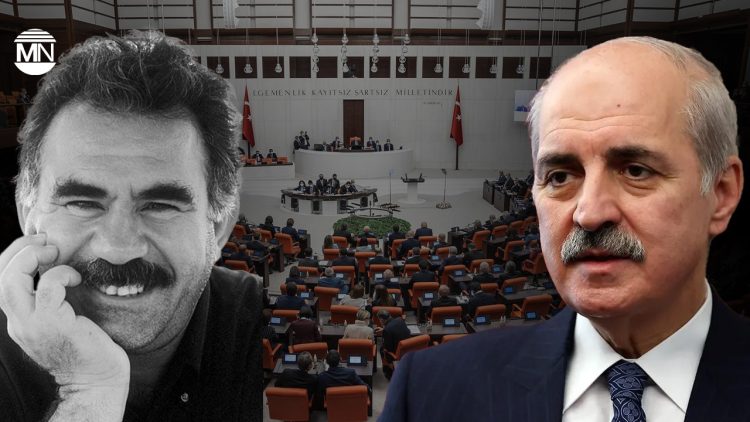
President of the Turkish Parliament, Numan Kurtulmuş, has underlined the significance of an expected statement from Abdullah Öcalan, the imprisoned Kurdish leader who has been incarcerated on İmralı, an island in the Marmara Sea, for 26 years. Speaking to journalists, Kurtulmuş stated that Öcalan’s statement is of “vital importance” and reiterated that a resolution to the Kurdish issue should respect “the dignity of Kurds and the pride of Turks”.
The reconciliation process, initiated in October following a call from Devlet Bahçeli, leader of the Nationalist Movement Party (MHP) and coalition partner of the ruling Justice and Development Party (AKP), has seen renewed discussions on Kurdish rights and Turkish unity. Since then, Öcalan, who has been in near-total isolation for over two decades, has been granted three visits, marking a significant shift in Turkey’s approach.
Öcalan, considered the key figure in the entire Kurdish political movement, has already played the most crucial role in both resistance and past peace processes in the last half a century. His influence extends beyond Turkey, affecting Kurdish movements in Syria, Iraq, and Iran, making his statements significant not only domestically but across the broader Middle East. With shifting alliances and increasing geopolitical tensions in the region, Öcalan’s potential power carries implications for the entire region.
As anticipation grew over a possible video statement from Öcalan on 15 February, the 26th anniversary of his abduction, no such message was delivered. Kurdistan Workers’ Party (PKK) Executive Committee Member Duran Kalkan stated that the PKK doesn’t know why this is the case, but they can say with certainty that any delay did not originate from their movement. Kalkan further indicated that those who gave such assurances should have explained their actions. ”What is clear, however, is that our commitment remains firm to Rêber Apo (Abdullah Öcalan),” he said.
The pro-Kurdish Peoples’ Equality and Democracy (DEM) Party has been actively engaging in dialogue, meeting with all political parties in the Turkish Grand National Assembly (TBMM) following their discussions with Kurtulmuş. The parliament president acknowledged the importance of these meetings and described the reconciliation process as “transparent”, noting that it was initiated under the leadership of both President Recep Tayyip Erdoğan and Devlet Bahçeli.
Kurtulmuş dismissed speculation of secret negotiations regarding constitutional changes or new definitions of citizenship, asserting that the goal is to ensure unity and mutual respect.
"An agreement must be found that upholds the dignity of Kurds and the pride of Turks," he said. "Every citizen must feel they are treated equally, while at the same time, there should be no suspicions of covert deals."
Emphasising the symbolic significance of his statement, Kurtulmuş framed the Kurdish issue as one of mutual recognition and national unity.
"When I say the dignity of Kurds, I mean ensuring that every Kurdish citizen feels an equal and rightful member of the republic. When I speak of the pride of Turks, I mean that there should be no perception of secret agreements or imposed solutions. The process must be built on trust and transparency."
Regarding calls for early elections from opposition parties, Kurtulmuş downplayed the likelihood, arguing that the necessary political and numerical conditions are not currently in place. He urged political actors to exercise caution in their statements, warning that irresponsible rhetoric could jeopardise progress.
With discussions intensifying, the next developments in the reconciliation process are expected to shape the political landscape in Turkey in the coming months.