

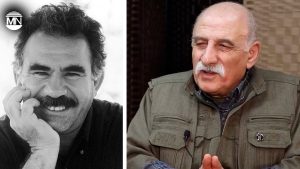
Kurdistan Workers’ Party (PKK) Executive Committee member Duran Kalkan has reiterated the party’s unwavering support for the peace efforts of their imprisoned leader Abdullah Öcalan. Speaking to Medya Haber TV, Kalkan stated that Öcalan remains determined to achieve a democratic resolution to the Kurdish question, urging both the Kurdish movement and Turkish society to embrace transformation.
Kalkan highlighted Öcalan’s recent meetings with the delegation from the Peoples’ Equality and Democracy (DEM) Party. He noted that the Kurdish side remains committed to Öcalan’s vision of a peaceful and democratic resolution, while criticising the Turkish government for its continued resistance to reform. Kalkan elaborated on Öcalan’s peace initiative, stating:
“Rêber Apo (Abdullah Öcalan) is extremely clear and determined in his approach to peace. He has always put forth a strategy based on democratic change and transformation, not only for the Kurdish people but for all of Turkey. His proposal is not just about ending conflict, but about changing the political and social structure of Turkey to ensure democracy, justice, and peace for all peoples. We, as the PKK, fully stand behind this vision.”
He continued, “Rêber Apo has always emphasised that a just and lasting peace cannot be achieved through military solutions. It requires a transformation of mindset, both on the Kurdish side and within the Turkish state and society. He has called for an end to hostilities and for a new dialogue process that would allow for democratic negotiations. But despite his openness to peace, the response from the Turkish state has been repression and isolation. Even in his most difficult conditions, he has never wavered from his commitment to peace.”
Related Articles
Historical moment for Turkey: PKK steps forward for peace ahead of Öcalan’s statementKCK’s Cemil Bayık: International conspiracy against Öcalan has lost ground amid regional changes
Regarding the February discussions of the pro-Kurdish DEM Party delegation in the Kurdistan Region of Iraq (KRI), Kalkan acknowledged that expectations had been set for an announcement from Öcalan but emphasised that delays were not due to any inaction from their side. He denounced misleading statements and urged caution against those claiming to speak on Öcalan’s behalf. “We are not the ones delaying the process,” Kalkan stated.
“Some circles made promises, spreading claims that a statement from Önder Apo would come in mid-February. But 15 February passed, and no such announcement came. We do not know why this is the case, but we can say with certainty that any delay did not originate from our movement. Those who gave such assurances should explain their actions. What is clear, however, is that our commitment remains firm.”
Kalkan also condemned the Turkish government’s policies, accusing President Recep Tayyip Erdoğan and the AKP-Nationalist Movement Party (MHP) alliance in Turkey of attempting to suppress the Kurdish movement. He argued that the ongoing political repression, replacement of elected representatives by state appointed trustees, and arrests aim to weaken Öcalan’s influence but asserted that the movement remains resolute.
Emphasising the broader scope of Öcalan’s struggle, Kalkan stressed that his vision extends beyond Kurdish interests, advocating for a democratic and pluralistic Middle East. “Önder Apo is not just fighting for the Kurdish people; his vision encompasses all peoples of the region. He seeks a solution that is based on democratic coexistence, where Arabs, Turks, Persians, Armenians, and all other communities can live together in peace and justice. His approach does not seek to exclude anyone. Rather, he proposes a framework where democratic rights and freedoms are recognised for all.”
He called on Kurdish political actors to support unity efforts and strengthen democratic alliances across the region.
“Our movement remains committed to democratic dialogue and cooperation with all parties willing to engage in meaningful discussions. The Kurdish struggle for freedom and the Turkish people's struggle for democracy are deeply intertwined. Only through collective effort can we achieve the goals that Rêber Apo has long fought for.”
Kalkan further stated that closing İmralı Prison would be a significant step toward peace, arguing that Öcalan’s continued isolation remains one of the biggest obstacles to dialogue. “The existence of İmralı as a prison is symbolic of Turkey’s resistance to democratic transformation. If the Turkish state is truly serious about peace, then the first and most crucial step is to dismantle the İmralı isolation system and allow Rêber Apo to freely engage in negotiations. Without this, any talk of a peace process remains hollow,” he said. He urged the international community to support efforts to end Öcalan’s isolation, and stated:
“Those who genuinely want stability in the region should acknowledge that peace will not be possible as long as Rêber Apo is kept in captivity. His freedom is not just a demand of the Kurdish people; it is essential for a democratic future in Turkey and the Middle East.”
Since his capture in 1999, Abdullah Öcalan has been imprisoned on İmralı Island, a high-security facility in the Sea of Marmara. For over 26 years, he has been held in complete isolation, with his legal team and family largely denied access for almost four years. International human rights organisations and legal experts have consistently raised concerns about his incommunicado detention, which has prevented him from engaging in any political discussions about the Kurdish issue. His legal status remains one of the most contested elements of Turkey’s approach to resolving the decades-long conflict
Responding to MHP leader Devlet Bahçeli’s remarks and Erdoğan’s recent statements regarding disarmament, Kalkan dismissed the rhetoric as ineffective. He reaffirmed that the PKK remains prepared for both conflict and negotiations but underscored their preference for a peaceful and democratic resolution.


