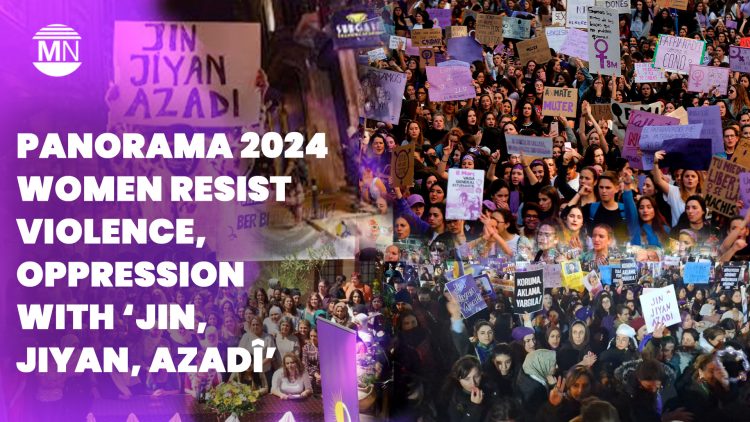
The year 2024 will be remembered as a time when women refused to yield to oppression, Mezopotamya Agency journalist Zemo Ağgöz reported on Wednesday. In the face of escalating violence, political repression, and social injustices, women defied threats and came together across Turkey and the broader Kurdish regions. Their resistance was powerfully united under the Kurdish feminist slogan, ‘Jin, Jiyan, Azadî’ (Women, Life, Freedom).
A year of defiance and resilience
Women’s organisations demanded accountability for the murders of hundreds of women, resisted government crackdowns, and fought for representation and justice in every sphere of life. From local elections to grassroots activism, their message was clear: there will be no retreat in the struggle for equality and freedom.
Women faced relentless challenges in 2024, with at least 347 women killed and 195 dying under suspicious circumstances, according to Jin News reports. Despite these grim figures, women’s movements stood firm against systemic violence, patriarchal governance, and inequality.
International Women’s Day rallies
On International Women’s Day, 8 March, women’s organisations held rallies across Turkey, including in the Kurdish-inhabited southeastern region. Despite bans on demonstrations and efforts to disperse the gatherings, women turned out in large numbers, from Istanbul to Diyarbakır (Amed). In the Kurdish-majority areas, rallies were held in 15 cities.
In Diyarbakır, the spirit of International Women’s Day was particularly strong. Tülay Hatimoğulları, Co-chair of the People’s Equality and Democracy Party (DEM), declared: “We women will defend life both in Istanbul and in Amed.”
Elections, local gains and state pushback
The year began with heightened activism surrounding the 31 March local elections. Equality for Women Platform (EŞİK) presented five urgent demands, including combating violence against women, gender-sensitive urban planning, and ecological resilience. Turkey’s pro-Kurdish Peoples’ Equality and Democracy (DEM) Party became the only party advocating equal representation through its co-chair system, securing victories in 78 municipalities.
In DEM Party-led municipalities, women’s empowerment took precedence. Initiatives included legal support services, reopening women’s centres shut down by government-appointed trustees, and introducing programmes like JINKART for accessible transportation. Groundbreaking establishments such as the Solidarity Centre of Taybet Mother in Sırnak (Şirnex) and the Women’s Works Library and Research Centre in Van (Wan) symbolised hope.
However, these gains were met with hostility. The Ministry of Interior dismissed elected mayors in seven municipalities, appointing trustees to dismantle women’s initiatives. In the Kurdish majority Batman (Êlih), the trustee replaced the ‘Kompleksa Werzîşê Ya Jinê’ (Women’s Sports Complex, in Kurdish) sign with ‘Batman Belediyesi Spor Kompleksi’ (Batman Municipality Sports Complex, in Turkish). In Mardin (Mêrdîn), the Women’s Directorate was handed over to a male appointee.
Women demand justice for missing and killed
Women also demanded answers for unresolved cases, including the disappearance of Gülistan Doku, a Munzur University student last seen in January 2020. Her family and activists continue to ask, “Where is Gülistan Doku?” Meanwhile, grassroots protests decried the judiciary’s role in perpetuating impunity for gender-based violence.
Media and activism under threat
Women journalists were frequent targets. Mezopotamya Women Journalists Association (MKG) reported that 21 female journalists were detained, with nine spending the year in prison. They faced harassment and arrests for exposing violence and government failings. Nonetheless, they persisted, documenting women’s struggles and victories.
Kurdish journalist’s home raided after exposing state-linked prostitution, drug rings in Turkey
Political and legislative setbacks
The government’s anti-women agenda intensified with new policies aimed at curtailing women’s rights. However, protests successfully lead to the removal of a clause restricting women’s ability to retain their surnames after marriage, included in the 9th Judicial Reform Package. Meanwhile, the 2025 budget allocated a mere 38 kuruş KURUSH (around 1 cent) per woman per day, sparking outrage among activists.
Peace Mothers and advocacy for peace
The Peace Mothers played a pivotal role in 2024’s resistance, demanding an end to the isolation of Abdullah Öcalan and a peaceful resolution to the Kurdish conflict. Their advocacy faced state backlash, with members arrested and subjected to humiliating searches. Despite these challenges, they continued to organise and amplify their call for peace.
Symbolic movements and collective action
Mass demonstrations on 25 November (International Day for the Elimination of Violence Against Women) highlighted the year’s resistance. Women across Turkey and Kurdish regions declared: “We will not give up our rights, lives, or cities.” In Diyarbakır (Amed), women defied bans on chanting “Jin, Jiyan, Azadî,” reinforcing their commitment to the slogan.
Victims of judicial failures or systemic injustice?
Throughout the year, numerous cases emerged of women being murdered by men who had already been sentenced to imprisonment. These incidents highlighted the judicial system’s inability to prevent such tragedies, underscoring systemic failures and deep-seated injustice in the handling of cases involving violence against women.
In 2024, the following murders of women by men previously sentenced to imprisonment were recorded:
– T.Y. murdered his ex-wife Özlem Şımarık while on furlough from prison.
– A.S., who threatened K.T. for seeking a divorce, faced no penalties.
– Courts reduced sentences for convicted killers like Şervan Gülel, who received a “good behaviour” reduction in Hasret Tutal’s murder case.
– Sude Naz Atak’s abuser Yılmaz Akman, with 18 prior offences, was released.
– Dilek Bitgin’s attempted murderer Ahmet Bitgin was released with a lighter charge.
– Mehmet Ali Elbeli, on prison furlough, murdered his wife Müge Elbeli.
On other cases, law enforcement’s neglect led to preventable murders:
– Senem Kıvrık (Muğla), despite a restraining order against her husband.
– Elif Ceren Arslan (Konya), killed by a partner under a restraining order.
– Serap Doğan (Ankara), whose plea for police protection was ignored.
– Fadim Temirhanoğulları (Antalya), despite existing restraining measures.
– Antika Ayer (Antalya), killed despite protection orders.
– Simge Karakiraz (İstanbul), whose restraining order was not enforced.
– Derya Pas (Bursa), and Selda Elle (Manisa), victims of ignored restraining orders.
– Bişar Atlı, accused of sexual assault, was released despite evidence.
Legacy and vision for 2025
As 2024 ended, women’s activism showed no signs of slowing. From defending gains against systemic assaults to advocating for broader reforms, women’s movements remained a beacon of hope in a tumultuous year. Their rallying cry, “Jin, Jiyan, Azadî,” encapsulated their unyielding demand for justice, equality, and freedom.