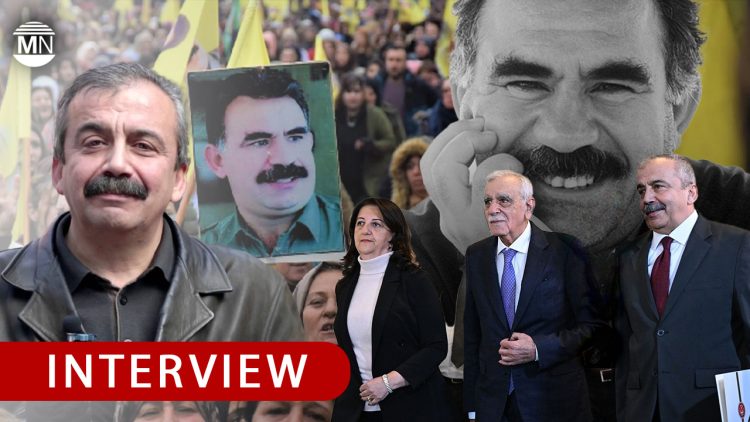
Abdullah Öcalan’s commitment to resolving the Kurdish question and fostering regional peace remains steadfast despite decades of isolation. In an exclusive interview with Mezopotamya Ajansı, İmralı delegation member and DEM Party MP Sırrı Süreyya Önder revealed the core elements of Öcalan’s approach, rooted in his theory of democratic confederalism.
“Amidst the uncertainties of regional politics, Öcalan’s position stands out as the clearest,” Önder said. “He advocates for overcoming conflict, fostering coexistence, and advancing democratic governance as the path to peace.”
The İmralı delegation, including Önder, Pervin Buldan, and Ahmet Türk, has been meeting with political parties and imprisoned Kurdish leaders, including Selahattin Demirtaş and Figen Yüksekdağ. These efforts follow Öcalan’s directive to involve all stakeholders in the peace process.
State Ambiguity and Uncertain Decisions
Önder described the Turkish state’s current stance as ambiguous, oscillating between potential reconciliation and continued conflict. “Will the state seek peace with the Kurds to become a key regional actor, or will it opt for repression and conflict? This remains the central question,” he remarked. The state’s indecision has contributed to a sense of cautious optimism among the Kurdish public, who have drawn lessons from decades of struggle and resilience.
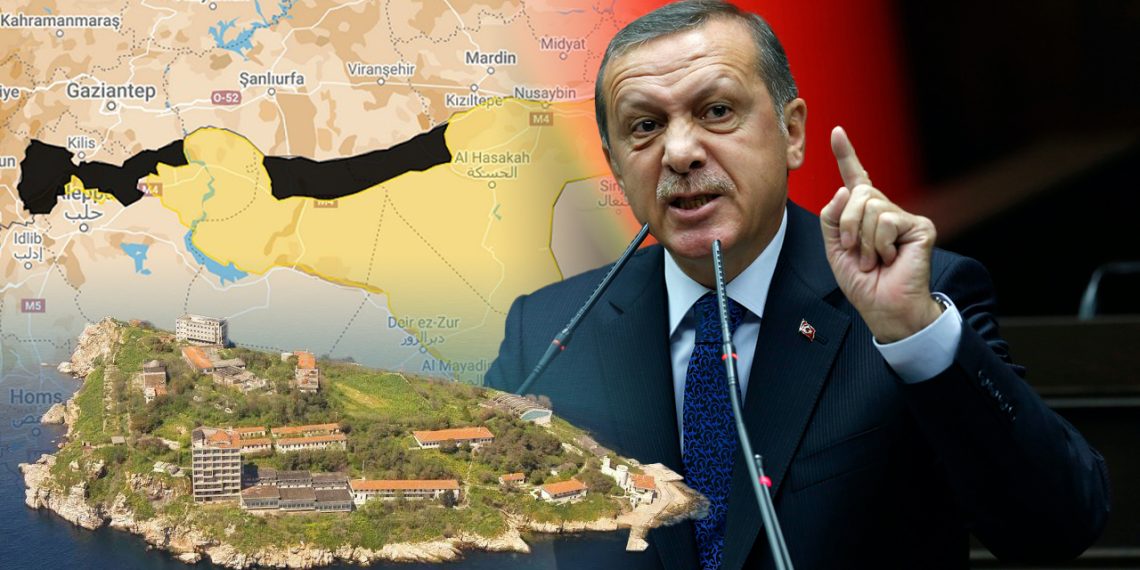
The interview also underscored the fluid dynamics of Middle Eastern politics. “Neither the United States, Israel, Iran, Turkey, nor Syria has a clear course of action,” Önder noted. In this context, Öcalan’s proposal for democratic confederalism—a framework emphasising local governance, inclusivity, and coexistence—offers a stable and visionary alternative.
‘Cautious Optimism’ Amidst Challenges
While acknowledging public concerns over recent military operations, trustee appointments, and attacks on Kurdish autonomy, Önder highlighted the resilience of Kurdish society. “This cautious optimism reflects the wisdom and experience of a people who know that peace requires collective effort,” he said.
Related Articles :
Öcalan’s message trends in Turkey: A path towards Kurdish-Turkish reconciliation
Pervin Buldan announces: ‘We are closer to peace than ever before’
Buldan and Önder: We are much more hopeful than before
Pro-Kurdish DEM Party to hold key talks with political parties in Ankara
Önder concluded by emphasising the shared responsibility for peace. “This process is not just about resolving the Kurdish question—it is about creating a future where all peoples of the region can coexist in freedom and security. Öcalan’s vision provides the clearest path forward.”
READ THE FULL TRANSLATED INTERVIEW BELOW
Q: Everyone is wondering—what is happening, and what should we expect next?
The only thing we know but the public doesn’t is the content of the discussions we’ve held with Öcalan. These details will also be made public once the process [the ‘reconciliation process’ started on 28 December] reaches a certain point. Beyond this, there is nothing we know about the future that we are withholding in our disposal.
Q: Is this uncertainty normal?
I am not saying that this uncertainty is normal, but it is not related to the sincerity of the process. It is tied to the conjuncture[the regional tensions and changes, starting with October 2023 of Hamas attack, Israel’s occupation of Gaza, genocide, attacks to Lebanon, Hezbollah, since 26 November so far the changes in Syria, and the Turkey’s aggression towards NE Syria Kurdish led autonomy] . Not just us, but those who govern the State and other actors in the Middle East are also taking various steps to reduce the uncertainties about the future. The process we are involved in is just one of many of these efforts aimed at creating a base/ground to eliminate uncertainty.
Q: Most of the topics being discussed today are related to regional developments. What are Abdullah Öcalan’s suggestions and evaluations regarding these developments?
At the moment, neither the United States, nor Israel, Iran, Turkey, or other actors on the Syrian stage have clarity on what course they will take. The new government in Damascus also has not made clear what it will do or how it envisions a restructured Syria. It is precisely during this period of uncertainty that Öcalan once again puts forward his Middle Eastern projection as a proposal. In this sense, perhaps the clearest position belongs to Öcalan.
Q: Can you expand a bit on what makes Öcalan’s position so clear?
His political stance aims to overcome war, conflict, and sharp lines that have become walls between peoples, instead advocating for peace, coexistence, and fluidity.
Q: You do not share many details. What is your assessment of the government or the State’s position?
The government is at a crossroads. Will it engage the “state wisdom” we attribute to it, seek peace with the Kurds to eliminate uncertainty, and thereby become a central actor in the Middle East? Or will it proceed with the “iron fist in a velvet glove” and enter a harsh conflict with the Kurds in Syria? The primary question to be resolved is whether they will decide between these two options.
Q: Are you saying the State has not yet made a decision on this matter?
Exactly. I believe the process remains uncertain because no clear decision has been made yet. On the other hand, there are concerns, particularly among Kurdish society and those who have paid a price for peace. Many describe the public sentiment as “cautious optimism.” This is normal for such periods. Moreover, this society has wisdom, experience, and lessons drawn from past events. ‘Cautious optimism’ is the most distilled form of this wisdom. It is not merely about being hopeful; it also reflects the effort to create peace. Peace should be the shared ideal of everyone living on this land. We must all work harder than ever to realise it.
Q: Many point to regional developments and the conjuncture. Some focus only on opportunities, while others see only threats. What would you say to those who argue, “There are great opportunities; why engage in such initiatives now”?
Yes, looking at certain perspectives, one cannot help but be astonished. According to these views, if the Kurds invest in “peace,” they will lose the great opportunity—namely, the prospect of Kurdish independence. But if peace does not happen now, will the doors of opportunities really open for the Kurds? Will they achieve freedom by sidestepping the conflicts of great powers? This scenario involves enormous risks. From the very beginning, Öcalan has warned that taking such risks could bring not only historic success but also historic catastrophe. His theory of democratic confederalism is built precisely on these two possibilities. Öcalan did not develop this theory because it lacked “Kurdishness,” but because it prioritises the security of the Kurds as much as their freedom.
Q: What can be said about the State’s attitude towards this theory?
The state itself has two conflicting tendencies. On one hand, it can engage positively with Öcalan’s theory, which calls for coexistence and democratic resolution. On the other, it could double down on repression. The Kurdish movement and Öcalan remain clear in their pursuit of peace. When the State achieves a similar clarity, the real “process” will begin. It may not yet be called a “resolution process,” but peace is an essential first step toward resolution.
Q: There are so many issues to consider: the possibility of peace, trustee appointments, the conflict in Rojava, military operations, and more. Don’t these developments undermine public optimism?
As the delegation, we are focused on advancing things positively. Of course, we are doing our best to prevent negative developments. But the responsibility lies with the entire society to carry this process forward despite everything. As the process unfolds, we will have clearer opportunities to discuss some matters more openly.