

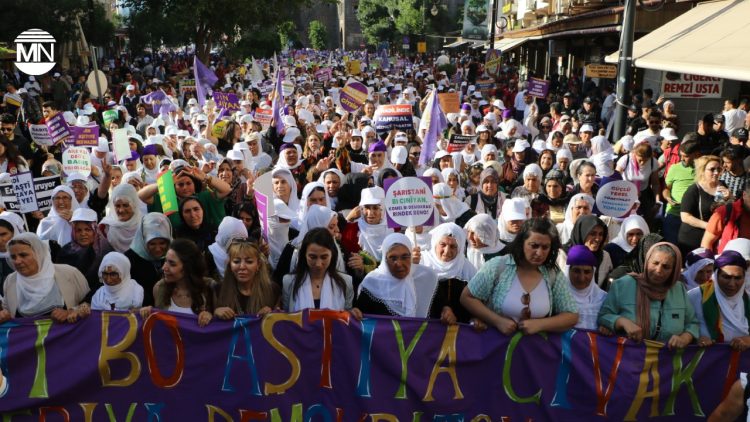
Thousands of women took to the streets of Diyarbakır (Amed) in southeast Turkey on Sunday, in a mass demonstration calling for an inclusive peace process and a democratic resolution to the Kurdish issue, placing gender equality at the heart of their demands.
Organised by the Free Women’s Movement (Tevgera Jinen Azad – TJA), the march brought together women from across Turkey and the Kurdish regions under the slogan “Women walk for social peace and democratic resolution”. Leading figures from the pro-Kurdish Peoples’ Equality and Democracy (DEM) Party and the Democratic Regions Party (DBP) joined the demonstration, which featured Kurdish songs, chants and banners in Turkish and Kurdish.
The protest coincides with renewed political interest in resolving the decades-long Kurdish conflict, following the 27 February peace call made by Abdullah Öcalan, the imprisoned leader of the now disbanded Kurdistan Workers’ Party (PKK), who has been held in isolation on İmralı Island since 1999. In a public statement, the organisers declared: “With Mr Öcalan’s call, a new path has opened for the democratic resolution of the Kurdish question. We women will not abandon this call for peace.”
Participants carried portraits of women who had been murdered or executed, including Gülistan Doku and Rojbin Kabaiş, as well as Pakhshan Azizi and Warisha Moradi, who have both been sentenced to death in Iran, though there is a temporary halt on Azizi’s sentence. The demonstration was marked by traditional dances, white scarves symbolising peace and slogans such as “Jin, jiyan, azadî” (Woman, life, freedom) and “Peace must be built in our mother tongue”.
In a statement read aloud in Kurdish by Xece Şahin, the TJA warned against allowing the peace process to be shaped by male-dominated politics and militarist media. “We will not let this process be sabotaged by the male-dominated media that incites war,” she said. The women emphasised that peace must include not only disarmament but also legal recognition of Kurdish identity and language, and women’s rights.
Specific demands included the lifting of Öcalan’s isolation, his recognition as a legitimate interlocutor in peace negotiations, and the establishment of parliamentary commissions where women play a leading role. They also called for the removal of state-appointed trustees from municipalities where they have been placed in a controversial practice in which the Turkish government replaces elected officials in pro-Kurdish areas with appointed administrators. “We will not accept the dismissal of democratically elected representatives,” said the statement, urging the return of local governance to the communities in cities like Van (Wan), Siirt (Sêrt) and Mardin (Mêrdîn).
Speakers also drew attention to the economic and social costs of ongoing conflict. Selin Top, from the “I Need Peace” initiative, said: “War intensifies male domination and drives society into poverty through security-based policies. Women have always led the struggle for peace – and we are doing so again today.”
The march concluded with a renewed pledge by the women to remain central actors in any future peace efforts, warning that lasting resolution will be impossible without addressing gender-based violence, cultural suppression and the legacy of state-led conflict in the region.


