

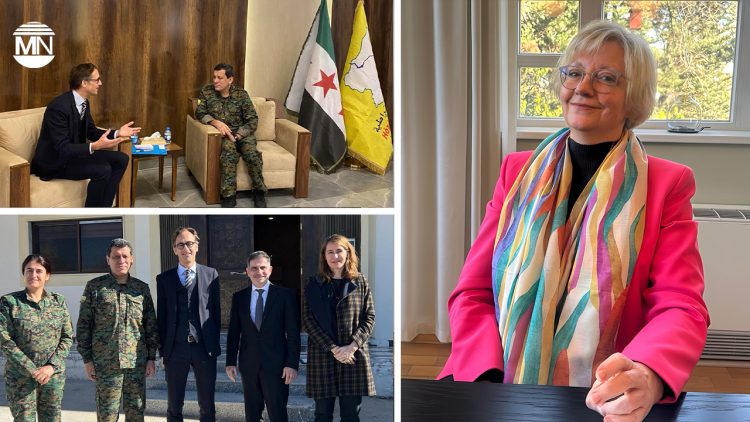
German officials are increasingly voicing the importance of Kurdish inclusion in fostering dialogue and promoting stability in Syria. Recent statements highlight Germany’s growing engagement with the region’s complex challenges, particularly in addressing Kurdish rights and preventing a resurgence of ISIS.
Tobias Tunkel, Director for the Middle East and North Africa at the German Foreign Office, shared his views on X (formerly Twitter) after a two-day visit to North and East Syria. In one post, he stressed how the rights and interests of Syrian Kurds can “best be safeguarded in an inner-Syrian dialogue with Damascus”. Tunkel also noted his discussions with Syrian Democratic Forces (SDF) commander Mazloum Abdi on pressing issues requiring direct contact between the SDF and Hay’at Tahrir al-Sham (HTS) leadership, alongside ongoing efforts against ISIS.
Speaking from the Iraqi-Syrian border in Fishkhabur on 20 January, Tunkel described his meetings with Kurdish leaders and civil society representatives in Qamishli (Qamişlo), Hasakah (Hesekê) and al-Malikiyah (Derik). Stressing the importance of including Kurdish voices in a national dialogue with Damascus, he said: “A strong Kurdish voice must be claimed in the national dialogue, which has to start now.”
Germany’s ambassador to Turkey, Sibylle Katharina Sorg, explained Germany’s position on the Kurdish issue and the role of the SDF in the Syrian reconciliation process, during an interview with T24 journalist Cansu Çamlıbel published on 20 January. Sorg described Germany’s perspective on Syria as “pragmatic” and highlighted the significant contributions of Kurdish forces, including the SDF, in the fight against ISIS. She called their efforts “essential for the stability of the region” and stressed the need for armed groups in northern Syria to disarm as part of a broader reconciliation framework.
Sorg also noted that Germany’s approach prioritises inclusivity, urging for all ethnic and religious groups, including the Kurds, to play an active role in shaping Syria’s future. “A sustainable solution for Syria cannot exclude the Kurds or overlook their significant contribution to the security and resilience of the region,” she added.
Germany’s recent statements emphasise the critical role of Kurdish inclusion in Syria’s reconciliation process. By emphasising dialogue with Damascus and regional cooperation, German officials reaffirm their focus on supporting a stable and inclusive Syria.


