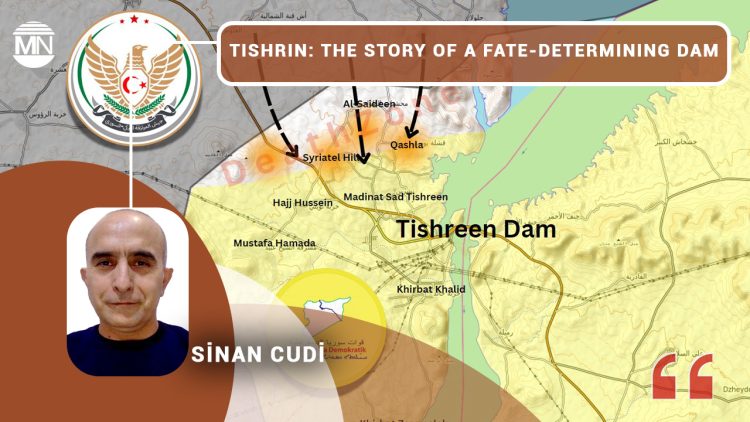
Sinan Cudi
In mid-December 2015, I visited Kobani (Kobanê) with a group of journalist friends. The city had mobilised to heal the wounds inflicted by ISIS attacks and had begun clearing the remnants of war. Kobani was liberated on 26 January 2015 after 134 days of ISIS assaults that had started on 15 September 2014. Yet the destruction caused by the war was visible everywhere in the city. We wanted to observe first-hand the devastation [there] and draw attention to the suffering of its people while also following the operations and offensives launched by the People’s Protection Units (YPG) and Women’s Protection Units (YPJ) fighters against ISIS.
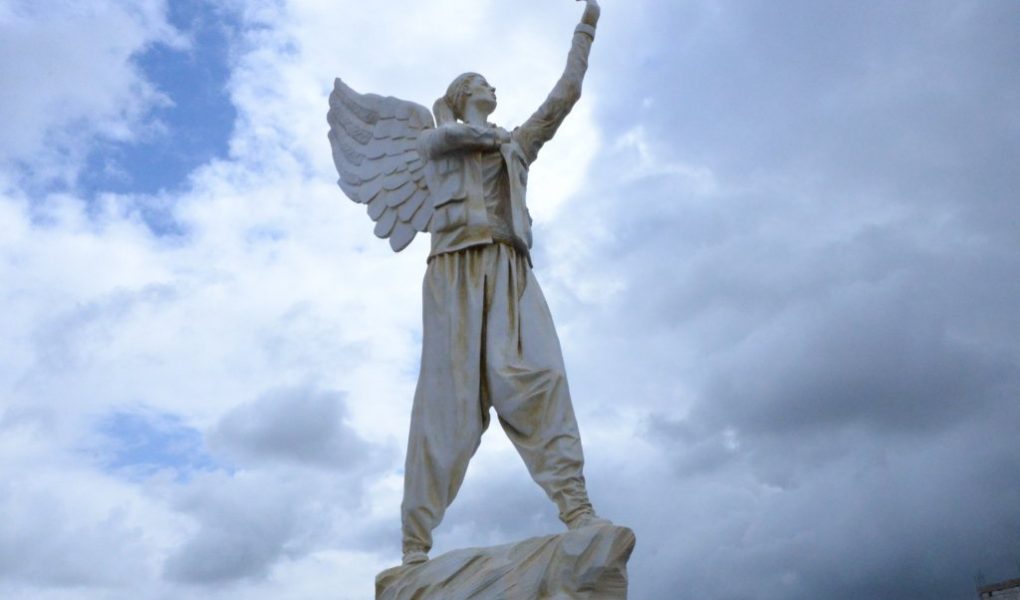
When we learned that a new operation targeting ISIS fighters was to be launched in the countryside south of Kobani, we felt compelled to extend our visit.
The Tishreen (Tişrîn) offensive
On 23 December, an operation called “an Operation to clear the countryside south of Kobani” was launched, which concluded on 26 December with the capture of the Tishreen Dam. The rapidly advancing [Kurdish] forces crossed to the west of the Euphrates at the time, despite much debate and strong opposition from the Turkish Republic.
A press statement made at the eastern end of the dam’s structure on 30 December reported that 100 villages and hamlets had been liberated during the operation, and 219 ISIS members killed.
The Tishreen Dam is located 45 km south of the Turkish-Syrian border, 55 km southwest of Kobani, 26 km southeast of Manbij (Minbîc), and 85 km northwest of Raqqa (Reqa). Official records indicate that Tishreen, Syria’s second-largest dam, became functional in 1999.
In the wake of the popular uprisings that began in 2011, a group calling itself the Free Syrian Army (FSA) seized control of the dam from Assad’s regime on 25 November 2012. However, on 15 May 2014, ISIS captured the Tishreen Dam from the FSA without encountering significant resistance.
Consolidating its dominance west of the Euphrates, ISIS used the cities of Jarablus (Cerablûs) and Manbij as key bases for its attacks on Kobani. Following the liberation of Kobani city, the international anti-ISIS coalition forces bombed the bridges of Jarablus and Qara Quzak (Qere Qozaq), severing ISIS’s land connections. The Tishreen Dam remained ISIS’s last connection to cross the Euphrates to the east.
This move by the Syrian Democratic Forces (SDF) was therefore of critical strategic importance. To protect Kobani and prevent further ISIS attacks, the SDF needed to control the Tishreen Dam and secure a 5-km-deep area west of the Euphrates.
Turkey’s discomfort west of the Euphrates
This offensive not only prevented ISIS from launching attacks east of the Euphrates but also severed the key supply line between Raqqa, its declared capital, and Manbij. The coalition’s air superiority made alternative routes from Dayr Hafir (Deir Hafer) and Tabqa to Raqqa through Manbij highly risky for ISIS, inflicting a significant blow.
Following the Tishreen Offensive, then Turkish Prime Minister Ahmet Davutoğlu issued an open threat on 15 February 2016, declaring, “The YPG will never cross to the west of the Euphrates!” Throughout 2016, Turkish officials exerted intense pressure on the international anti-ISIS coalition to stop it cooperating with the Kurdish-led SDF against ISIS.
Despite these efforts at obstruction, the SDF and the Manbij Military Council, in coordination with the international anti-ISIS coalition, launched the Manbij Offensive on 1 June 2016. Just nine days after the offensive concluded on 15 August, the Turkish military entered Syrian territory on 24 August, claiming to be targeting ISIS.
Yet in Jarablus, where Turkey claimed it was conducting operations against ISIS, no clashes occurred, and ISIS handed control of the city to the Turkish military. [Turkey’s] then Chief of General Staff Hulusi Akar openly stated during his visit to Gaziantep on 30 August that attacks on Turkish soldiers in the region were not coming from ISIS. Akar added, “We will never allow them to cross west of the Euphrates. They will withdraw, or we will do what is necessary,” referring to the YPG forces. These remarks explained the true reasons for Turkey’s subsequent attacks in the region.
It is worth noting that Hulusi Akar, who commanded these operations as Chief of General Staff, later became Turkey’s defence minister. The ongoing attacks on the Tishreen Dam are closely linked to this same team and their continued strategies.
What are the goals of Turkey and the Syrian National Army?
On 27 November 2024, Hay’at Tahrir al-Sham (HTS) launched an assault on Aleppo (Halab), seizing the city from forces of the Assad regime without resistance and advancing southward to capture Hama and Homs in a matter of days. Simultaneously, US-backed moderate opposition forces advanced from the south towards Damascus.
This rapid progression culminated in the regime’s collapse on 8 December. Capitalising on the chaos, Turkey’s Syrian National Army (SNA) forces attacked Manbij on the same day. After the withdrawal of the Manbij Military Council, the SNA and the Turkish military positioned themselves in Manbij, and lon 13 December, launched a comprehensive attack on Tishreen and Qara Quzak.
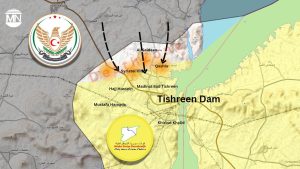
Despite two ceasefire agreements mediated by the US, and SDF proposals to demilitarise the area, Turkish and SNA forces have continued their attacks to date.
Ecological and humanitarian crisis at Tishreen
On 1 January 2025, the [Kurdish-led] Autonomous Administration [of North and East Syria] announced that attacks had severely damaged the Tishreen Dam, posing a risk of collapse. Civilians from eastern Euphrates cantons began a vigil near the dam, which Turkish warplanes targeted, with bombings that killed 22 civilians including women and young people, and injured over 100.
In the past decade, the Tishreen and Qara Quzak regions have endured relentless attacks from Turkey and the groups allied to it. These ongoing attacks, lacking any justification, are seen as Turkey’s attempt to assert influence in the region and maintain leverage in Syrian politics. Without intervention, this crisis risks escalating into a catastrophic humanitarian and ecological disaster.
*Sinan Cudi is a seasoned journalist and political analyst who has been reporting on Kurdish struggles and Middle Eastern politics for over two decades. Since the liberation of Rojava, he has been based in North and East Syria, covering key developments and offering in-depth analyses on the region’s political and social dynamics.