

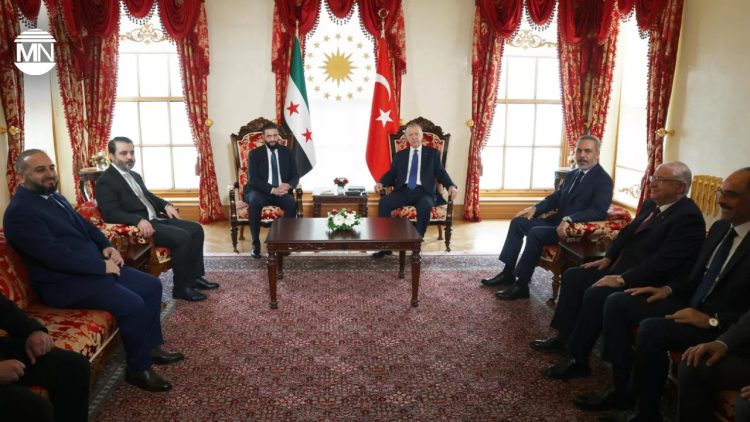
Syrian interim president Ahmed al-Sharaa held unannounced talks with Turkish President Recep Tayyip Erdoğan in İstanbul on Saturday, in a meeting that reflects rapidly shifting regional alliances following the lifting of US and EU sanctions on Syria’s transitional government.
The talks, held at Dolmabahçe Palace, mark al-Sharaa’s third visit to Turkey since assuming the presidency of Syria in January 2025 following the collapse of Bashar al-Assad’s regime. The first visit, a discreet meeting in Ankara on 4 February, focussed on a joint defence pact, security cooperation and economic ties. The second, a high-profile appearance at the Antalya Diplomacy Forum in April, triggered widespread Alawite protests. By contrast, this latest meeting was conducted behind closed doors, signalling deeper strategic coordination between Ankara and Damascus. Foreign Minister Hakan Fidan and intelligence chief İbrahim Kalın were present during the talks.
A former jihadist commander and once head of al-Qaeda’s Syrian affiliate, al-Sharaa has rebranded himself as a transitional leader and recently gained political traction through top-level meetings, including one with US President Donald Trump in Riyadh. In İstanbul, he thanked Erdoğan for Turkey’s “critical support” in ending Syria’s diplomatic isolation.
Erdoğan called the lifting of sanctions a “positive step” and reaffirmed Turkey’s support for Syria’s territorial integrity—a phrase Turkish officials often use to express opposition for Kurdish self-rule in northern Syria.
Two days earlier, on his return flight from Hungary following an informal summit of the Organisation of Turkic States, Erdoğan had stated, “We believe the coming days are critical. The PKK’s disarmament and dissolution must also include its Syrian branch. We are encouraging Damascus to focus on this issue.”
The Turkish president also condemned Israeli military actions in Syria, calling them “unacceptable acts of occupation and aggression”. Turkish officials confirmed that future cooperation with the Syrian transitional government would prioritise energy, defence and transport.
Independent journalist and MedyaNews columnist Fréderike Geerdink, reporting from northeast Syria, has cautioned that the lifting of sanctions may also open the door to Turkish economic influence in Kurdish-led regions. “Not with tanks, but with telecoms and construction firms”, she wrote, warning that such soft-power strategies could erode Rojava’s autonomy.


