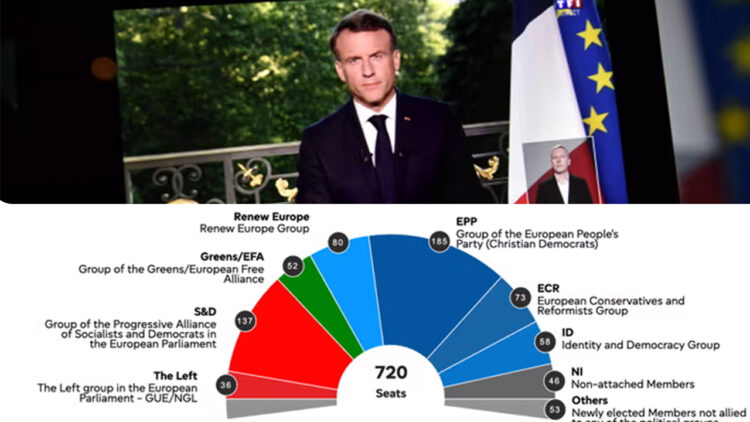
French President Emmanuel Macron has surprised many in Europe by calling snap elections in France following large gains by Marine Le Pen’s far-right National Rally Party in the European Parliament (EP) elections on Sunday 9 June.
Although the centre-right held on to the balance of power, the far-right made significant gains in some countries in the EP elections, notably France, Germany, Austria and Italy. In contrast, while Victor Orban’s far-right Fidesz Party won again in Hungary, their share of the vote fell by around nine points from the 2019 elections.
One of the biggest shocks of the election was the gains made by the far-right in France, where Marine Le Pen’s National Rally Party surged to gain 31.5% of the vote, more than twice as many votes as Macron’s centrist Renaissance Party’s 15.2%.
Macron spoke to the nation via social media on Sunday evening announcing that he was dissolving the National Assembly with immediate effect. He called the results of the election “a disaster” for his government, and said that he had decided to “give the choice of our parliamentary future” back to the people. The dates of these French national elections, which are held in two rounds, have been set for 30 June and 7 July.
“I am dissolving the National Assembly”, French President Emmanuel Macron stated as he called a national election.
The announcement comes as France’s far-right National Rally Party (RN) took over 30% of votes in the European Parliamentary elections.#EUElections2024 pic.twitter.com/iLSfBS2acg
— euronews (@euronews) June 9, 2024
The French president still has three years to serve in his current term, and is not in danger of losing his position, though he could find he has far less sway than he has had to date. Pawel Zerka, a commentator from the European Council of Foreign Relations (ECFR) thinktank, said, “He seeks to get a second life, and avoid a lame duck status – but it could also lead to a Macron – Le Pen cohabitation.”
The thinktank is not the only observer to see Macron’s decision as a massive gamble. Mireille Clapot, a member of Macron’s party, and of the National Assembly until last night, has said she does not believe the National Rally can get a majority in a parliamentary election despite their European result, but also that Macron’s decision is a very high risk, “Not only for us but it is a risk for democracy in France.”
Despite the far-right gains in a number of countries, and a surprising fall in the votes for Greens in Austria and Germany, left-wing parties managed to gain power in all three Nordic countries, where there was actually a fall in the far-right vote. In Sweden, the Social Democrats emerged as the leaders, in Denmark, the Socialist People’s Party became the largest party, and in Finland the socialist Left Alliance made unexpected gains, though it still came in second to Prime Minister Petteri Orpo’s National Coalition Party, leaving Finland’s far-right, at least, out in the cold.