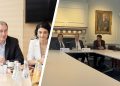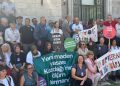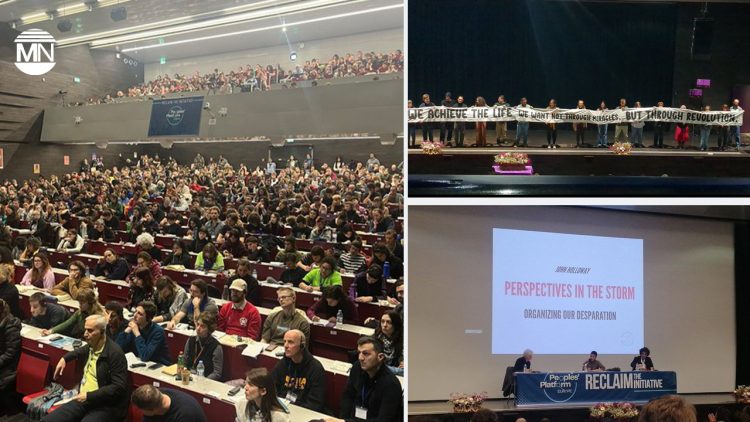
Peoples’ Platform Europe has kicked off at the University of Vienna, as 800 participants from across Europe and beyond come together to discuss strategies to overcome multiple crises. A broad range of grassroots organisations will be taking part in workshops over the next three days, with the aim of building a new organised force as a counter to capitalism, racism, constant war and the rapid rise of the far-right in Europe.
The organisers of the Platform emphasise that the event is not intended to be a traditional left-wing conference, where participants listen to speakers, ask questions and go home. Instead, it is intended to be a part of a directly democratic transnational political process, where the Platform’s participants will discuss how to organise together to build a renewed international movement.
Peoples’ Platform Europe has been organised by the Academy of Democratic Modernity, in collaboration with the Students Union of the University of Vienna and Fey-Kom, the organisation of Kurdish Associations in Austria.
The Platform is being attended by a delegation from Abya Yala (Latin America), who are planning to organise a similar event in their region.
‘Culture is the lifeline of the revolution’
The event commenced with several cultural performances. One performer announced, “me and my comrades who have fallen in the struggle, we are the winds blowing in the forests and the mountains”. In these performances, the artists, who are also Platform participants, asserted their commitment to building up alternatives. The organisers of the Platform explained their decision to begin the event with music and dance, pointing out that “Culture is the lifeline of the revolution”.
The parliamentary system cannot deliver change
The opening speech of the Platform came from Adem Uzun of the Kurdistan National Congress (KNK). Uzun explained the ideological perspective of the Peoples’ Platform. According to Uzun: “Decisions are no longer made by so-called free people, but by international corporations… Social engineering is in full swing to create a uniform type of human.”
Uzun explained that a global consumer society is being created “that is culturally uprooted” and thus is “helpless, morally collapsed”, “alienated from nature and trapped in individualist patterns of life”.
Uzun made a powerful critique of the European Left’s reliance on parliamentary strategies, pointing out that a lack of faith in electoral politics is leading to a rapidly decreasing voter turnout. Uzun highlighted that there are many “legitimate demands such as defending identities and freedoms against ethnic religious and sexual oppression, actively opposing ecological destruction, supporting immigrants and opening up space for local politics.” However, he noted there is a danger of moving from creating an ‘alternative to capitalism’ to an ‘alternative within it’. “This is one of the main reasons for the rise of the right.”
Uzun highlighted that:
“The classical European Left urgently needs to be more clearly opposed to reformist policies … It needs to have more practical policies that [can impact] society.”
According to Uzun, prioritising the struggle within the parliamentary system “cannot bring the change it promised”, in fact they “delay the ground for real change”. On the other hand, he said, “the forces outside the system” are not organised enough either.
He argued that we need “to have more concrete, practical policies that are integrated with society. Beyond identifying and defining crisis, we need to overcome serious blockages and repetitions in the labs of developing solution and alternatives.”
The KNK member emphasised the power of social movements, including ecological and feminist movements, in breaking out of this impasse, and expressed hopes that the Platform could develop new forms of international organising.
Uzun concluded by emphasising that “Yes we are the majority, and we have the motivation to reclaim the initiative.”
The Platform participants will hear contributions this afternoon from sociologist and philosopher John Holloway, international law professor Mireille Fanon, US professor of sociology William Robinson and Italian-American Marxist feminist and professor Silvia Federici. Later today, the Platform’s nine participatory workshops will commence. Later this evening, a concert will take place at Vienna’s Akzent Theatre.