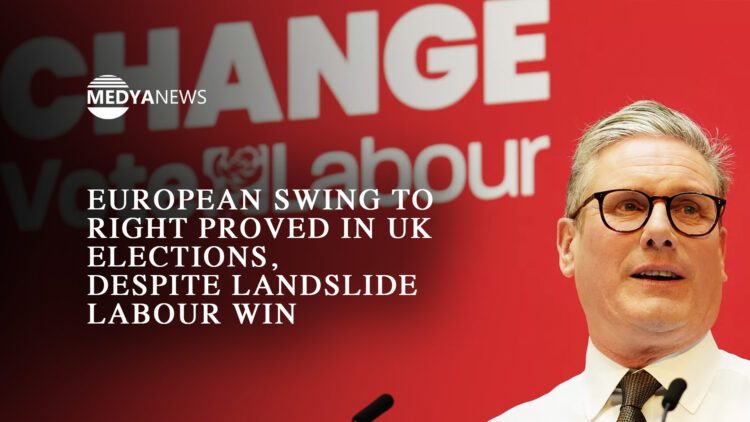
The Labour Party in the United Kingdom is celebrating a landslide vote, seizing back the government in Thursday’s polls from 15 years of Conservative rule. Post-COVID politics in the UK have been marked by austerity, privatisation of essential services, a rise in living costs affecting those on minimum wage, elite tax avoidance, and increasing mistrust in mainstream politics.
Celebrations for Labour on election night were tainted by wins gained in constituencies that had a swing from the now-former ruling conservatives to Reform, a right-wing protest party, claiming to be anti-establishment, launched just weeks before polls stealing loyal blue votes.
Winning his seat, Reform leader Nigel Farage said, “In four weeks of Reform, there’s been an “enormous gap in the centre right of British politics.”
“Westminster is completely out of touch with ordinary people,” he added, vowing to leave the EU Human Hights convention and stop refugees from coming to the UK.
“We are coming for labour, be in no doubt about that, this is just the first step in something that will stun all of you.”
Moments later Jeremy Corbyn, former Labour Party leader coming in as an independent member of parliament, won his constituency with 24,120 votes to 2,660 for the Green Party’s Sheridan Kates. Corbyn has since been expelled from the Labour Party.
Corbyn said, “Our campaign was a positive one, it did not get into the gutter of politics. Not answering mental health or the homeless and demonising refugees, won’t solve problems. Our campaign was determined to bring unity. We want something different, a better end to a government that on the world stage seeks for peace, not war.” Corbyn, expelled from the Labour party, remains a staunch supporter of the Kurdish cause.
He advocated for a “grassroots campaign for all roots of life” and “for something better, to deal with individual problems, and to speak up about social problems. [We want] steadfast, kind, and inclusive politics.”
As the results night became predictable, former Conservative Home Secretary Suella Braverman and MP for Fareham said, “I’m sorry. We have acted like we are entitled. We have not listened to voters and made promises we didn’t keep.”
Iain Duncan Smith, former Conservative leader, said the results were “dreadful”. The party had “taken a battering” and “lost touch with the public.”
Rishi Sunak, former-to-be Prime Minister of the UK, was heralded by mainstream TV as having possibly made the “worst political mistake of all time” in calling early general elections.
Dissatisfaction with the now former government, which instigated the early elections, sewed rich ground for right-wing voters seeking more immigration controls who were taken in by the nationalistic persona of Reform leader Farage.
Discussion of Labour’s landslide win in the mainstream press was accompanied by the fact that significant gains were thanks to previously loyal conservative voters moving to the right-wing Reform Party, who has its sights set on winning the next general elections in 2029.
In France, Le Pen’s right-wing party has just secured victory in a first round. Trump is poised to make a comeback in the US. The European Parliament elections almost spurred snap elections in Germany due to high votes made by the right-leaning party. Across Europe, we see a rise in nationalistic agenda, targeting among others, the Kurdish disapora.
Finalising the election night, Rishi Sunak, Prime Minister of the United Kingdom, about to give up the mantle to his constituency in Yorkshire, said, “I am sorry.” His Chancellor of Exchequer Jeremy Hunt, meanwhile said the results had been formed, “Not by bombs, but by democracy.”
So, Labour’s win is partly a consequence of the advantage afforded by Reform’s entry into politics, which stole seats from the previous ruling conservative vote. Dissatisfaction with the former government has wrapped up with a hard push to the right, and Labour centrists winning out, but for how long?
The Labour Party, in its manifesto promises to abandon the Rwanda Plan which threatened to eject refugees seeking solace on dangerous illegal boat crossings and in turn reject governmental plans to disregard the International Human Rights Convention, save social security and invest in the National Health Service (NHS), tax private schools for the benefit of the masses, and close tax loopholes for the mega-rich. It also pledges an environmental commitment to nationalising green energy.
Despite a few populist policies to appeal to middle and working class people, the manifesto is not hailed across the board as socialist, green, anti-racist or anti-capitalist. Critics fear ever more capitalist ‘growth’, increased investment in multinational corporations rather than small businesses, a continuation of a racist UK border regime, an expansion of the prison-industrial complex, an ever more violent police presence on the streets and expansion of the UK’s reliance on nuclear power.
The Labour party took the UK into a war in Iraq that resulted into over a million Iraqi deaths, blindly supported the US’ imperialist wars, shredded civil liberties [1] in the UK, strengthened police powers to oppress marginalised groups, victimised people claiming benefits, and took significant steps towards NHS privatisation and the privatisation of other public services. Opposition voices highlight how Labour plans to continue that process by privatising the NHS further. Labour leader Keir Starmer also has been condemned as a self-confessed Zionist and an enthusiastic cheerleader for Israel’s genocide against the people of Gaza.
Turnout suggests much of the electorate in the UK are stuck with a choice of the least worst option, rather than a true democratic decision. This choice will grow even more stark as politics pushes rightwards across Europe. Social movements continue to organise beyond elections, toward a people’s democracy as an alternative to unequal, repressive and violent systems.
[1] see Chapter 16, p232