

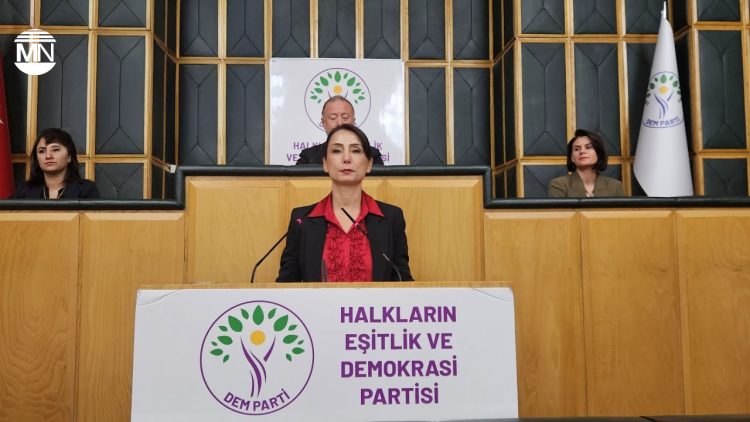
“History does not give us the luxury of waiting – it never has,” said Tülay Hatimoğulları, co-chair of Turkey’s pro-Kurdish Peoples’ Equality and Democracy (DEM) Party, during a group meeting in parliament in Ankara on Tuesday, as she called on the Turkish parliament to urgently remain in session and address a peace-oriented agenda for the Kurdish question amid regional and global crises.
Hatimoğulları warned that the war between Iran and Israel was not an isolated conflict, but part of a broader crisis threatening the global order. “The smoke rising from Iran and Israel only casts a shadow over the future,” she said. “Those trying to warm themselves by the fire of war will eventually burn down their own homes.”
She urged parliament to abandon its planned recess and instead act swiftly to establish a peace commission. Her intervention came in response to the escalating conflict between Iran and Israel, recent attacks on civilians in Syria, and what she described as Turkey’s failure to institutionalise democratic mechanisms for peace. She emphasised the urgent need for action, citing both internal repression and regional instability as consequences of political stagnation.
Hatimoğulları condemned the normalisation of war through the lens of “security”. “Everything is being viewed through a security lens. But what that means is more disasters, more hunger, and unrest,” she said. “Under the name of ‘security’, the horror of war is being normalised in our eyes.”
She argued that global powers, including NATO and the G7, were reinforcing military responses to crises while neglecting democratic development. “We are facing a chain of wars built on the exploitation of the labour of people like Ahmed, Fatima, Rojda, Hans, Robert – that is, citizens of the world – and the denial of their right to life,” she said.
Turning her focus inward, Hatimoğulları warned that Turkey was also at risk from this logic of militarisation. “This is not a simple quarrel between two states,” she said. “The region is being redesigned as part of imperialism’s war for division and control.”
Hatimoğulları strongly criticised governments that stoke nationalist fears to suppress dissent. “They speak of national security. This is a trap,” she said. “While nation-states cannot provide security for their own people, they legitimise anti-democratic practices by creating the image of an absolute external enemy.”
She denounced the suppression of civil society and highlighted the recent arrest of a high school student in Turgutlu for chanting the Kurdish feminist slogan ‘Jin, Jiyan, Azadî’ (Women, Life, Freedom) as an example of democratic backsliding. “The political establishment and the state are not acknowledging the worries of society. They must,” she said.
Hatimoğulları also called for the creation of a parliamentary peace commission that includes representation from civil society, the women’s movement, and the Democratic Society Congress (DTK), and emphasised that such a body must be legally recognised and inclusive.
She expressed cautious optimism about Speaker of Parliament Numan Kurtulmuş’s initiative to meet with parliamentary group leaders to discuss this possibility. “This is undoubtedly a positive step. We hope that today’s meeting will result in concrete outcomes. The path to peace is paved with courage, determination, and sincerity.”
Hatimoğulları reaffirmed the need for dialogue with Abdullah Öcalan, the imprisoned leader of the Kurdish movement. “Everyone wants to speak with him,” she said, referring to domestic and international campaigns calling for access to Öcalan. “In the coming days, we also know that a large delegation from Europe wishing to meet with him will be arriving.”
“Let İmralı’s doors open to peace,” she added, stating that Öcalan had expressed willingness to meet with intellectuals, writers, and lawyers to advance a vision of democratic society.
Hatimoğulları concluded by reminding lawmakers and the public alike that war cannot be treated as a game. “People who have never known war sit at their keyboards as if playing video games with missiles and fighter jets,” she said. “But war is not a game. The weapons are not consoles – they are real.”


