

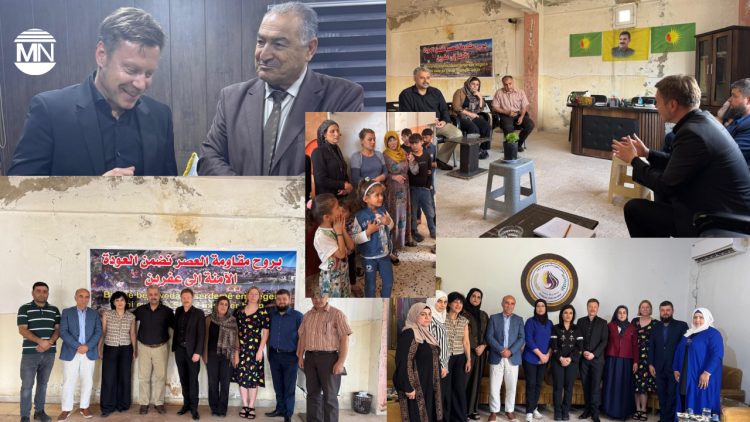
The most senior delegation from the European Parliament to visit North and East Syria to date concluded its visit on Saturday. Led by Martin Schirdewan, co-chair of the Left Group in the European Parliament, the group explored ways to support democratic self-governance and the renewed peace efforts between Turkey and Kurdish representatives.
On their last day, the delegation met with Ilham Ahmed, Co-Chair of the Foreign Relations Department of the Autonomous Administration of North and East Syria (AANES), and visited Roj Camp, which houses the families of foreign ISIS members.
Schirdewan was accompanied by Rosa Luxemburg Centre Deputy Executive Director Philip Degenhardt; DEM Party representative to the European institutions in Strasbourg Fayik Yağızay; Schirdewan’s assistant Nora Friese-Wendenburg; and Yağızay’s assistant Sarah Glynn.
In their meeting with Ilham Ahmed, the delegation discussed the geopolitical challenges faced by the Autonomous Administration. Ahmed noted that, since the beginning of the Kurdish peace talks, the AANES has been in direct discussions with Turkey on a range of issues. She expressed the view that these talks require third-party sponsorship in order to succeed.
The Left Group voiced its desire to offer practical support in Europe. Areas discussed included applying pressure on the new Syrian Government to fulfil its promises of democracy and equal rights and to advance the agreement process with the AANES that was kick-started on 10 March. Other discussions centred around supporting the Turkish-Kurdish peace process in order to counter reluctance from Turkey’s government.
Time and security constraints limited the delegation’s visit to Roj Camp, which accommodates 2,323 individuals, primarily families of foreign ISIS fighters, to a drive around the perimeter. Nonetheless, they were able to gain an impression of the living conditions and speak with members of the camp administration, including the administrators of both Roj and al-Hawl camps and the co-chairs overseeing Roj Camp. Officials reported that detainees have become more assertive since al-Sharaa has been in power in Syria. Women in the camp were said to be plotting escapes with the help of traffickers, and on the morning of the visit, when an electrician attempted to repair some switches, a number of women reportedly told him the work was unnecessary as they expected to be released soon.
Concerning daily life in these restricted conditions, the delegation was told how difficult it was to provide any activities, as the women were resistant to leaving their ISIS lifestyle. Any paper and pens are used to teach the children in the ways of ISIS, so paper and pens are not generally allowed, but the women register their children for the camp school, and on the first day they get given writing equipment. They take this and never show up at school again.
Two days earlier, on 29 May, the delegation had held meetings in Raqqa and Kobanê, where they spoke with AANES leaders, displaced civilians from Afrîn and local women’s organisations. These discussions highlighted the urgent need for international support in the face of ongoing displacement, repression and regional instability, while also highlighting the resilience of local communities and their push for inclusive governance and gender equality.
The purpose of the visit to Kurdistan was to gain first-hand understanding of how the Left Group can support the struggle for freedom and democracy. After an intensive week, the delegation’s work is only just beginning.


