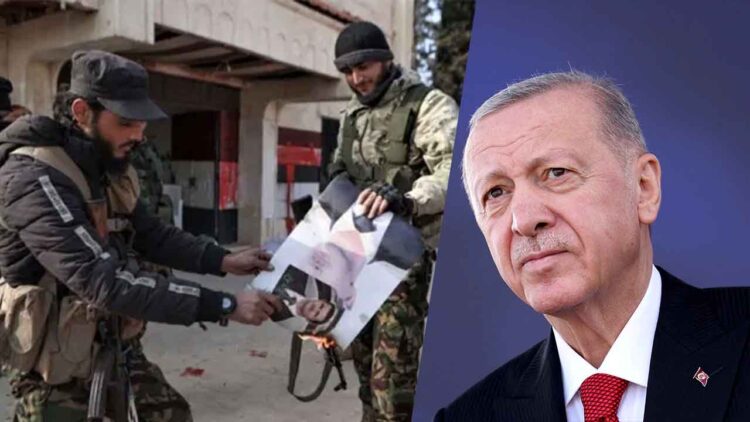
Turkish President Recep Tayyip Erdoğan’s recent endorsement of Syrian jihadists and Turkish-backed mercenary forces’ advances towards Damascus has sparked significant debate, particularly in light of Foreign Minister Hakan Fidan’s prior assertions of non-involvement in these offensives.
In his remarks, made after Friday prayers in Istanbul, Erdoğan said: “The opposition’s march is ongoing, and as of now, they are targeting areas such as Hama, Homs, and Damascus. Our wish is that this march continues without a hitch.”
These comments appear to contradict earlier statements from Turkish officials. Fidan had previously stated that the Syrian government needed to reconcile with its people and opposition, emphasising that Turkey had no direct involvement in the recent offensives led by groups such as Hay’at Tahrir al-Sham (HTS) and the Syrian National Army (SNA).
HTS, often identified as a jihadist organisation, has been designated a terrorist group by multiple countries. The SNA, comprising various factions, is widely regarded as Turkish-backed mercenaries. The collaboration between these groups in the recent offensives raises questions about Turkey’s role and influence in the region. Earlier, Medya News highlighted how Western mainstream media have rebranded terms like ‘terrorist’ and ‘jihadist’ to ‘opposition’, ‘rebels’, and ‘militias’ in their coverage, effectively downplaying the extremist nature of certain groups. *This editorial critique also pointed out that the passive stance of the US and Western governments signifies tacit approval of a conspiracy against Assad’s regime.
Adding to the complexity, Erdoğan’s recent support for the HTS and SNA’s massive military offensives stands in stark contrast to his previous overtures towards reconciliation with Syrian President Bashar al-Assad. Just a few months ago, Erdoğan expressed a desire to meet and reconcile with Assad, signalling a potential shift in Turkey’s Syria policy.
This apparent policy reversal has led to criticisms that Turkey is endorsing actions that violate Syria’s sovereignty, further destabilising the region.
Erdoğan’s recent statements supporting the Syrian jihadists massive advance towards Damascus not only contradict earlier diplomatic positions but also raise concerns about Turkey’s commitment to respecting the sovereignty of neighbouring states. Turkey invaded Afrin (Efrîn) in 2018 and Gire Spî (Tal Abyad) and Serêkanîyê (Ras al-Ayn) in 2019. While the former was indirectly recognised as an occupation by a UN resolution, the latter was de facto legitimised through a ceasefire brokered by the United States and Russia.
These blatant violations of sovereignty and inconsistency with internationally recognised conventions by Turkey poses challenges to safety of indigenous communities, regional stability and diplomatic relations to the extent of committing crimes against humanity like ethnic cleansing, mass displacement, and massacres of civilian populations.
* For a detailed analysis, you can refer to Medya News’ article and interview titled “Salih Muslim evaluates Erdoğan’s desire to reconcile with Assad”, which discusses these issues in depth.