

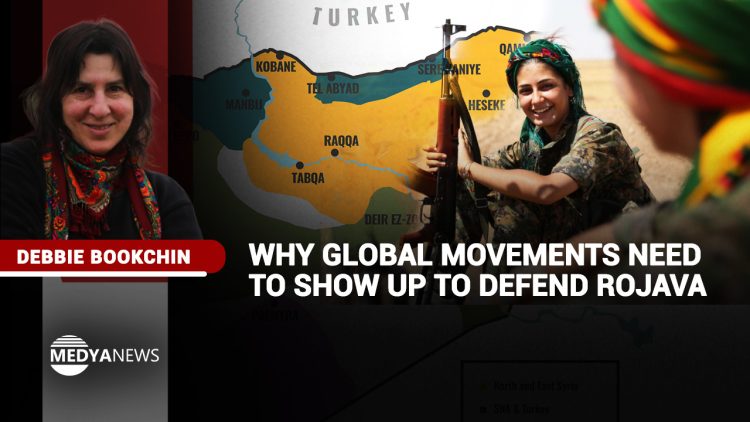
By Debbie Bookchin
It is more important than ever for those of us living outside of Syria to live up to the great history of internationalism and do everything we can to show our solidarity and support for the people of Rojava right now – at perhaps the most dangerous moment in Rojava’s history.
Rojava’s struggle: A call for solidarity to preserve democracy and women’s rights
The events of the last two weeks in Syria have opened the door for powerful nation-states to jockey for position in the Middle East. In the west of Syria, Israel is pressing to further occupy the Golan heights, while in the east Turkey is exploiting the chaos of Assad’s fall to try to completely destabilize Rojava. Even before Assad was deposed on December 8, Turkey had already been bombing Tel Rifaat, and other parts of the Shehba region while its jihadi proxy forces, the criminal gangs that comprise the so-called Syrian National Army or SNA, functions as on the ground shock troops. As a result, more than 100,000 people fled the Shehba canton within just a few days. It’s impossible to overstate how horrific the SNA’s activities have been in places like Manbij, where they have engaged in grotesque violations of human rights that have included the kidnapping of women and girls. Everywhere they go, the SNA gangs replace a culture of democracy and women’s rights with a culture of looting, rape, kidnapping and murder.
As Salih Muslim has mentioned, right now the biggest prize of all for Turkey is Kobani, the city where the Kurds handed ISIS their first defeat, and which Turkish President Erdogan, a supporter of ISIS, considers his biggest humiliation. As we consider why it is so critical for us to show solidarity with Rojava right now we should remember three things:
Rojava’s model of multi-ethnic democracy and women’s leadership
First, no one in the Middle East has been able to ensure the rights of all the multi-ethnic peoples of Syria the way the Kurdish-led regions have done. From the very first day that the region declared autonomy in 2012, the leadership has taken painstaking steps to include and safeguard the rights of the many different ethnicities in North and East Syria. As people know very well by now, this includes making sure that wherever there is a Kurdish person in a leadership position there is also an Arab, Assyrian Christian, Turkmen or other individual of a different ethnicity sharing that position and holding the same level of authority. It is impossible to overstate how extraordinary this is in a region that has been so riven by sectarian violence.
I also want to emphasise that this model, which exists in such direct opposition to the sectarianism and distrust that is being fostered by authoritarian rulers in Western nations, again stands as a kind of defiant rejection of the policies of hatred and antagonism that threaten to undermine the social fabric of many, many nations around the world. So, for that reason alone, it is really important for all of us in progressive movements to lend our support and solidarity to Rojava.
Women’s revolution: A unique model for the world
Second, women’s rights are also enshrined in word and deed in Rojava a way that is simply absent everywhere else in the region. When I spent time in Rojava, I came to understand that the Rojava Revolution was at its core a women’s revolution. The fact that in a society of millions of people, women are equal partners in the decision-making of every aspect of life – political, economic, social – is unique not only to the region but really to the rest of the world. In Rojava, the full exercise of women’s rights is not just an aspiration; it is a reality. And it means that the entire culture is transformed: the way people think about every aspect of life, from education to marriage, from medical care to child care, are all informed by the unique perspective of women. And unlike like most other parts of the world, it means that women, and women alone, get to make decisions about their bodies, about their health, and about their futures.
So, as I came to see in Rojava, the women’s revolution is not just a revolution for women, but for everyone in society, a revolution that has completely transformed everyday life. Again, it is impossible to overstate how unique this is – especially at a time when women’s rights are under assault all over the world, including in places like the United States where we thought we had won those rights 50 years ago, and where instead we see today men telling women what they can and cannot do with their own bodies. So we can say without exaggeration that the Kurdish women’s movement is decades ahead of its time. And that means that the Kurdish model is a model that can inspire and teach all of us, and that we all have a deeply vested interest in preserving it.
Listen to this podcast
Rojava solidarity group promotes women-led direct democracy on US tour
Read more
Global calls for immediate action to halt Turkey’s ‘war against humanity’ in North and East Syria
International women call on UN to stop Turkey’s attacks on Kurds
Turkey’s aggression: Colonialism in disguise
Finally, what Turkey is doing in the northeast of Syria is at its core, pure and simple colonialism, and in a horrific form. Turkey’s animus toward the Kurdish people, which has only intensified under Erdoğan, has led the country to become the very terrorists it supposedly fears. Killing and maiming children, using drones to terrorise communities and assassinate female leaders and journalists, displacing hundreds of thousands of people from their homes – this is ethnic cleansing and forced demographic change that would be deemed outrageous by any western standards if Turkey were not the second largest military power in NATO. This fact has led the other NATO countries to tip-toe around its feared NATO ally. Rather than stand up for basic human rights and challenge Turkey to live peacefully within its borders, western nations bend over backwards to accommodate Turkey’s egregious human rights violations.
By now, it is painfully clear that the Turkish state opposes stability; it opposes women’s rights; it opposes peaceful co-existence between ethnically diverse peoples. It opposes democracy, and especially a grassroots democracy in which people can decide the future of their own communities. It is antagonistic to all the values that liberal democracy claims to represent, and it is certainly antagonistic to the values espoused by the left.
And as for HTS, there are no guarantees that HTS will do any better in preserving women’s rights given its allegiance to Turkey and allegiance to Sharia law. Indeed, its history in Idlib would indicate the opposite: as a direct descendent of the terrorist organizations Jabhat al-Nusra and before that Al Qaeda, there is every reason to believe that once installed in full power, the HTS leadership will turn its back on women just as the Taliban did in Afghanistan.
Defending Rojava: A crucial responsibility for the good of all the globe
For these reasons, it is imperative that all of us act with haste to support the Rojava revolution – and I say this especially to people who consider themselves supporters of women’s rights and non-sectarianism. There are many ways to show solidarity, but for those living in the United States, one of the most important things that must happen right now is to call our representatives and demand that they support the bipartisan bill just introduced by Senators Lindsey Graham and Chris Van Hollen that would sanction Erdoğan and other senior Turkish officials as well as prohibiting further military assistance to Turkey, if Turkey does not immediately agree to a ceasefire plan.
This is absolutely critical right now. And these representatives in Washington, whether Democrat or Republican, must insist that the incoming Trump administration also abide by these sanctions. If we claim to believe in the rights of women, democracy, and an ecological future, we must press our leaders wherever we live to make similar demands of Erdoğan and we must insist on political recognition for Rojava, and on humanitarian aid for the tens of thousands of people who have been displaced. We must demand a halt to all military aid to Turkey until Turkey agrees to withdraw its proxy forces from the region.
If we can’t mount the kind of urgent solidarity necessary to support the liberatory, new social paradigm that is Rojava – and the Kurdish freedom movement more broadly – really what exactly are we fighting for? If we fail Rojava, not only do we face the very real risk that millions of women will be forced back to the status of chattel, and not only will it be a setback for the entire Middle East, but it will be a setback for progressives everywhere, because we need this new model of doing politics to survive – we need to learn from it, and to support it. Our own dreams of a better world depend on it.
Debbie Bookchin is a longtime journalist and author. She is the co-founder of the Emergency Committee for Rojava, the largest US based Rojava solidarity organisation.
@debbiebookchin
@DefendRojava


