

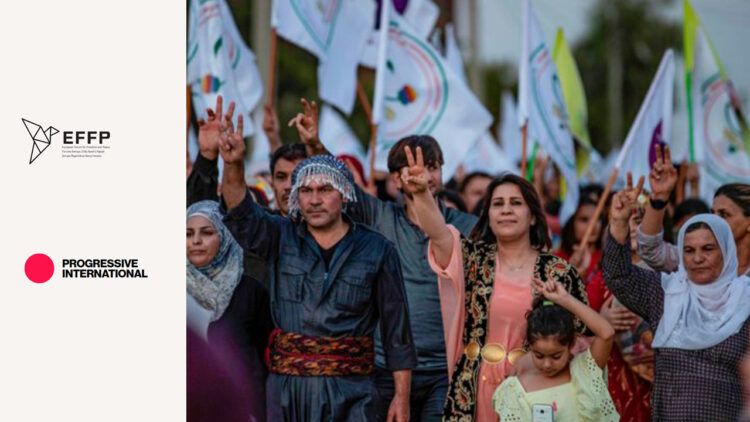
The escalation of violence against the Kurdish people, and the response by the Autonomous Administration of North and East Syria (AANES) was the focus of an online panel entitled ‘Standing up for peace’. The event, organised on Wednesday 18 December by the European Forum for Freedom and Peace (EFFP) and Progressive International, provided an insider’s view of developments in Syria through voices who live in or have visited AANES-controlled areas.
The panel featured Salih Muslim, former co-chair of the Democratic Union Party (PYD), Debbie Bookchin, an award-winning US journalist who has visited northeast Syria, and UK member of parliament and former leader of the Labour Party, Jeremy Corbyn.
As Salih Muslim put it, there are many forces – both states and militias – competing for trade routes and political sovereignty in the Middle East and northeast Syria. This competition threatens the survival of ethnicities and peoples. “The Kurdish people are only trying to defend themselves on their own land,” said Muslim.
Muslim highlighted AANES’s constant attempts to establish diplomatic relations with the new HTS-led government. “We have [known] HTS since 2012,” he said. A diplomatic delegation is “ready to go to Damascus”. He also said that HTS does not threaten AANES, but the threat comes from the mercenaries supported by Turkey. “Turkey planned the invasion of AANES regions on the very day of the fall of the Assad regime,” he added.
Jeremy Corbyn drew attention to Israel’s invasion of Syrian territory, far beyond the already occupied Golan Heights. He also pointed out that the Syrian people face a great challenge to bring peace to the country; the presence of many weapons on the ground could act as a booster for clashes. Corbyn concluded by saying that all left progressive forces must understand well what is happening in Syria, and come together to unite forces.
Debbie Bookchin said that the Turkish-backed mercenaries of the Syrian National Army (SNA) “are replacing the culture of democracy and peace with the culture of violence and rape”. She highlighted the unprecedented inclusiveness of diverse ethnic groups under the umbrella of AANES, making it a unique example in the world. Bookchin emphasised that in the AANES system, women participate in all aspects of life, using their autonomy to make decisions and take action. Women’s freedom leads to a “cultural transformation because all areas of life are shaped by women’s point of view”, she concluded.
Speaking again, Salih Muslim denied that AANES needed US support to continue. “It has been said that if the US leaves [Syria], the Kurds will be gone, but that’s not true,” he emphasised. “We [the Kurds and the administration] were already here when we reached an agreement with the US in 2015,” he added.
Muslim explained that the international coalition is well aware that Turkey is supporting attacks by ISIS cells in Syria, but it doesn’t intervene because Turkey is a NATO member.
He also added, responding to a question, that “we [AANES] are not enemies of the Jewish people”. “Jews are part of the Middle Eastern people and we want a system where everyone can express themselves,” he concluded.
At the end of the panel, moderator Latife Akyuz summed up the meeting. She emphasised the need to remain in solidarity with the people living in the AANES regions; even more solidarity is needed – she said – with the people of Kobani (Kobanê) who are facing the threat of a Turkish invasion.


