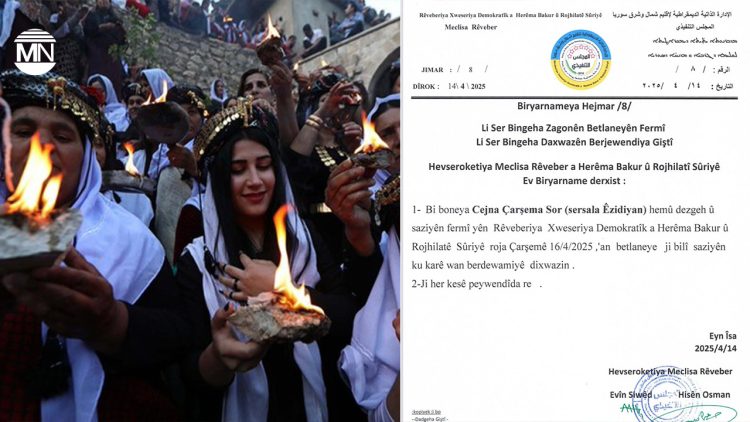
The Autonomous Administration of North and East Syria (AANES) officially declared Çarşema Sor (the Yazidi New Year) a public holiday across its regions on Monday, amid ongoing challenges faced by Yazidi communities — particularly in Sinjar (Şengal), on the Iraqi border, which was the site of the 2014 genocide and mass enslavement carried out by the Islamic State (ISIS).
The holiday — also known as Red Wednesday — marks the Yazidi belief in the creation of life and the descent of the angel Tawûsê Melek to Earth. The sacred day, celebrated each year on the first Wednesday after 13 April, is considered by the Yazidis as the beginning of the new year and the arrival of spring.
In a written statement, Kurdistan Communities Union (KCK), a Kurdish umbrella organisation, extended its greetings to the Yazidi community and the broader Kurdish population. The KCK expressed hope that the festival would inspire renewed commitments to democracy, peace, and freedom, especially in the face of what it described as “ongoing genocidal threats” against the Yazidis.
The KCK accused both Turkey and the Iraqi central government of exerting pressure on Yazidis in Sinjar, hindering their right to self-governance and putting their existence at risk. “Our Yazidi people are celebrating Çarşema Sor once again under the threat of genocide and systematic oppression,” the KCK’s Peoples and Beliefs Committee said.
“The only meaningful response to these attacks is to organise with democratic awareness, strengthen unity and institutionalise the model of democratic self-administration,” the KCK added, framing these efforts as key to ensuring the survival of the Yazidi people.
Sinjar has been at the heart of contention since ISIS committed its atrocities there a decade ago, massacring thousands and abducting women and children en masse. While the ISIS was militarily defeated, the power vacuum and regional rivalry have left Yazidis vulnerable.
The KCK called on Yazidis to expand the “construction of democratic society” in Sinjar, which it claimed would have a positive influence on broader Iraqi Kurdistan by encouraging more transparent and inclusive governance.
The statement also warned that Yazidis should be vigilant against further state-led attacks and internal betrayal, urging Yazidi clerics and elders to play a guiding role in preserving community unity and resisting foreign intervention.
Despite hardship, the KCK highlighted the Yazidi resistance in Sinjar as a source of inspiration for Yazidis worldwide and called on all Kurds to support the ongoing struggle as part of a wider movement for democratic autonomy and cultural survival.
Çarşema Sor continues to be celebrated with the lighting of fires, decorating homes with flowers, and prayers for prosperity and protection — traditions rooted in one of the world’s oldest faiths, now carrying renewed political significance amid continued regional instability.