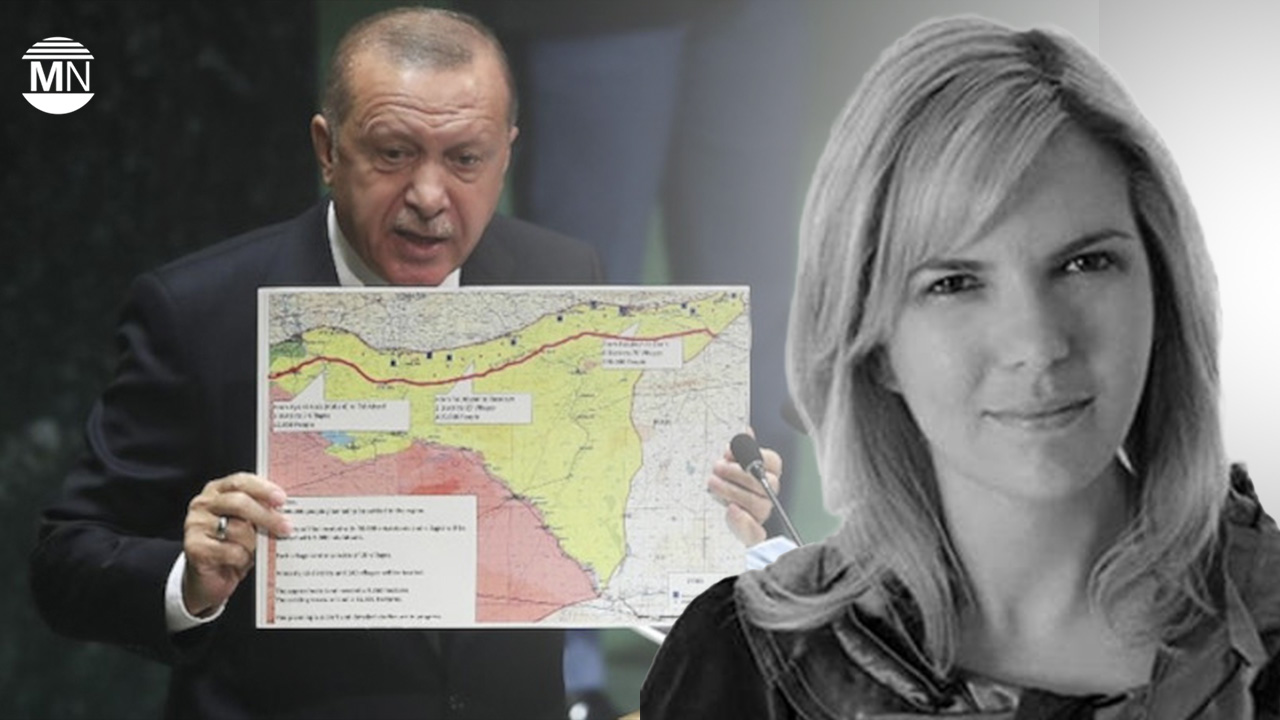
In an incisive analysis, journalist Cansu Çamlıbel critiques Turkish President Recep Tayyip Erdoğan’s latest strategy in Syria, arguing that it prioritises regional power plays over resolving the Kurdish issue. Drawing from her extensive experience as a diplomatic correspondent and former Washington bureau chief for Hürriyet, Çamlıbel highlights Ankara’s attempt to leverage its position with the incoming Trump administration.
Erdoğan’s substitute for SDF: A strategic play in Syria
Erdoğan’s government has proposed establishing Turkish-Arab forces to take over regions controlled by the Syrian Democratic Forces (SDF), which have been pivotal in the fight against ISIS. This plan, Çamlıbel explains, aims to replace the SDF with forces more aligned with Ankara’s interests, presenting it as a counter-ISIS strategy while simultaneously curbing Kurdish influence in northern Syria.
“Ankara sees the Trump era as a strategic opportunity to reassert control over northern Syria by sidelining the SDF, which it perceives as an extension of the PKK. The push to engage Öcalan, the imprisoned Kurdish leader, is less about reconciliation and more about creating the illusion of internal resolution to strengthen Turkey’s hand externally.”
Erdoğan’s race against time
Çamlıbel points out that Erdoğan’s government is racing to secure this initiative before March, anticipating a more accommodating stance from the Trump administration. By orchestrating a disarmament call from Öcalan, Turkey seeks to bolster its regional credibility. However, the analyst stresses that this approach ignores the broader rights and freedoms of Kurdish communities within Turkey.
“The Turkish proposal to involve Arab nations in replacing the SDF faces scepticism from the US,” Çamlıbel notes, adding that American officials have questioned the feasibility of such a plan, particularly given the complexity of integrating disparate factions into a unified force.
Regional and domestic implications
This strategy, Çamlıbel argues, underscores Erdoğan’s dual focus on regional dominance and domestic consolidation. Domestically, the involvement of the Nationalist Movement Party (MHP) ensures nationalist support for Ankara’s policies, but this reliance also reveals the limitations of Erdoğan’s initiative.
During his recent speech in Diyarbakır (Amed) on 11 January, Erdoğan declared:
“This is merely about removing the last obstacle to a strong and great Turkey. It is not a matter concerning our Kurdish brothers but is limited to the elimination of the terror organisation.”
He further clarified, during his expected weekly group meeting in the Turkish Parliament on 15 January, about his government’s approach to addressing challenges in Syria, particularly concerning Kurdish autonomy and security threats in regards with the presence of US-led anti-ISIS coalition. Erdoğan explicitly stated:
“The greatest issue in Syria is the YPG. ISIS has been used as a fabricated excuse by certain countries to justify their presence in Syria. Everyone must withdraw from the region. Together with our Syrian brothers and sisters, we can swiftly crush ISIS, the YPG, and other terrorist organisations.”
He emphasised Turkey’s stance against the YPG and its broader goals in the region:
“If the YPG terrorist organisation, which has also been plundering Syria’s natural resources, does not disband and lay down its arms, it will not escape the bitter fate awaiting it. We are committed to resolving all matters concerning our Kurdish brothers. We are their guarantors of security and their strongest supporters.”
Çamlıbel concludes that Erdoğan’s strategy, while tactically astute, is unlikely to address the root causes of conflict. By focusing on geopolitical gains and undermining the SDF, Ankara risks perpetuating instability in the region and deepening internal divisions.
“The so-called ‘solution’ appears to be more about appeasing international actors than achieving genuine peace,” she writes.
The argumentation, Çamlıbel suggests, highlights the insincerity of Ankara’s initiative, which frames the Kurdish issue purely in terms of terrorism while ignoring the political and cultural demands of Kurdish communities.