

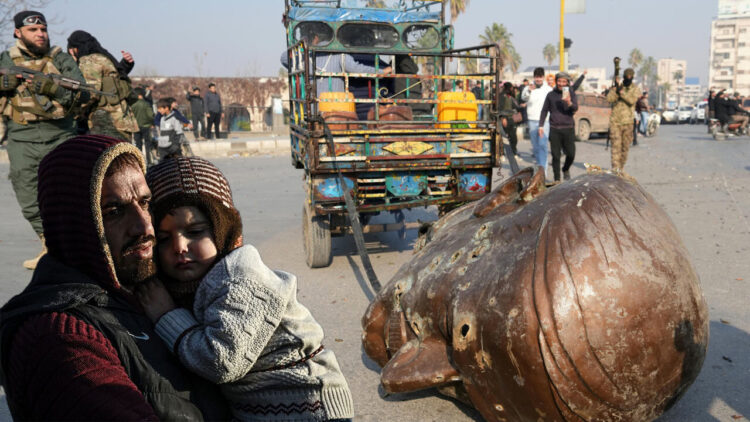
The fall of the Assad regime has been celebrated all over Syria – and the world – but the takeover by the jihadist Hay’at Tahrir al-Sham (HTS) has sparked fears of oppression amongst minorities in Syria.
An article written by Maria Alexeeva and published by the investigative media outlet The Insider on 9 December shares insights into the realities of the Kurdish, Armenian and Christian minorities in Syria, who are doubtful about HTS’ promises to protect religious and ethnic groups in the country.
Alexeeva interviews Mohammed, a Kurdish resident from Sheikh Maqsoud in Aleppo. He spoke about the ongoing curfew, and the HTS siege.
According to Mohammed: “the HTS is not touching people yet, trying to save face, trying to show how progressive they are, but people don’t believe them, because they know the past of HTS… minorities are very scared, Kurds, Yazidis and also especially Christians who make up 10 percent of the population of Aleppo.”
“Now they want to put the West’s vigilance to sleep,” Mohammad said.
Mohammad explained that the minorities in Aleppo “fear bloodshed” but that many are staying in their homes, because they’d “rather be killed than leave”.
Aras Yousef of the Kurdish Peace Institute in Qamishli (Qamişlo) says that Kurds are worried that what happened in Afrin and Serekaniye will now happen again: “Ordinary people, civilians, want security. Some are… against the Assad regime, some are neutral, but the main thing that all Kurds are concerned about is how to avoid the carnage that happened in Afrin and Serekaniye.”
Thousands have fled from Aleppo to the regions under the control of the Autonomous Administration of North and East Syria (AANES), and tent camps have been set up near the Tabqa Dam on the Euphrates river.
The conditions in these emergency camps are dire, and in early December a four-month-old baby named Noa Mohammad Rasho – whose family were forced to leave Shahba – froze to death in a camp in Raqqa.
At least two Yazidi Kurds have been murdered while fleeing. According to The Insider: “Ahmed Hassou, from the village of Kibar, died while trying to flee the town of Tel Rifat towards Afrin. His wife sustained gunshot wounds and was hospitalised. And on 29 November, Mamdouh Bakr Osman was killed near Aleppo. His family stated that three gunshot wounds were found on his body.”
There also are reports from the Syrian Democratic Forces (SDF) of hundreds of Kurdish civilians being kidnapped by Turkish-backed mercenaries while they tried to flee. The Insider states that these refugees were “stopped” in their cars, and then “driven in an unknown direction”.
In Damascus, according to The Insider piece, most people celebrated the fall of Assad’s regime, but there is still a lot of uncertainty about the future. Additionally, there are reports emerging about robberies by HTS fighters.
Many people’s biggest concern is the Turkey-backed Syrian National Army (SNA). According to Mohammed, the SNA, which is now committing massacres in northern Syria, has “more than 30 groups fighting within their ranks, many of which are known for their atrocities and are officially recognised as terrorist in the US and other states”.
Aras Yousef told The Insider about the fate of Kurdish refugees from the Afrin region, which was invaded by Turkey in 2018, saying that displaced people from Afrin make up most of the population of the Sheikh Maqsoud and Ashrafiyah neighbourhoods in Aleppo. Up to 200,000 refugees from Afrin were living in the Shahba Camp north of Aleppo and have now been forced to flee again, after being attacked by the SNA and the Turkish Army.
Many of Aleppo’s Christians have reportedly now fled to the Kurdish controlled neighbourhoods. But, for the moment at least, HTS are allowing church services in Aleppo to take place. One Syrian-Armenian woman from Aleppo said: “We heard opposition fighters telling locals: don’t be afraid, we are not against you, our actions are against the Syrian government, and your life will be better.” But Christians are still worried for the future.
Up to 10,000 Armenians remain in the territory under the control of HTS, according to Zare Sinanyan, Chief Commissioner for Diaspora Affairs of the Republic of Armenia. The Armenian Diaspora representative Maria Ibrahim called the HTS’ offensive a “Turkish occupation”.
“We can’t imagine life under Turkish rule,” an Armenian student from Aleppo told The Insider. “We are scared and unsure of what could happen tomorrow.”
“Nothing bad has happened in the city so far. Electricity has been given more often, which is good. The lights are on several times a day for longer periods of time. But these are such small things compared to the possible massacres that everyone is talking about,” another Armenian woman explained.
The Armenians interviewed were worried about their identity, their language and their safety. One interviewee said: “We don’t know what might happen later, especially since we are Armenian and the opposition groups are backed by Turkey… What will happen to our Armenian schools, our language? Maybe in a month they will demand that women wear the hijab or forbid to speak Armenian, to teach it in schools. Maybe they will force us to learn Turkish or involve our youth in military service.”
The people interviewed by The Insider were deeply sceptical about the positive statements being reported in the media by Aleppo’s Armenian Christians. Many say that people are scared to speak out honestly in public.


