

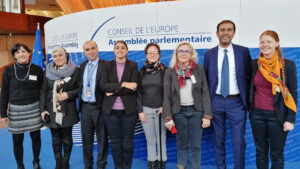
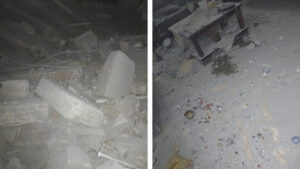
A year and a half ago, a delegation of three women visited the Council of Europe to meet with MPs. Each of them was inspired by the Kurdish struggle and the ideas of Abdullah Öcalan, and they talked with me about what motivated them. One of the three was Sawsan Shouman from Lebanon, who told me that she discussed Öcalan’s ideas with women from other Middle Eastern countries over Zoom and also held group discussions in her home. On Tuesday, that home was reduced to rubble by an Israeli bomb (see images), which seriously injured members of her family. I asked Sawsan to describe what happened, her response to Israel’s claims that their attacks are against Hezbollah, people’s attitudes towards Hezbollah, what Western activists can do, and the relevance of Öcalan’s ideas to the situation in Lebanon. This is her response. – Sarah Glynn

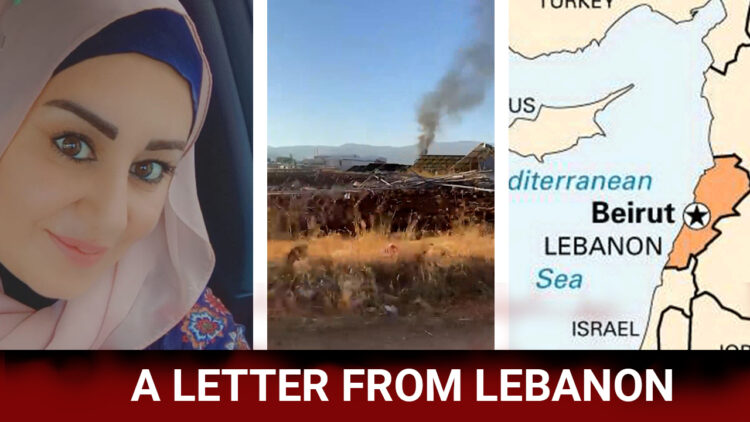
Tuesday night was one of the most challenging nights we have ever faced. We learned through the media that the Israeli forces were planning airstrikes in the Bekaa Valley, targeting Hezbollah positions. Secluded in our home in Sirin, near Baalbek, we did not expect to be caught in their crossfire, believing ourselves safe as mere civilians — especially since I am an activist in civil society organisations unrelated to any political party.
Suddenly, a powerful explosion shattered the night, and the walls of our home began to crumble. We quickly realized that our surroundings had been hit, resulting in severe injuries to my daughter, who was praying outside, as well as to my son in his bedroom, and my husband, who was struck in the head. We rushed out into the chaos, gasping for breath amidst the acrid stench of gunpowder.
My daughter was admitted to the hospital, her body covered in burns and a deep wound to her head. Her lungs were also injured, making it impossible for her to breathe properly. Yet, we were forced to take her out due to the lack of available beds, as more severe cases poured in. We left our home, unable to stay in the ruins of what was once our sanctuary, half-destroyed. We walked a great distance, as the roads had been bombed by the occupying forces. We sought refuge in what we hoped was a safer place, but here, too, we witnessed endless massacres — innocent civilians, unaffiliated with any party, falling victim to this brutality. It is a crime, a cruelty so immense, no words could ever capture it.
The occupying forces are deceitful in their claims. Thousands of martyrs are civilians — women and children — our neighbours, people we know well, whose identities and lives are familiar to us. Israel is a criminal and shameless entity, committing genocide against civilians under the false pretence of destroying Hezbollah’s power. Did they find Hezbollah’s forces in my home, among my five children playing innocently, unaware that a brutal enemy lurks, one that cannot distinguish between a child and a fighter?
The aftermath of the Israeli bomb on Sawsan’s house in Sirin, Lebanon
When we witness the brutality of this enemy, its massacres, and the atrocities committed against civilians, we grow ever more resolute in the belief that peaceful solutions and negotiations cannot be the right path with such a beast. The road to peace is neither possible nor conceivable with an enemy that destroys both life and land. These vile acts only deepen the people’s resolve to support Hezbollah.
Peace with this enemy is not a prerequisite for a ceasefire. The United Nations must act swiftly and decisively to put an end to this genocide, issuing an urgent resolution to halt the bloodshed in Gaza and Lebanon. Direct negotiations are out of the question, for the Zionist entity is not a mere adversary but an occupying force on Arab land. Therefore, such resolutions cannot arise from humiliating negotiations like the agreements the enemy has signed with Egypt, the UAE, and Jordan.
Humanitarian organisations are called upon to shed light on the brutality of the actions committed by this enemy in Lebanon and Gaza, where the victims are overwhelmingly civilians. If these organisations do not raise their voices in defiance of such violations —violations that trample upon every human rights charter and international standard —then what purpose do they truly serve if they fail to take meaningful action in the face of such atrocities?
Abdullah Öcalan stood defiantly against tyranny and oppression, paying the price with his freedom for 24 long years. It is no secret that Israeli intelligence played a key role in his capture in Kenya. Inspired by his ideas of resistance to injustice and the pursuit of freedom, we reaffirm our condemnation of the brutality of this enemy, whose cruelty knows no bounds. I come from a school of thought that believes in living freely, that champions the role of women—women who themselves now face an unparalleled campaign of annihilation and arrogance.


