

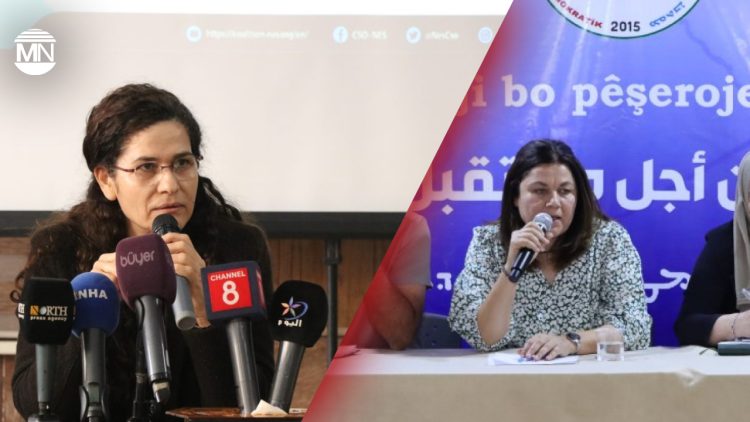
Senior Kurdish politicians from North and East Syria have warned that reverting to a Baathist system of centralised rule risks renewed conflict, calling instead for inclusive political dialogue with the Damascus government to address the country’s enduring crisis.
Speaking at separate events on 24 May, Foza Yusif of the Democratic Union Party (PYD) and Ilham Ahmed of the Autonomous Administration of North and East Syria (AANES) stressed that a decentralised system and sustained negotiations form the only viable path toward a peaceful resolution in Syria. They highlighted the dangers of a military approach and warned of ongoing jihadist threats and growing social inequality.
At a panel in Qamishli (Qamişlo) organised by the Syrian Democratic Council (SDC), Foza Yusif described Syria as being gripped by a deep political crisis. She said military methods had caused “great harm” to the country’s economic, social and cultural fabric. “The solution must be political and inclusive, it must not be based on security or military logic,” she said.
Yusif referred to the 10 March agreement between the Kurdish-led Syrian Democratic Forces (SDF) and the Damascus government, noting partial progress on issues affecting Aleppo’s Kurdish neighbourhoods Sheikh Maqsoud (Şêxmeqsûd) and Ashrafieh (Eşrefiye), and the Tishrin Dam. However, she noted that direct political talks with the Syrian state had not yet taken place and called for international mediation to advance the process.
On the issue of education, Samira Hec Elî of the AANES’s Education Council noted some cooperation with Syria’s Ministry of Education. She said the ministry had invited the Council to Damascus in April but stressed the need for coordination to avoid harming students who prefer to take exams in their local areas due to financial and psychological hardship.
Meanwhile in Athens, Ilham Ahmed addressed an international conference on the Kurdish issue and Middle East dynamics. She stated that it was “impossible” to return to the Baath regime’s model and called for a pluralistic, decentralised governance system that reflects Syria’s diverse ethnic and religious composition.
She observed that jihadist groups such as Islamic State (ISIS) continued to pose a threat despite years of war, and said the SDF remained the most effective local force in confronting them.
Ahmed also warned that continued insistence on centralised rule risked pushing Syria towards renewed civil conflict. “If state institutions are not reformed, communities may begin to make decisions independently,” she said. She also raised concerns about rising Islamist pressure on women, warning of increasing violations of women’s rights.
Both leaders underlined that negotiations with the Syrian government must be expanded to include all ethnic and religious groups and must be grounded in a framework that respects local autonomy and protects civil rights. Ahmed also noted that the outcome of the recent 12th Congress of the Kurdistan Workers’ Party (PKK) had created an opportunity for legal and democratic steps across the region and urged that political solutions be pursued within a lawful framework.
Participants in the SDC panel similarly emphasised that prolonged delays in negotiation were not in the interest of the Syrian people and called for regional and international actors to bring pressure to bear on Damascus to engage constructively.


