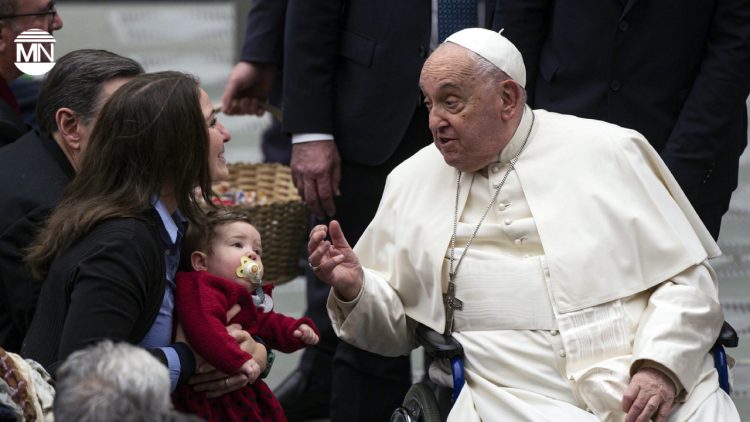
Pope Francis, the leader of the Catholic Church, died on 21 April at the age of 88 in his residence at the Vatican’s Casa Santa Marta. The Vatican announced his passing at 7:35 am local time, attributing it to complications following a recent bout of severe pneumonia. Cardinal Kevin Farrell, Camerlengo of the Apostolic Chamber, confirmed the death, marking the end of a 12-year pontificate defined by compassion and outspoken advocacy on global issues.
Born in Argentina as Jorge Mario Bergoglio, he chose the papal name Francis after St. Francis of Assisi upon his election in 2013, becoming the first Jesuit and the first Latin American pope. His papacy focused on the marginalised, addressing conflicts, inequality, and social inclusion with a pastoral approach. Despite his frailty, he delivered his final Easter Sunday blessing on 20 April in St. Peter’s Square, urging world leaders to pursue peace.
Pope Francis was a vocal critic of war, describing global conflicts as a “third world war fought piecemeal”. He condemned the arms trade and called for ceasefires in regions like Gaza and Ukraine. “War is always a defeat,” he stated in his 2025 New Year’s message, highlighting the human cost of violence. His peace efforts included supporting negotiations in Colombia and meeting South Sudanese leaders in 2019, where he kissed their feet to urge reconciliation.
On the Israeli-Palestinian conflict, Pope Francis advocated for a two-state solution and Palestinian self-determination. He called the humanitarian crisis in Gaza a potential “genocide” in his 2024 book, Hope Never Disappoints, and maintained nightly calls with Palestinians under siege. “These are not collateral damage, but men and women with names,” he said of civilian deaths, condemning violence on both sides. His 2024 Christmas display of a Nativity scene with Jesus on a Palestinian keffiyeh scarf symbolised his solidarity.
The pope’s concern for oppressed minorities extended to Middle Eastern conflicts, including those affecting ethnic groups displaced by war. During his 2021 visit to Iraq, Pope Francis met communities devastated by the Islamic State (ISIS), a Sunni jihadist group, calling for dialogue to protect all minorities. His broader anti-war stance addressed the plight of displaced populations across Syria and Iraq, emphasising humanitarian aid.
Pope Francis also pushed for greater inclusion within the Church. He appointed women to Vatican roles, such as Sister Alessandra Smerilli, and opened liturgical roles to them, though he rejected their ordination as priests. “Women have a vital role, but it differs from men’s,” he explained, balancing tradition with calls for equality. His stance drew mixed reactions, with some praising his steps and others seeking bolder reform.
On LGBTQ+ issues, Pope Francis shifted the Church’s tone. He endorsed civil unions for same-sex couples in 2020, stating, “They have a right to a family.” The 2023 Vatican document Fiducia Supplicans, issued by the Dicastery for the Doctrine of the Faith (a Vatican office overseeing doctrine), allowed blessings for same-sex couples but did not permit marriage. He also met transgender and gay individuals, but his criticism of gender theory as an “ugly ideology” sparked debate.
Francis’s environmental advocacy, notably in his 2015 encyclical Laudato Si’, linked climate change to poverty, urging global action. His critiques of capitalism and inequality, as in Evangelii Gaudium (2013), resonated with social justice movements. His interfaith efforts, including visits to Muslim-majority nations, fostered dialogue across divides.
The Vatican enters a sede vacante period, with cardinals under 80 preparing for a conclave to elect a successor. Francis requested a simple funeral and burial at Santa Maria Maggiore, reflecting his humility. World leaders, including US Vice President JD Vance, whom Francis met on 20 April, expressed condolences, noting his global impact.