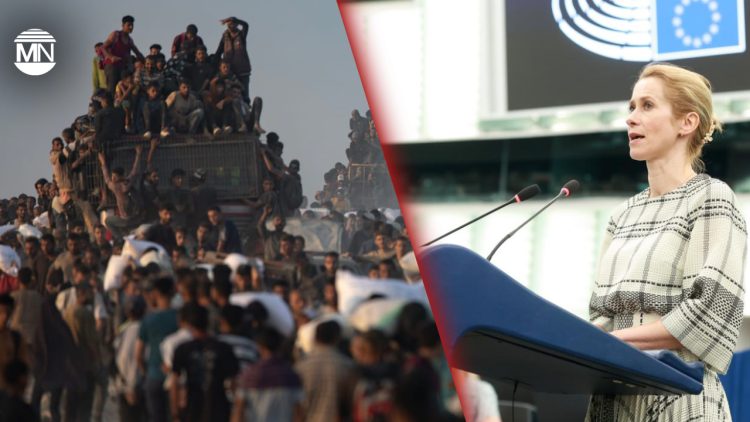
Israel’s military campaign in Gaza has violated the European Union’s key human rights agreement with the country, according to a formal review by the EU’s diplomatic service. The finding puts trade and political consequences on the table, with foreign ministers set to debate potential sanctions in Brussels on Monday 23 June.
The European External Action Service (EEAS) concluded that Israel’s response to the 7 October 2023 Hamas attacks involved disproportionate force, widespread destruction of civilian infrastructure, and systematic obstruction of humanitarian aid. The review highlights “an unprecedented level of killing and injury of civilians” and the forced displacement of 90% of Gaza’s population.
Speaking at the European Parliament on 18 June, EU foreign policy chief Kaja Kallas stated, “Israel has the right to self-defence, but what we see in practice from Israel goes beyond self-defence.” She added, “Blocking food and medicine for Palestinians trapped in Gaza doesn’t protect Israel” and warned that international humanitarian principles are being undermined.
The EU-Israel Association Agreement, which underpins political and trade relations between the EU and Israel, includes binding commitments to human rights under Article 2. A full suspension of the agreement would require unanimous consent from all 27 EU countries, but limited measures such as trade restrictions could be adopted by qualified majority.
On Monday 23 June, the EU Foreign Affairs Council will convene to discuss the EEAS report and assess possible responses. Later in the week, European Council leaders are expected to take up the issue at a summit in Brussels. The decisions could mark a turning point in EU-Israel relations, which have long been defined by close economic and political cooperation.
Although support for stronger action is growing among several EU governments, internal divisions remain. Germany and Austria have expressed reservations over measures that might be seen to undermine Israel’s right to security.
Separately, Belgium and eight other EU member states, including Ireland, Spain and Sweden, have called on the European Commission to review the legality of trade with Israeli settlements in the occupied West Bank. The initiative follows a 2024 International Court of Justice ruling warning against economic activity that contributes to illegal occupation.
While the EU has condemned the expansion of settlements and rising settler violence, action to date has been limited to sanctions on nine individuals and five entities. Discussions are now underway on whether to expand these measures further.
Kallas acknowledged the institutional limitations of her role, noting that any EU sanctions must be adopted unanimously. “Sanctions need unanimity,” she told lawmakers. “We don’t have 27 Member States on board and that’s the reality.”
She urged members of the European Parliament to press their national governments to support stronger measures and reiterated the EU’s position: “The two-state solution is the right path and always will be.”
The EU remains the largest international donor to Palestinians, with €170 million allocated for humanitarian aid this year and more than 5,000 tonnes of supplies delivered to Gaza. But with the humanitarian crisis worsening, the EU is under pressure to align its foreign policy with its stated human rights values.
Meanwhile, an Israeli aircraft fired a missile at starving Palestinians waiting for food aid in Gaza, killing at least 44 people on Friday, according to local officials. The Gaza Health Ministry reported that at least 25 of those killed were near Netzarim in central Gaza while awaiting aid trucks.
Timeline: EU review of Israel’s actions in Gaza
On Wednesday 18 June, Kaja Kallas addressed the European Parliament, confirming that a review of the EU-Israel Association Agreement was underway and warning that Israel’s conduct was “beyond self-defence”.
On Thursday 19 June, Belgium and eight other countries formally requested that the European Commission assess whether trade with Israeli settlements complies with international law, citing a 2024 ruling from the International Court of Justice.
On Friday 20 June, POLITICO published details of a leaked EEAS report concluding that Israel’s actions breach Article 2 of the EU-Israel Association Agreement, particularly in relation to humanitarian obstruction and the displacement of civilians.
On Sunday 22 June, EU ambassadors (COREPER) are expected to meet to prepare the agenda and political groundwork.
On Monday 23 June, the Foreign Affairs Council will meet in Brussels to discuss the report and potential measures. Limited trade restrictions could be approved by qualified majority, while sanctions would require unanimity.
On Thursday 26 and Friday 27 June, the European Council summit will likely take up the matter, with Kallas expected to brief EU leaders and seek consensus on a political course of action.
How the EU process works in cases like this
The European External Action Service (EEAS) is the EU’s diplomatic body, led by the High Representative for Foreign Affairs — currently Kaja Kallas. It conducts legal and political assessments on foreign policy issues, including compliance with the EU-Israel Association Agreement.
The European Parliament can debate and influence foreign policy through resolutions and public pressure but holds no binding authority over sanctions or external agreements.
The Foreign Affairs Council (FAC), composed of foreign ministers from all 27 Member States, is the key decision-making body for foreign policy. It can adopt sanctions or trade restrictions. Sanctions require unanimity, while some trade measures can be passed by qualified majority.
The European Commission handles technical and legal assessments. It is currently reviewing whether trade with Israeli settlements violates international law, based on the Belgian-led request.
Finally, the European Council, comprising national leaders, sets the EU’s political direction. Kallas is expected to present the EEAS findings at the next Council summit to seek further guidance or mandates for action.
In short, while the Parliament shapes the political mood, real power lies with the Foreign Affairs Council and European Council — and their ability to build consensus.