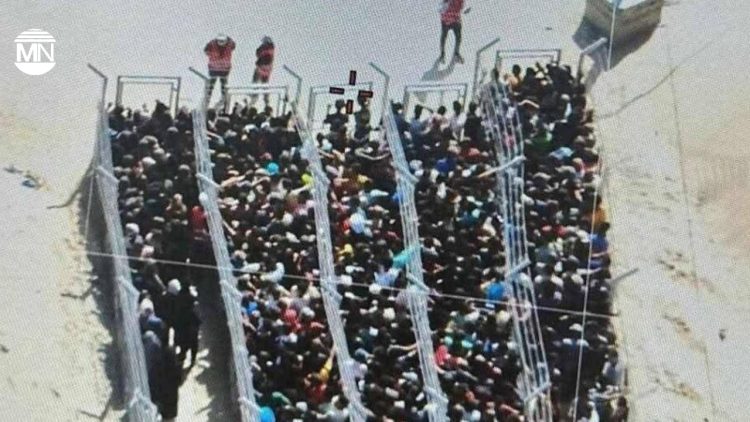
A newly published report has raised serious concerns about the purpose and legality of the Gaza Humanitarian Foundation (GHF) aid distribution compounds constructed by the Israeli authorities in Gaza. The facilities, operational since late May, appear to prioritise military control over humanitarian access — while newly released population estimates, also included, point to over 377,000 Palestinians currently unaccounted for.
The report, authored by researcher Yaakov Garb and hosted on the Harvard Dataverse, offers a spatial and structural analysis of five compounds established by Israel with American involvement. The study, titled “The Israeli/American/GHF ‘aid distribution’ compounds in Gaza: Dataset and initial analysis of location, context and internal structure”, contends that the design, operation and location of these compounds are deeply incompatible with humanitarian principles.
According to the report, the compounds are situated in areas declared buffer zones by the Israelis, where civilian entry is formally restricted. Civilians must cross dangerous terrain — often on foot and through areas marked as no-go zones — to reach the compounds. Once there, the sites offer no shelter, water or sanitation, and are designed with narrow entry and exit corridors, maximising control through surveillance and armed security.
Rather than being run by neutral humanitarian agencies, the compounds are staffed by private US-based security contractors under the protection of Israeli forces. The internal structure — uniform across all five locations — is described as a “fatal funnel”, a term used in military planning to denote bottlenecks designed to restrict movement and heighten vulnerability.
These findings raise major concerns regarding Israel’s compliance with the Fourth Geneva Convention, which obligates occupying powers to provide and facilitate humanitarian aid through neutral and independent means. The absence of basic facilities and the overtly securitised structure of the compounds suggest a deliberate departure from internationally accepted aid practices.
Further compounding the issue are the population figures included in the same report. Drawing from estimates attributed to Israeli Defence Forces sources, the report maps three remaining population enclaves in Gaza — Gaza City (1 million), Mawasi (0.5 million), and central Gaza (0.35 million) — totalling 1.85 million people. Gaza’s pre-war population stood at 2.227 million, leaving an estimated 377,000 Palestinians unaccounted for.
While some of the missing may be displaced or hiding in inaccessible areas, the scale of the gap suggests a larger humanitarian catastrophe than has been publicly acknowledged. The figure far exceeds confirmed casualty numbers, prompting urgent calls for investigation into displacement, deaths from starvation and dehydration, and lack of medical access.
The report concludes that the compounds “do not bring food to needy populations, but rather entice, under conditions of severe duress, some portions of these populations into remote and highly militarised settings”. It warns that the system is likely to result in repeated civilian exposure to harm, and could generate further violence in the guise of crowd control.