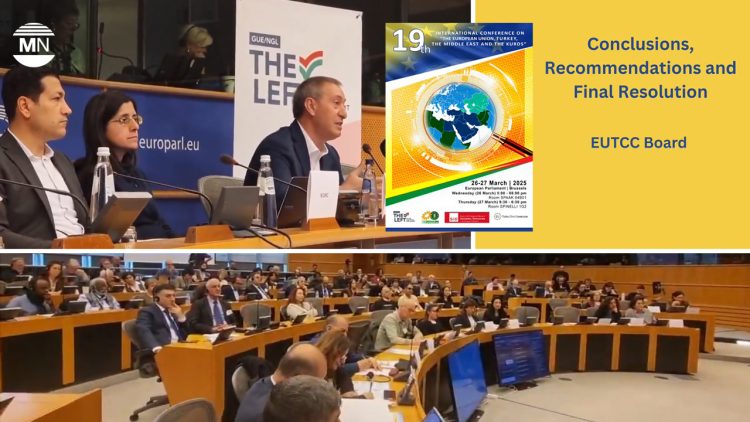
The EU Turkey Civic Commission (EUTCC) wrapped up its 19th International Conference on ‘The European Union, Turkey, the Middle East and the Kurds’ on 27 March at the European Parliament in Brussels, issuing a final declaration urging concrete support for a renewed peace process and democratic reforms in Turkey and across the region.
The two-day conference, held on 26–27 March 2025, brought together Members of the European Parliament (MEPs), Nobel Laureates Shirin Ebadi and Jody Williams, representatives of the Autonomous Administration of North and East Syria (AANES), and members of the İmralı delegation, who visited imprisoned Kurdish leader Abdullah Öcalan on 27 February.
Öcalan, abducted illegally and imprisoned in an island prison in Turkey since 1999, is a Kurdish leader recognised by the Kurds as the key actor for peace. Although Öcalan has spent most of his time under severe isolation and he has been held in total incommunicado conditions for nearly four years. Aside from four short visits by political delegations since October 2024 in relation to ongoing reconciliation discussions in Turkey, he has had no contact with the outside world.
Themed around growing regional instability and opportunities for reconciliation, the event featured five in-depth panel discussions, ranging from “Turkey in the New World Order” to “Promoting Democracy – Shaping the Future.” Participants addressed the intensifying crackdown on Kurdish political activity in Turkey, military operations across Kurdish regions, and the EU’s role in responding to democratic backsliding.
The final resolution described the 27 February statement by Öcalan as a “historic” message, stressing that lasting peace requires his direct participation. The Kurdistan Workers’ Party (PKK) had followed up with a unilateral ceasefire, which the EUTCC described as creating a “unique moment” for restarting negotiations.
Key demands in the resolution included:
*Immediate release of Abdullah Öcalan to enable his role in peace efforts.
*Cessation of Turkish military operations in North and East Syria and the Kurdistan Region of Iraq.
*Recognition of the Autonomous Administration of North and East Syria as a democratic and pluralistic entity.
*Removal of the PKK from the EU terror list to facilitate dialogue and political engagement.
*Enforcement of European Court of Human Rights rulings regarding Öcalan’s imprisonment.
*Democratic reforms in Turkey, including reversing the appointment of state trustees replacing elected mayors.
EUTCC Board Member and Kurdish Academic Network co-chair Dersim Dağdeviren told Medya News ahead of the conference that recent developments in Syria and Öcalan’s call had “significantly increased interest in this year’s conference”.
Ilham Ahmed, Foreign Relations Representative of the AANES, and Peoples’ Equality and Democracy (DEM) Party Co-chair Tuncer Bakırhan were among the high-profile speakers advocating for international recognition of Kurdish self-governance and democratic autonomy.
The EUTCC stressed that without truth, justice, and recognition of Kurdish political rights, peace in the Middle East remains impossible. The statement also warned that societal trauma caused by decades of repression and conflict must be addressed through processes akin to South Africa’s Truth and Reconciliation Commission.
The event was co-hosted by The Left, Greens/EFA, and S&D political groups in the European Parliament. The EUTCC, founded in 2004 by prominent figures including Kurdish politician Leyla Zana and South African Archbishop Desmond Tutu, is a civic platform that brings together civil society organisations, academics, politicians and policy experts. It aims to promote a democratic resolution to the Kurdish question and advance human rights in Turkey.