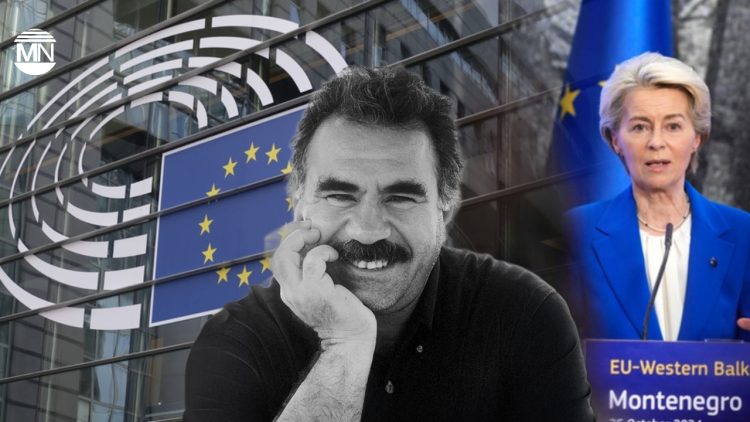
Twenty-nine Members of the European Parliament (MEPs) issued a collective call to the European Commission on 22 March, urging it to play an active and constructive role in fostering a sustainable peace process in Turkey.
The MEPs were acknowledging a pivotal declaration by imprisoned Kurdish leader Abdullah Öcalan on 27 February, in which he called for a democratic and peaceful resolution to the Kurdish question. In response to Öcalan’s call, the Kurdistan Workers’ Party (PKK) declared a unilateral ceasefire and expressed readiness to dissolve the organisation under conditions that would guarantee a safe and legitimate political transition.
Despite this historic offer, the Turkish government has failed to respond with any meaningful or positive steps. On the contrary, it has intensified military operations targeting PKK bases in the Kurdistan Region of Iraq, and has launched continued airstrikes on the Kurdish-led autonomous region of North and East Syria. The MEPs say these actions threaten to derail the peace process before it can begin, reinforcing mistrust and undermining efforts to move from conflict to democratic dialogue. They note that the attacks are preventing PKK members from organising a congress or transitioning into civilian life, effectively closing the door on the organisation’s stated intention to disarm and demobilise.
“There can be no conceivable excuse for such attacks,” the MEPs write. “Öcalan’s call seeks peace through democracy. For any peace to be lasting, people need a democratic route through which to achieve rights and resolve grievances.” One of the strongest appeals in the statement is that Öcalan must be allowed “to communicate freely and intervene in the political debate”.
The MEPs represent a diverse political alignment across the European Parliament—including the Left, S&D, Greens/EFA, and Renew Europe. Their collective statement calls for the Turkish government to urgently address the fundamental democratic deficits that have deepened in recent years. These include the mass incarceration of political opponents, the dismissal of democratically elected mayors and their replacement with centrally appointed trustees, the erosion of judicial independence, and the restriction of media freedom. Rebuilding the rule of law and protecting fundamental rights are central pillars, they argue, to any genuine and lasting peace.
“This opportunity will have implications far beyond the region and requires international support.”
In this light, the MEPs urge the European Commission to place democratic standards at the centre of its relations with Turkey, using its influence to ensure compliance with international law and human rights obligations.
The parliamentarians are particularly concerned about Turkey’s ongoing military incursions across its borders. Operations in Iraq and Syria have targeted Kurdish communities and self-governing regions, including areas under the Autonomous Administration of North and East Syria (AANES). The MEPs also criticise Ankara’s role in obstructing a recent peace agreement between the Kurdish-led administration and the interim Syrian government, warning that Turkey’s interventions are not only destabilising but are undermining potential frameworks for regional cooperation and peaceful coexistence. The MEPs warn that such operations do not address security concerns but rather destabilise regions already suffering from the effects of war and displacement.
“The attacks by Turkey and their proxy militias and Turkish intervention against the recent agreement between North and East Syria and the interim government in Damascus are a major source of instability in this fragile region.”
Although the PKK has publicly committed to ending armed resistance, the continuation of hostilities by Turkish forces raises serious questions about Ankara’s willingness to pursue peace. Political figures from both the PKK and the pro-Kurdish Peoples’ Equality and Democracy (DEM) Party have reiterated their appeal to President Recep Tayyip Erdoğan’s government, calling on it to engage seriously with this political moment and uphold its responsibility to explore peaceful solutions. The DEM Party has further stressed that reconciliation cannot take place without respect for democratic representation and the reinstatement of local political mandates.
The MEPs note that Abdullah Öcalan “has the trust of millions of Kurds, but he must be allowed the opportunity to communicate freely and intervene in the political debate.” They call on the EU Commission to “actively support the creation of conditions that will allow Abdullah Öcalan to play his vital role in a peace process”, concluding by calling on the EU Commission “to reinforce the link between EU Turkey relations and the practice of democratic norms”.