

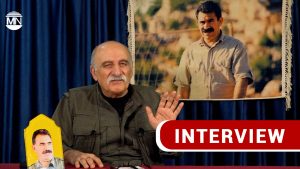
Kurdistan Workers Party (PKK) executive committee member Duran Kalkan has openly criticised the Turkish government for failing to respond to Abdullah Öcalan’s 27 February appeal to end the decades-long conflict. In response to Öcalan’s call, PKK leaders had made statements saying that they would fulfill the requirements of Öcalan’s call for the process to move forward, but that the Turkish government had to take the necessary steps.
The Turkish Ministry of National Defence issued a statement asking the PKK to immediately convene its congress and decide to lay down arms, but the Turkish Armed Forces’ operations in the region continue uninterruptedly. In addition, 10 people, including children, were killed in recent days in an attack by Turkish drones on civilian areas in northern Syria. Kalkan statement included comprehensive evaluations on the developments since the day the peace talks actually started.
Related Articles :
KCK’s Bayık: Öcalan’s participation essential for meaningful peace dialogue in Turkey
PKK’s Helin Ümit: We need to communicate with our leader Abdullah Öcalan
PKK executive Karayılan welcomes Öcalan’s disarmament call, but warns Turkey must meet ceasefire
Despite Öcalan’s ‘historic call’ to move away from armed conflict, no corresponding legal or constitutional steps have been taken by the Turkish authorities, Kalkan stressed that Öcalan, who is imprisoned on İmralı Island, has not seen any improvement in his prison conditions, pointing to the government’s “delay and duplicity” in addressing core Kurdish grievances.
According to Kalkan, Öcalan’s call to shift the conflict from a military to a legal and political framework sparked initial optimism, but has yet to produce concrete progress. Despite discussions about improving Öcalan’s prison conditions and introducing key legal reforms, Kalkan claims that no substantial steps have been taken. “Everything is as it was,” he said, accusing Ankara of “delaying and deceiving” both Ocalan and the Kurdish public.
Kalkan cited the PKK’s unilateral ceasefire, declared after Öcalan’s appeal, as a sign of goodwill. However, government officials reportedly rejected the ceasefire and demanded unconditional disarmament. For Kalkan, this reflects a refusal to address the political and constitutional issues at the heart of the dispute.
“They want the PKK to disappear, but without offering a credible way to meet Kurdish aspirations or release Öcalan.”
Central to Kalkan’s position is that only Öcalan can call a PKK congress to discuss disarming or disbanding. “No one else has that authority,” he stressed, describing PKK fighters as unswervingly loyal to Öcalan’s leadership. In his view, calls for the PKK to lay down its arms are hollow without legal and constitutional guarantees.
Kalkan also highlighted the wider significance of this year’s Newroz celebrations, pointing to large gatherings in “all four parts of Kurdistan” and among Kurdish communities abroad. He described it as a collective call for Öcalan’s physical freedom. “This was not a routine Newroz,” he stressed. “Tens of thousands gathered to demand the release of Leader Apo”.
Reflecting on the past, Kalkan recalled that the leader of the Nationalist Movement Party (MHP), Devlet Bahçeli, once invited Öcalan to address parliament.
“That invitation suggested a real paradigm shift, but nothing concrete came of it. The government slipped back into its old stance of refusal.”
While international actors have expressed a desire for a peaceful solution, Kalkan accused them of remaining only superficially supportive of peace by not pressing Turkey for concrete steps on Öcalan’s detention. “Words alone are not enough,” he said. “They must insist on ways that will ensure a fair solution and an end to Ocalan’s isolation.”
In conclusion, Kalkan called for more public pressure in Turkey and internationally to achieve a genuine dialogue. He warned that the PKK’s ceasefire offer could not last indefinitely if Ankara continued to sideline Öcalan’s role. “The key is to unlock the door to İmralı,” he said. “Only when Öcalan is free can the PKK discuss its future, whether that means disbanding or laying down arms.”


