

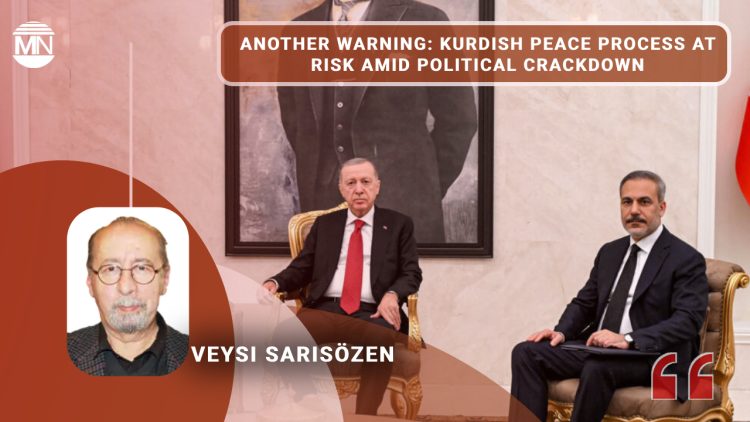
Veysi Sarısözen
While the Kurdish Freedom Movement is struggling to reach a “democratic settlement” with the Turkish state — with whom it has been at war for half a century — for the sake of all the peoples of the region, the ruling Justice and Development Party (AKP) government is playing with fire. On one hand, it fails to take the democratic steps urgently needed in exchange for the Kurdistan Workers’ Party (PKK) ending its armed struggle and dismantling its underground structure. On the other, it escalates attacks against the main opposition Republican People’s Party (CHP) to such a degree that it threatens not just democracy, but even the faintest hope of peace — amounting to a “civilian coup”.
The CHP rally in İstanbul’s Gaziosmanpaşa district last Wednesday made it crystal clear that the party’s grassroots are running out of patience. CHP leader Özgür Özel, referring to these gatherings first as “rallies” and then as “actions”, warned that if things continue like this, the people who have so far “gone home” after protesting may stop going home — drawing a parallel to the AKP’s use of “Rabia squares” [a reference to the ruling party’s mass mobilisations named after a four-finger salute symbolising unity and resistance, originally inspired by pro-Morsi protests in Egypt].
Now imagine if the court cancels the CHP’s party congress on 30 June by declaring it legally null and void. In that case, the vow “not to go home” heard in Gaziosmanpaşa will almost certainly turn into real action. And if the protests evolve into “occupations of public squares”, the struggle itself will turn into “popular resistance against a coup”. Any parliamentary commission established to discuss “a transition to peace and democracy” would then be rendered meaningless.
However, if there is no serious faction within the state resisting Erdoğan’s reckless direction, no element within the military willing to stop this madness, and — more importantly — if the Kurdish people and the broader opposition do not fully support such a resistance, then the CHP grassroots, who lack experience in “revolutionary” struggle, cannot be expected to prevail against the state’s police and military forces. If the regime crushes such resistance by labelling it an “uprising” and then moves towards an autocracy without elections, no one should be surprised. From Gezi to one-man rule, from a fake coup to sabotaging the peace table and triggering war — the end of that path is “fascism without elections”.
And again, if President Recep Tayyip Erdoğan, Foreign Minister Hakan Fidan and Intelligence Chief İbrahim Kalın have indeed signed secret deals with the US and Israel targeting Iran, then silencing the opposition beforehand is undoubtedly the main purpose of this “political crisis”. It’s no coincidence that they’re pressuring the PKK to “lay down arms immediately” — a clever tactic meant to corner the movement.
At this critical juncture, it is the duty of the entire opposition, including the pro-Kurdish Peoples’ Equality and Democracy (DEM) Party, to deliver a clear and forceful warning to Erdoğan to stop this dangerous escalation. That warning must also include “measures” — which should be decided collectively by these parties. It’s not for me to say from this column what those measures should be.
There is no room for hesitation like “what if this harms the process?” On the contrary, if no such step is taken, the damage will be far greater.
Because as PKK founder Abdullah Öcalan, the DEM Party, Nationalist Movement Party (MHP) leader Devlet Bahçeli and parliamentary speaker Numan Kurtulmuş have all signalled a path from war to peace via a commission in the Turkish Grand National Assembly, no reasonable person can believe that the main opposition party CHP — which represents the majority of voters — would be willing or able to contribute to such a commission under these circumstances.
And without the participation of the electoral majority, there can be no meaningful “peace and democratic society process” to speak of.
It is clear we are facing a major provocation.
6 June 2025, Yeni Özgür Politika


