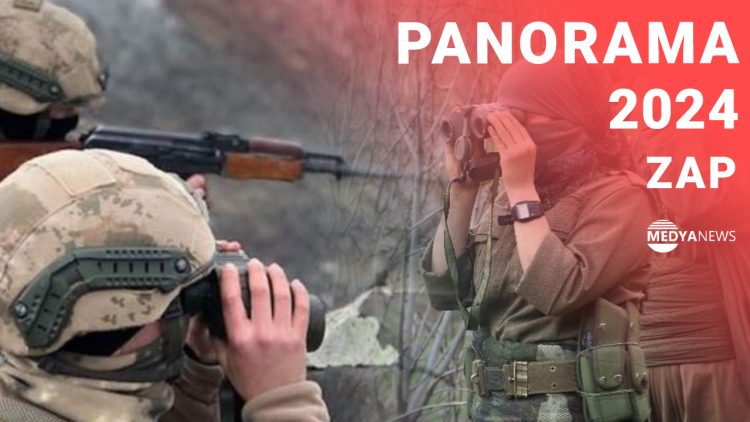
PANORAMA 2024 | PKK guerrillas continue to resist Turkish forces in Zap region
🔴#PANORAMA2024 | Erdoğan vows to crush the PKK by summer, but Zap remains unconquered. The fight in Iraqi Kurdistan rages on, with PKK forces halting Turkish advances despite chemical attacks and… pic.twitter.com/HqKk1BtKk3
— MedyaNews (@medyanews_) December 26, 2024
Murat Karayılan, Commander of the People’s Defence Centre (HSM) Headquarters, has highlighted their successful resistance against Turkish advances in the Zap Valley since 2021. As 2025 approaches, despite support from the Kurdistan Democratic Party (KDP) and the central Iraqi state, Turkish forces have yet to establish control over Zap in the Kurdistan Region of Iraq (KRI). In preparation for a winter offensive, they continue to reinforce their position, clinging to the hope of eventual success.
Following issued reports of nine Turkish soldiers killed in the Zap region on 13 January 2024, President Recep Tayyip Erdoğan convened an emergency security meeting with senior officials, including Foreign Minister Hakan Fidan, Interior Minister Ali Yerlikaya, Defence Minister Yaşar Güler, Chief of General Staff Metin Gürak, and National Intelligence Organisation head İbrahim Kalın. Erdoğan declared his intention to completely eradicate Kurdistan Workers’ Party (PKK) guerrilla forces by the summer of 2024.
With the arrival of spring, Erdoğan hinted at a new military operation, reiterating Turkey’s goal of establishing a “security corridor” extending 30-40 kilometres into Syrian territory. This plan aligned with Turkey’s broader agenda to neutralise perceived threats from Kurds along its southern borders, particularly in the KRI.
The high-level discussions between Turkish, Iraqi, and Kurdistan Region officials sparked speculation about an imminent military campaign. These talks suggested a coordinated effort by Ankara to mobilise Iraq and the Iraqi Kurdistan government (KRG) in a joint operation against PKK forces entrenched in various strongholds.
In March 2024, Turkey was preparing for a renewed military campaign in Iraqi Kurdistan. Turkish authorities had ramped up political, military, and diplomatic efforts to expand their operations against the PKK in the north of Iraq. Turkish Defence Minister Yaşar Güler stated that concerted military action would make terrorism a non-issue for Turkey.
By April 2024, Turkey had threatened an imminent, major military operation, with Turkish officials speaking of the PKK’s complete eradication. Iraq’s National Security Council announced that the PKK would be banned from operating in the country, following a high-level security meeting with a Turkish delegation in Baghdad, which was notably attended by Turkish Foreign Minister Hakan Fidan and Iraqi Deputy Prime Minister and Foreign Minister Fuad Hussein.
Preparations for Turkey’s offensive underscored the role of the Kurdistan Democratic Party (KDP), the dominant political force in Iraqi Kurdistan, led by the Barzani family. The KDP was accused of collaborating with Turkey in operations against Kurdish factions. Extensive talks between Turkish authorities and the KDP were held to secure local support for the success of its operations.
As Turkey launched its massive attacks on the KRI region, the People’s Defence Forces (HPG) accused the Turkish army of using chemical weapons and banned explosives in attacks on Kurdish fighters in the Western Zap region. The HPG reported the use of chemical gas on 10-11 May and again on 17 May, with 17 airstrikes targeting HPG-held areas. Kurdish groups and human rights defenders condemned these actions as violations of international law.
In August 2024, the HPG reported a series of successful operations against Turkish military forces in the Metina and western Zap regions of the KRI. According to a statement from the HPG’s press office on 12 August, their forces targeted Turkish military personnel and equipment over several days, halting enemy movements and inflicting casualties. The HPG’s statement concluded by reaffirming their commitment to resisting Turkish military operations in northern Iraq, expressing their determination to continue their fight until their goals were achieved.
Protests against Turkish invasions
Protests erupted in the KRI and Turkey, particularly in Istanbul and Mersin, against the KDP-backed attacks on PKK guerrillas in Iraq’s Bradost region. Demonstrators, led by pro-Kurdish parties and civil groups, faced heavy police crackdowns, resulting in 21 detentions, including key activists. Similar protests in Şırnak’s Silopi district were met with harsh security measures, and injuries were reported. Protesters condemned the KDP’s actions, calling for unity and an end to intra-Kurdish conflict. In July 2024, former KRG Peshmerga Minister Jabbar Yawar accused Turkey of war crimes and condemned the KDP for aiding Ankara’s military expansion. Turkey has established nearly 80 bases, violating Iraqi sovereignty and international law. Yawar criticised the silence of Iraqi and KRG authorities, urging global condemnation of Turkey’s cross-border operations. Furthermore, the Kurdistan National Congress (KNK), in a published report, criticised the KDP’s collaboration for supporting Turkey’s offensive, describing the party as “politically and economically dependent on Ankara”. Additionally, many campaigns were formed by intellectuals, civil society activists, and academics protesting Turkey’s extensive attacks on the Zap region.
Impact of Turkish invasion on Iraqi Kurdistan
Turkey’s relentless attacks on the Zap region in the KRI, aided by the KDP’s cooperation, devastated over 2,000 hectares of farmland. Due to the increasing incursions, 161 villages in the region were forcibly evacuated, and a further 602 villages were at risk of imminent displacement. The forced evacuation of villages in the Garê and Zap region not only disrupted the lives of local people but also raised concerns about the treatment of civilians in conflict zones.
Military base expansions continued, fuelling Ankara’s territorial ambitions while wreaking havoc on the region’s ecosystem. The Turkish army’s invasion of KRI has led to massive displacement and environmental destruction, particularly in the Penjwen (Pêncewîn) region. The bombings not only threatened forests but also caused anxiety among residents and deterred tourism, leading to economic hardship.
In its ongoing invasion, a Turkish drone targeted a civilian car in the village of Gondeh Resh in the Sayd Sadegh region near Sulaymaniyah (Silêmanî) on 23 August, killing two women journalists, Gulîstan Tara and Hero Bahadin.
Visions of 2025
The continued resistance of PKK forces in the Zap region continues to thwart Turkish President Erdoğan’s ambitions. Despite his 2024 vow to eliminate the PKK guerrillas, Erdoğan remains ensnared in preparations to seize control of Zap. Turkey’s longstanding promises to eradicate the PKK, echoed by previous prime ministers such as Turgut Özal, Tansu Çiller, Mesut Yılmaz, and Bülent Ecevit, have repeatedly failed. As 2025 draws nearer, Erdoğan’s impending failure appears all but certain, marking yet another chapter in this protracted struggle.