

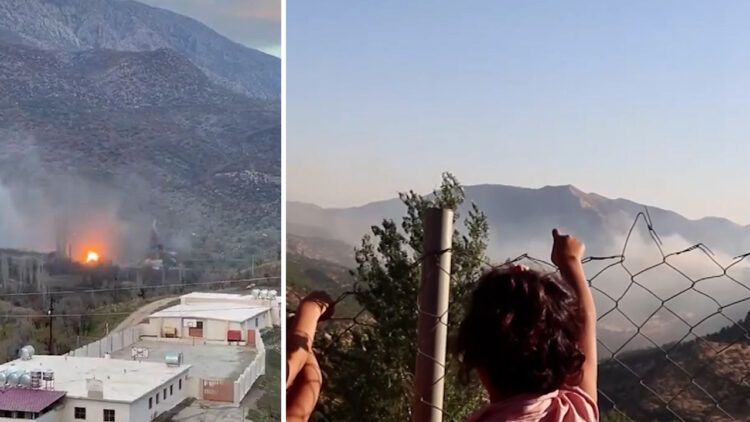
The Turkish army’s invasion of the Iraqi Kurdistan region has led to massive displacement and environmental destruction, particularly in the Penjwen (Pêncewîn) region. The bombings not only threaten forests but also cause anxiety among residents and deter tourists, leading to economic hardship.
Residents of Penjwen (Pêncewîn), situated 20 kilometres from Iranian Kurdistan’s (Rojhilat) Marivan, report that the attacks by the Turkish army and the state’s drones pose a substantial threat to the local environment. Consequently, environmental activists are urging the Kurdistan Regional Government (KRG) and the central government of Iraq to adopt diplomatic solutions to prevent the continuation of these attacks.
Speaking on this issue, Rebwar Kamal, the head of the Melkaw Environmental Organisation, told Roj News, “Large fires constantly threaten the forests of the Penjwen region, but a significant cause of these fires is the Turkish army’s bombings. These ongoing bombings have burnt and destroyed large parts of the forests in the region.”
Kamal highlighted that in some cases, the bombings have caused fires affecting areas of 8,000 to 10,000 dunams. The continuous nature of these bombings is a major concern for the residents of the region, making the silence of the KRG and the Iraqi central government notable. This has caused the residents to protest against this issue themselves.
In another statement, Amir Jamal, a resident of the Penjwen (Pêncewîn) region, mentioned that the bombings have caused anxiety among the residents and extensive environmental destruction, particularly to the region’s forests. Jamal noted that the bombings have deterred tourists from what has been a popular location, resulting in economic damage for the local residents.
Turkey’s invasion into Iraqi Kurdistan has caused considerable harm to the environment and its residents. Villagers from Duhok and Erbil have compared this devastation to the Anfal campaign.


