

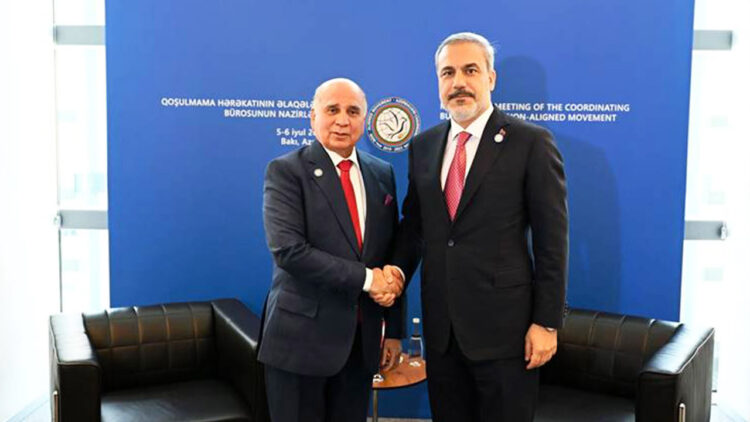
Ankara and Baghdad formalised a new security memorandum of understanding on 15 August, which includes the establishment of a joint operations centre at the Bashiqa (Başika) military base in Iraq’s Kurdistan Region, where Turkish forces have been stationed since 2015.
This agreement, supported by the Kurdistan Democratic Party (KDP), has led to significant debate, with critics questioning Iraq’s decision to deepen cooperation with Turkey instead of seeking the withdrawal of Turkish forces from its territory.
The details of the memorandum, made public on 21 August, outline a framework for enhanced military cooperation between Turkey and Iraq, focusing on joint training, counterterrorism and intelligence sharing. The agreement stipulates that the operations centre at Bashiqa will be managed by a joint committee comprised of senior officials from Turkey, Iraq and the Kurdistan Regional Government (KRG). This centre will coordinate military operations and serve as the main hub for intelligence collected from the border regions.
A crucial aspect of the agreement is its focus on combating “banned organisations,” a term used in the memorandum without specifying which groups are targeted. This language reflects Iraq’s recent decision to ban the Kurdistan Workers’ Party (PKK) from operating within its borders, recognising it as a security threat but stopping short of Turkey’s demand to categorise the group as a ‘terrorist organisation.’ Following this, Iraq also banned the Yazidi Freedom and Democracy Party (PADÊ) and other political groups linked to the PKK, underlining Iraq’s broader efforts to curb PKK influence in response to Turkish pressure.
This security memorandum is part of a broader strategy that was previously outlined in a 24-point agreement signed between Turkey and Iraq on 22 April. That earlier deal included joint security measures specifically targeting the PKK and proposed collaborative infrastructure projects. However, despite these recent bans, it remains unclear if Iraq has fully labelled the PKK as a proscribed organisation, even as its members are to be treated as political refugees under specific conditions.
The agreement has been met with criticism from Iraqi security experts and political commentators. Sefa Asim, an Iraqi security analyst, expressed concerns that the joint operations centre could facilitate further Turkish military expansion in Iraq, particularly within the Kurdistan Region. Speaking to Rojnews on Monday, Asim noted that “the security agreement signed between Iraq and Turkey is still incomplete, with several unresolved issues remaining on the table. Despite this, Baghdad is signing agreements with Turkey rather than focusing on removing Turkish forces from Iraqi soil.”
Asim pointed out that the establishment of a joint operations centre, as outlined in the agreement, is likely to serve as a control hub, further entrenching Turkey’s military presence in Iraq. He also highlighted the possibility that, in the near future, the Iraqi government could issue an order to withdraw Turkish forces from the Kurdistan Region, a move that has not yet been made but remains within Iraq’s potential capabilities.


