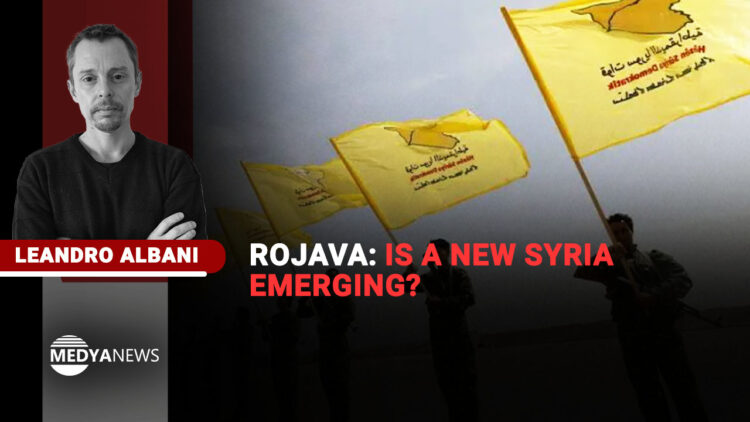
Leandro Albani
Thousands are celebrating the fall of Bashar al-Assad’s regime in Syrian Kurdistan (Rojava). Are they rejoicing because groups like Hay’at Tahrir al-Sham (HTS) have seized power in Damascus? Those familiar with the history of Kurdish-led struggle and resistance in North and East Syria know how distant their ideals are from those of HTS or similar factions, such as the Turkish-backed Syrian National Army (SNA).
The celebrations mark decades of resistance against the Ba’athist regime’s oppression, identity denial, imprisonment, torture and state-enforced poverty. They are the celebrations of comrades, brothers, sisters, mothers, spouses, grandchildren and other relatives of the 15,000 martyrs who stood against ISIS and achieved victory in 2019. These martyrs were Kurds, Arabs, Assyrians, Armenians, Turkmens, Muslims Christians and Yazidis.
There are plenty of challenges for the Autonomous Administration of North and East Syria (AANES), which grew from the roots of the Rojava revolution. Turkey seeks to dismantle this project that champions women’s rights, ecology, communal organisation and coexistence among diverse nationalities. New waves of conflict loom as the people of North and East Syria, with armed forces like the Syrian Democratic Forces (SDF), prepare to defend territory that has been liberated since 2012. This is a land where, for the first time in their history, they have been able to coexist and chart their own future.
But the threats are palpable. The Turkish state has already mobilised SNA mercenaries to attack the city of Manbij (Minbic) in a bid for illegal occupation. And the legacy of HTS stands in stark contrast to the principles embraced by the peoples of northeast Syria.
The coming days will be critical for this Kurdish-driven project, an unprecedented initiative in the Middle East. Remarkably, it finds its roots in the ideas of a man imprisoned and isolated for 26 years on Turkey’s İmrali Island, Abdullah Öcalan. Despite the bars separating him from his people, his philosophy transcends confinement, lighting the path toward a hopeful future.
Leandro Albani is an Argentinian journalist specialising in the Middle East and Maghreb, and author of several books on the Kurds, including ‘Revolution in Kurdistan’, ‘ISIS. The Army of Terror’, ‘Women of Kurdistan’ and co-author of ‘Kurdistan. Insurgent Chronicles’.