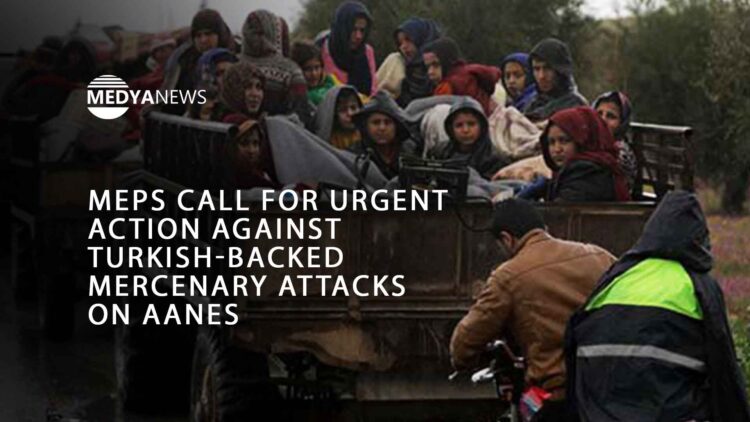
Raising alarm over escalating attacks in Syria by Hay’at Tahrir al-Sham (HTS) and the Turkish-backed Syrian National Army (SNA), co-chairs of the European Parliament’s Kurdish Working Group have issued a public letter to Kaja Kallas, the High Representative for Foreign Affairs and Security Policy of the European Commission on 5 December 2024.
The co-signatories, Andreas Schieder (Austria, S&D), Per Clausen (Denmark, The Left), and Leoluca Orlando (Italy, Greens), highlighted severe concerns about threats to the Kurdish-led Democratic Autonomous Administration of North and East Syria (AANES) and the broader implications for regional and international stability.
The parliamentarians described the AANES as a “beacon of democracy and peaceful coexistence” in a volatile region, commending its pivotal role in defeating ISIS at the cost of over 12,000 lives. However, they warned that ongoing operations by HTS and SNA aim to dismantle this fragile stability. “The operation against Assad, led by Al-Qaeda offshoot Hay’at Tahrir al-Sham (HTS), has been joined by Turkish-backed Jihadist mercenaries – the so-called Syrian National Army (SNA) – which is dedicated to destroying the Democratic Autonomous Administration,” the letter stated.
Three critical areas of concern
The MEPs identified three urgent issues requiring immediate EU action:
1. Humanitarian crisis in Tel Rifaat (Tal Rifat) and Shahba (Şehba):
The letter drew attention to the plight of approximately 120,000 internally displaced persons (IDPs) from Afrin,
forcibly displaced a second time by SNA attacks. The MEPs noted that these people, who fled Afrin’s occupation in 2018, are now scattered across Raqqa and other areas, in desperate need of humanitarian assistance.
2. Threats to 400,000 Kurds and minorities in Aleppo:
The Kurdish districts of Sheikh Maqsoud (Şêx Maqsud) and Ashrafiyah (Eşrefîye) in Aleppo, now home to many displaced Christians and other minorities, face siege by HTS and SNA forces. The letter warned of potential large-scale massacres, given the militias’ history of brutality.
3. Broader dangers to regional stability:
Turkey’s ongoing attacks on the Autonomous Administration and critical infrastructure pose long-term threats. “Turkey seeks to replace a region of peace and multi-ethnic friendship with a brutalised and intolerant version of Islamism,” the MEPs wrote. They also highlighted the risks posed by thousands of ISIS prisoners in the region, warning that these individuals could fuel a resurgence of extremism.
Call for EU action for Syrian Kurds and minorities
The signatories urged the European Union to take three decisive steps:
• Deliver urgent humanitarian aid to displaced populations.
• Pressure Turkey to rein in its militias and cease attacks on the Autonomous Administration.
• Adopt a firm stance against the crimes and instability generated by these groups.
“Silence in the face of these crimes and dangers is simply not an option,” the letter concluded, appealing to the EU to uphold its commitment to peace and human rights in the region.