Fréderike Geerdink
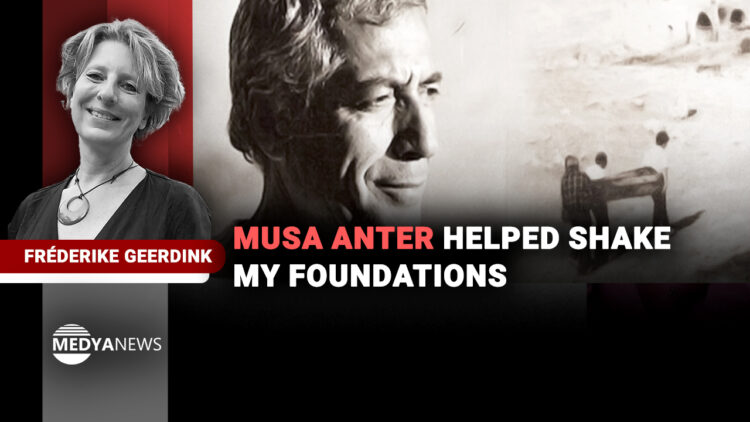
It is 32 years ago that Kurdish intellectual Musa Anter was murdered by the Turkish deep state. His memory lives on and his sharp vision on Turkey and the Kurds continues to shape new generations, and hopefully a freer future.
Musa Anter, known also as Ape Musa (Uncle Musa), was a writer, poet and journalist, and the founder of several Kurdish organisations, among which the Kurdish Institute in Istanbul. He dedicated his life to the freedom of the Kurds with his brave work, for which he first got into trouble already as a high school student. He was prosecuted and locked up again and again, but never wavered. He could have gone into exile, but he refused to, telling his family ‘Zilm ne qedere’, Cruelty is not fate.
Eventually, he paid with his life. On 20 September 1992, he was in Amed (Diyarbakır) for a cultural event. In the evening, he would go to a family dinner, but before that, he and politician Orhan Miroğlu were suddenly called and requested to mediate in a land dispute. They were picked up from their hotel and brought to the outskirts of the city, where Musa was killed and Miroğlu (who later became an AKP puppet) severely wounded.
Proper goodbye
It said something about Musa’s importance that absolutely nobody attended his funeral: the state didn’t allow it to be a proper goodbye, not even for his family, out of fear for it turning into the tribute Anter deserved. The same is inversely proportionally true for the way in which he is still commemorated every year ever since. He was well into his seventies when he was killed and that’s more than three decades ago, but his vision has lost nothing of the urgency it holds.
One of the things I learned from reading into his legacy, which I started doing when I became a freelance Turkey correspondent in 2006, revolved around the concept of ‘minorities’. As a white woman coming from a European country, I had never learned anything else than that countries have minorities and that they are assigned minority rights, depending on, amongst others, whether they are indigenous groups or migrant groups. Within that scope, I assumed that Kurds were an indigenous minority in Turkey, who needed to be assigned ‘minority rights’.
Separatism
But Kurds told me they didn’t consider themselves to be a minority. I didn’t understand that, as I thought they obviously were, not only in numbers but also, for example, linguistically. Besides that, Kurds lived in a specific part of the country. It only truly dawned on me what was meant when I read what Anter had said about the ‘separatism’ the Kurdish movement was accused of. He argued that no way were the Kurds separatist and no way would they want to create a state by chopping off a chunk of Turkey for their own. There were several reasons for that, but one of them was that he said that Kurds would never give up Istanbul and Izmir, and other cities. The Kurds had rights to those cities as well, for which they had also fought after the First World War, and where they had always lived and been part of the community. Kurds were, in other words, not a minority, but co-owners of the land.
This profoundly undermines the foundations of the nation-states as we know them, and the concepts I grew up with. Minorities are not something natural but instead the result of creating majorities and giving them supremacy over other groups. This majority’s language, culture, flag and what not, become the foundations of the state. Those who are not incorporated or forcibly assimilated into the majority identity, get the label ‘minority’, who are then granted ‘minority rights’. As icing on the cake, these minority rights are not considered to be the insult that they are but the pinnacle of civility. It’s absurd.
Mother tongue
Musa Anter summed it up brilliantly when he said: “When my mother tongue is shaking the foundations of your state, it probably means that you built your state on my land.” He shook the foundations of the state by thinking this radically different. He shook the foundations so profoundly, that he was not only murdered but also denied a proper burial. That nobody was allowed to attend his funeral, says something about how scared the state was of him and his legacy and his status in Kurdish society. And the fear and denial of his legacy continue till this very day. In 2022, the court case against his murderers and the deep state elements behind it expired due to the statute of limitations.
Musa Anter’s legacy lives on, and the big interest in his life and work and the significance of his commemoration every year, show how deep his impact has been. Anter also shook the foundations of my European outlook and I’m eternally grateful for that.
Fréderike Geerdink is an independent journalist. Follow her on Twitter or subscribe to her acclaimed weekly newsletter Expert Kurdistan.