Sütun 1
Sütun 2
Sütun 3
Medya News
Daily News
Breaking News
Subscribe
No Result
View All Result
  • Home
  • All News
  • Opinion
  • Kurdistan
  • Women
  • Politics
  • Human Rights
  • INTERVIEW
  • More
    • SPECIAL REPORTS
    • ECOLOGY
    • WORLD
    • AUDIO ARTICLES
    • JOURNALISM
    • ECONOMY
    • CULTURE & ART
    • LONG READS
    • NEWSLETTER
    • DAILY NEWS
MULTIMEDIA
PODCAST
LIVE BLOG
  • Home
  • All News
  • Opinion
  • Kurdistan
  • Women
  • Politics
  • Human Rights
  • INTERVIEW
  • More
    • SPECIAL REPORTS
    • ECOLOGY
    • WORLD
    • AUDIO ARTICLES
    • JOURNALISM
    • ECONOMY
    • CULTURE & ART
    • LONG READS
    • NEWSLETTER
    • DAILY NEWS
MULTIMEDIA
PODCAST
No Result
View All Result
Medya News

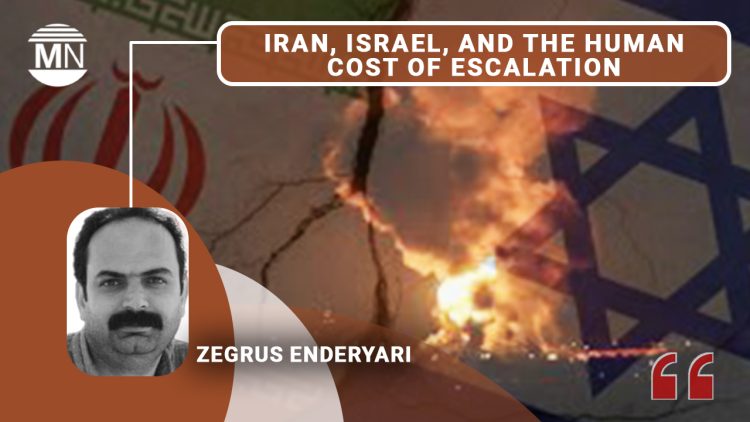
Iran, Israel, and the human cost of escalation

The Israeli airstrikes on Iran highlight the region’s deepening crisis, driven by Tehran’s repressive and aggressive policies. While Israel cites security concerns, its actions risk civilian lives. Ultimately, ordinary people—not political leaders—bear the brunt of escalating conflict and repression.

7:20 pm 13/06/2025
A A
Iran, Israel, and the human cost of escalation
Share post

Zegrus Enderyari

Following Israeli airstrikes on targets in and around Tehran on Friday morning, explosions and air raid sirens engulfed Iran and the wider region, sparking widespread anxiety. Israel described these strikes as a preemptive move against ‘escalating Iranian threats’, but they have once again pushed the Middle East to the brink of a devastating war.

Yet at the heart of this crisis lies a bitter and complex truth: while the Islamic Republic of Iran bears primary responsibility for fuelling tensions through its adventurous regional policies and internal repression, the ultimate victims of these decisions are not the commanders or policymakers, but ordinary people.

For decades, Tehran has prioritised expanding its regional influence through proxy forces rather than addressing domestic crises or responding to its citizens’ demands for freedom, justice and economic well-being. From supporting Hezbollah in Lebanon and Hamas in Gaza to arming militias in Iraq and Yemen, the Islamic Republic has established what it terms the ‘Axis of Resistance’ — a network that has, in practice, drawn Iran into deeper confrontation, heavier sanctions and growing international isolation.

The recent Israeli strike is a direct consequence of these policies: an opaque nuclear programme, growing distrust from the international community and inflammatory anti-Israel rhetoric, which have provided ample justification for military action.

However, Israel’s unilateral attack on another sovereign nation’s territory — even under the pretext of self-defence — is a dangerous and destabilising act. While Israeli officials claim the strike prevented an imminent threat, launching such an offensive without international approval undermines its legitimacy. Even more alarming is the fact that the airstrikes targeted densely populated civilian areas in eastern Tehran, home to thousands of innocent residents. This should be strongly condemned by the international community. Self-defence cannot be used as an excuse to endanger civilian lives.

Inside Iran, the situation is equally dire. The regime has used harsh repression, including mass arrests, widespread internet censorship, the silencing of civil society and political executions, to maintain its grip on power. Not only have citizens suffered the consequences of the regime’s costly foreign policy, they have also been deprived of basic freedoms and rights at home. While the state is pushing the country towards external conflict, there is no sign of accountability or willingness to change direction. The Iranian people neither shape the nuclear programme nor dictate regional strategy — yet they pay the ultimate price through sanctions, insecurity and, now, foreign military strikes.

There have been opportunities to reduce tensions. The Biden administration has repeatedly expressed a willingness to return to the 2015 nuclear deal (JCPOA), but Iran’s hardline demands and provocative actions, such as increased uranium enrichment and regional proxy attacks, have pushed negotiations into a dead end. Tehran’s reluctance to finalise any agreement appears to be rooted in fears that renewed diplomacy might create more freedom within the country, which could lead to broader calls for political change.

If the Islamic Republic were to opt for a full-scale military response, the likelihood of a regional war would increase dramatically. Retaliatory strikes by Iran and escalated responses by Israel could draw in third parties, especially the United States and Arab states, plunging the region into a catastrophic scenario. However, there is still an alternative: if Iran stops supporting armed groups, rejoins international agreements and allows space for reform at home, it may be possible to prevent the Middle East from sliding into war.

The current crisis has brought the region to a pivotal crossroads. Four major scenarios now appear most likely:

Continued low-scale conflict: Limited tit-for-tat strikes by Iran or its proxies, and Israeli responses, remain localised.
Wider war: Hezbollah enters the conflict and fighting intensifies in Lebanon and Syria. Other regional or global powers also become involved.
Return to Diplomacy: Mediation efforts by Oman, Qatar, China and Europe attempt to reopen channels and revive the nuclear deal.

Heightened domestic repression: Iran is exploiting the crisis to further suppress dissent and consolidate its internal control.
All of these paths have profound implications, but the real losers in each case are ordinary people, from Tehran to Haifa, Gaza to Beirut and Baghdad, not the politicians who orchestrate wars from their fortified offices.

Ultimately, the Islamic Republic bears primary responsibility for the current crisis, with its repressive domestic policies and reckless foreign agenda. However, the international community must ensure that the Iranian people do not bear the full cost of these decisions.

While Israel’s actions may be understandable from a security perspective, they must also be held accountable when civilian lives are put at risk. The Iranian people are weary of war and of a government that neither represents their will nor safeguards their well-being. They seek only a peaceful life, a brighter future and a government that answers to them.

However, if these voices continue to be ignored and the regime persists in its confrontational approach, a stable and peaceful future for Iran, Israel or the region as a whole will remain out of reach.


Share post
Tags: IranIsraeli airstrikesMiddle EastopinionTehranZegrus Enderyari

Related Posts

After the war the crackdown: in this week’s Kurdish news

After the war the crackdown: in this week’s Kurdish news

June 29, 2025
Turkey’s Pro-Kurdish DEM Party delegation engages US officials on peace, democratic reforms

Turkey’s Pro-Kurdish DEM Party delegation engages US officials on peace, democratic reforms

June 29, 2025
Sayın: Only Öcalan’s model can resolve war driven by corridor competition

Sayın: Only Öcalan’s model can resolve war driven by corridor competition

June 29, 2025
EPF condemns repression of activists in Iran; Reports highlight heavy impact on Kurds

EPF condemns repression of activists in Iran; Reports highlight heavy impact on Kurds

June 28, 2025
Îkram Balekanî: ‘The key to resolution in Iran is democratic confederalism’

Îkram Balekanî: ‘The key to resolution in Iran is democratic confederalism’

June 26, 2025
No time to wait—Parliament must launch Kurdish peace talks while wars rage, says DEM’s Hatimoğulları

No time to wait—Parliament must launch Kurdish peace talks while wars rage, says DEM’s Hatimoğulları

June 24, 2025

The news content on our website cannot be quoted without permission, even by citing the source. It cannot be copied or published elsewhere, contrary to the law or without permission.

Follow Medya News

Categories

  • All News
  • Politics
  • Human Rights
  • Opinion
  • Kurdistan
  • Human Rights
  • Interview
  • Women
  • Audio Articles
  • Special Report

Quick Menu

  • Daily News
  • Live Blog
  • Podcast
  • Videos
  • Breaking News

About

Impressum

About us

Privacy Policy

Welcome Back!

Login to your account below

Forgotten Password?

Retrieve your password

Please enter your username or email address to reset your password.

Log In
We use cookies on our website to give you the most relevant experience by remembering your preferences and repeat visits. By clicking “Accept All”, you consent to the use of ALL the cookies. However, you may visit "Cookie Settings" to provide a controlled consent.
Cookie SettingsAccept All
Manage consent

Privacy Overview

This website uses cookies to improve your experience while you navigate through the website. Out of these, the cookies that are categorized as necessary are stored on your browser as they are essential for the working of basic functionalities of the website. We also use third-party cookies that help us analyze and understand how you use this website. These cookies will be stored in your browser only with your consent. You also have the option to opt-out of these cookies. But opting out of some of these cookies may affect your browsing experience.
Necessary
Always Enabled
Necessary cookies are absolutely essential for the website to function properly. These cookies ensure basic functionalities and security features of the website, anonymously.
CookieDurationDescription
cookielawinfo-checkbox-analytics11 monthsThis cookie is set by GDPR Cookie Consent plugin. The cookie is used to store the user consent for the cookies in the category "Analytics".
cookielawinfo-checkbox-functional11 monthsThe cookie is set by GDPR cookie consent to record the user consent for the cookies in the category "Functional".
cookielawinfo-checkbox-necessary11 monthsThis cookie is set by GDPR Cookie Consent plugin. The cookies is used to store the user consent for the cookies in the category "Necessary".
cookielawinfo-checkbox-others11 monthsThis cookie is set by GDPR Cookie Consent plugin. The cookie is used to store the user consent for the cookies in the category "Other.
cookielawinfo-checkbox-performance11 monthsThis cookie is set by GDPR Cookie Consent plugin. The cookie is used to store the user consent for the cookies in the category "Performance".
viewed_cookie_policy11 monthsThe cookie is set by the GDPR Cookie Consent plugin and is used to store whether or not user has consented to the use of cookies. It does not store any personal data.
Functional
Functional cookies help to perform certain functionalities like sharing the content of the website on social media platforms, collect feedbacks, and other third-party features.
Performance
Performance cookies are used to understand and analyze the key performance indexes of the website which helps in delivering a better user experience for the visitors.
Analytics
Analytical cookies are used to understand how visitors interact with the website. These cookies help provide information on metrics the number of visitors, bounce rate, traffic source, etc.
Advertisement
Advertisement cookies are used to provide visitors with relevant ads and marketing campaigns. These cookies track visitors across websites and collect information to provide customized ads.
Others
Other uncategorized cookies are those that are being analyzed and have not been classified into a category as yet.
SAVE & ACCEPT

Add New Playlist

Contact

[contact-form-7 id=”18690″ title=”Contact form 1″]

[email-subscribers-form id=”1″]

No Result
View All Result
  • All News
  • Kurdistan
  • Women
  • Politics
  • Human Rights
  • Interview
  • Long Reads
  • World
  • Journalism
  • Ecology
  • Economy
  • Culture & Art
  • Daily News
  • Breaking News
  • Newsletter
  • Opinion
  • Authors
  • Podcast
  • LIVE BLOG

© 2020 Medyanews. All Rights Reserved