Fréderike Geerdink
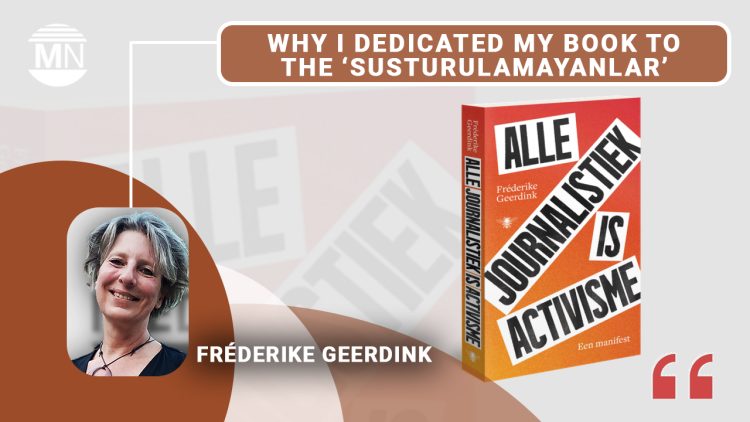
This week, my new book is being published in the Netherlands. It’s called “Alle journalistiek is activisme” (All journalism is activism), and it’s a manifesto for better journalism. And who were part of my journey to improve my journalism and eventually write this book? The so-called ‘susturulamayanlar’, which is Turkish for ‘those who cannot be silenced’. Kurdish journalists working for Kurdish media. I wouldn’t be doing what I do today without them.
My book is a manifesto, but also a journalistic autobiography. I didn’t start out, back in the early 1990s, as the journalist that I am today. What the susturulamayanlar helped me do, was reflect on my position. My position towards power, to be precise. They helped me to see that if you look at society through the eyes of those who have no institutional power, you see a very different society then when you are part of the dominant group. They forced me, in other words, to check my privilege. In the Netherlands and in the western world in general, you are trained to be an ‘objective’ journalist. That objectivity doesn’t exist, is acknowledged to a certain extent, but still, you have to ‘strive’ to be objective. I was still in journalism school when I started freelancing for a local newspaper. Even though I had wished to become a journalist as an idealistic rebellious teenager who wanted to change the world, I was soon moulded into the right shape to become a journalist for established media.
Perspective
I was a (women’s) health journalist in staff jobs for quite a few years, started freelancing in 2000 and decided to become a freelance correspondent in 2006. That’s the year I moved to Turkey. The Kurdish issue was on my radar from the beginning, but from the perspective that most western journalists approach it. Which is basically that yes, Kurds are being denied rights but on the other hand, Turkey is fighting a group that is designated as a terrorist organisation by much of the western world. From Istanbul, I followed the Kurdish media, but I took them with a grain of salt. Surely, I thought, their stories about police violence, about detentions of people who had engaged in non-violent activism, about unfair trials and what not, must be exaggerations. Or maybe there was truth to it, but we must hear the other side too, right? They were, I concluded, not objective journalists, but behaved more like activists for the Kurdish cause.
It all started changing when I decided to dive deeper into the Kurdish issue. This was in early 2012, when Roboskî massacre happened. In that massacre, on 28 December 2011, the Turkish army had bombed 34 boys and men to death who had been smuggling goods across the Iraqi-Turkish border. Later in 2012, I moved to Amed (Diyarbakır) to be closer to the village where most of the victims were from to be able to do my work more practically. Little did I know that it would be radically change my journalism – and my life, for that matter.
Teargas
I spent a lot of time in the village, lived in this mega city, and travelled around Kurdistan to report all kinds of stories. And often, I attended demonstrations, commemorations, funerals and celebrations that the Kurdish press also reported on. One of the first was the funeral of two PKK fighters in Amed. While the crowd was waiting for the family and the bodies to leave the mosque so the march to the graveyard could start, the police suddenly started firing teargas. Out of nowhere, unprovoked. I read the report the next day in one of the Kurdish papers, and it was exactly written how it had happened. I had seen it with my own eyes.
Of course, the Kurdish papers couldn’t go to any state institution for a ‘right to reply’, the journalistic rule that you ask for a comment of the person you accuse of something. The police would detain or prosecute them. The Kurdish media were just reporting what happened. And their network in Kurdistan was so extensive, that they always had their own eyes directly on the stories. What were their sources? Well, their own eyes, always.
Slogan
Truth is what journalism should be about, and honesty, and about holding power to account. I learned that you better listen very, very carefully to people in marginalized positions, because they know power very well. When I asked people in Roboskî why they thought the massacre had happened, they said: “Because we are Kurds”. My task as a journalist, I learned while doing my investigation, was to figure out why they said that, and not to shove it aside as a simplistic and dramatic slogan. I discovered, by diving into the circumstances of the massacre and the history of Kurds in Turkey, that actually, “Because we are Kurds” was a very profound truth.
I left my role as a ‘detached watchdog’ behind me, and switched to being a journalist who is an ‘advocate for social change’. It should be the default setting of every journalist, I deeply believe. Some colleagues in the Netherlands now see me as an ‘activist’ instead of a journalist, but they don’t see that their journalism actually serves power. Just like my journalism had done for so many years.
The susturulamayanlar had known this since the day they were born as Kurds and decided to dedicate their lives to journalism. I salute them for their professionalism and bravery. I wish all journalism was so brave.
Fréderike Geerdink is an independent journalist. Follow her on Bluesky (or X) or subscribe to her acclaimed weekly newsletter Expert Kurdistan.