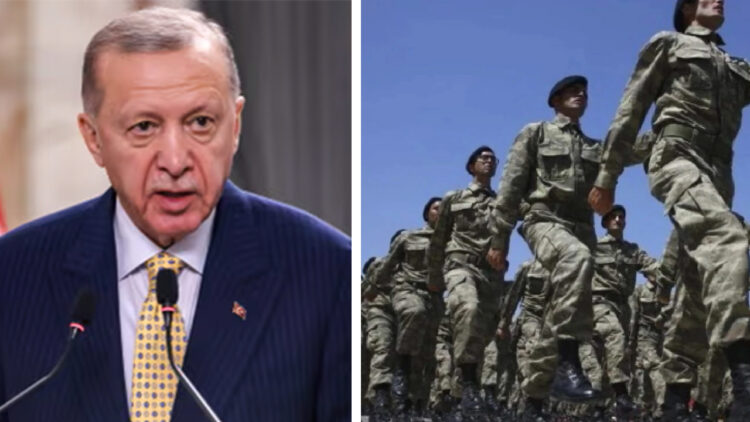
Turkey’s newly enacted Mobilisation and State of War Regulation, which centralises the authority to declare mobilisation and a state of war under President Recep Tayyip Erdoğan, continues to face significant criticism.
Erdoğan was given sole power to declare mobilisation and a state of war by decree, as published in Turkey’s Official Gazette on 22 May. The new regulation allows the president to declare mobilisation not only in the event of war, but also in cases of “rebellion, a strong and active uprising against the nation or the republic, or behaviour that endangers the unity and integrity of the country and the nation”, further consolidating his executive powers.
Sezai Temelli, deputy leader of the country’s pro-Kurdish Peoples’ Equality and Democracy Party (DEM), criticised the regulation, describing it as an extension of the State of Emergency intended for exceptional use only.
“The only way to maintain this system is to maintain a system of oppression. How can you prevent democratic demands from being expressed? By imposing a state of emergency. This is nothing but the widespread application of this exceptional state,” Temelli said.
Furthermore, he added that the absolute and prolonged isolation imposed by Turkish authorities on Kurdish leader Abdullah Öcalan in İmralı Prison was the basis for the normalisation of an extended state of emergency.
Veysel Keser, the deposed Peoples’ Democratic Party (HDP) mayor in exile, emphasised that Erdoğan has effectively used his own signature to transfer authority over mobilisation and the state of war to himself.
“The normal principle of the separation of powers – legislative, executive and judiciary – has already been delegated to the one-man regime,” Keser said. However, this was still not enough for Erdoğan’s purposes, “So he once again uses his own signature to transfer the power to declare mobilisation and a state of war to himself.”
“What does this imply? […] Serious war plans are being drawn up. A regional war is being mooted,” Keser added, noting that consolidating power under Erdoğan facilitates the economic planning of war efforts, including the allocation of private and public resources to war.
Former HDP MP Nursel Aydoğan pointed to the timing of the regulation, noting that it comes after residents of Van (Wan) launched a successful popular resistance in response to the electoral board’s overturning of results during local elections in the city on 31 March. Erdoğan’s ruling alliance suffered a historic defeat at the polls.
“The timing of the decree is significant. They thought they had completed their purge, but the Van resistance must have disturbed Erdoğan enough to put this law on the agenda,” Aydoğan said. She also pointed out that the Van resistance follows a series of uprisings in Turkey, including the Gezi Park protests and other Kobani (Kobanê) demonstrations related to an eight-year high-profile court case which drew a verdict on 16 May.
Observers continue to warn that the changes undermine democratic principles and checks on executive power in Turkey. Erdoğan’s extended powers raise questions over his leadership and the future trajectory of Turkish politics, with fears of a further erosion of democratic norms and a concentration of power in the presidency.