

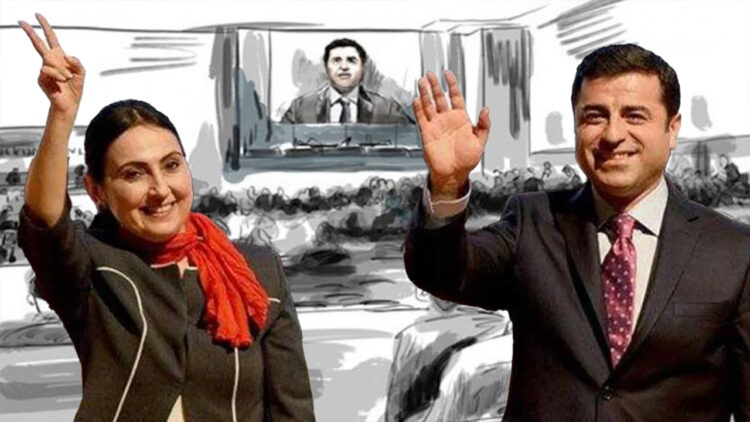
The eight year long Kobane conspiracy trial has seen former Peoples’ Democratic Party (HDP) co-chairs Selahattin Demirtaş and Figen Yüksekdağ, along with other Kurdish politicians, imprisoned since 2016. Today the panel of judges reached a decision in the case. The sentences are as follows:
– Selahattin Demirtaş: Sentenced to a total of 42 years in prison. The extensive range of sentences include 20 years for “disrupting the unity and integrity of the state” to 4 years and 6 months in prison for “inciting an offence”. Demirtaş also received 2 years and 6 months for his speech at Newroz (Kurdish New Year) on 21 March 2016 and to 1 year and 6 months for “inciting people to disobey the law” in his speech in Diyarbakır (Amed) on 29 February 2016. The court ordered that his detention should continue.
– Figen Yüksekdağ: Sentenced to a total of 32 years and 9 months.
– Ahmet Türk: Sentenced to 10 years in prison for “membership of a terrorist organization”.
– Ali Ürküt: Aggravated life imprisonment sentence of 13 years and 4 months. He will remain in prison.
– Alp Altınörs: Sentenced to 18 years for “disrupting the unity and integrity of the state. He was also sentenced to 4 years and 6 months in prison on the charge of “incitement to commit a crime”.
– Altan Tan: Acquitted.
– Ayhan Bilgen: Acquitted.
– Ayla Akat Ata: Sentenced to 6 years and 6 months in prison for “membership in an illegal organisation”.
– Aynur Aşan: Sentenced to 9 years imprisonment for “membership in an illegal organisation”. It was decided that she should remain in prison on the grounds of risk of escape.
-Aysel Tuğluk: Acquitted of the charge of “disrupting the unity and territorial integrity of the state”.
– Ayşe Yağcı: Sentenced to 9 years in prison for “membership in an illegal organisation”. She was released.
– Bülent Parmaksız: Sentenced to 16 years. He was sentenced to a further 4 years and 6 months for “incitement to commit a crime”.
– Bircan Yorulmaz: Acquitted
– Berfin Özge Köse: Acquitted
– Can Memiş: Acquitted
– Dilek Yağlı: Sentenced to 16 years. She was sentenced to a further 4 years and 6 months for “incitement to commit a crime”. She will remain in prison.
Emine Ayna: Sentenced to 10 years in prison. A ban on leaving the country was also imposed.
– Beyza Üstün: Acquitted of “disrupting the unity and integrity of the state”.
– Cihan Erdal – Sentenced to 16 years.
– Gülfer Akkaya: Acquitted of “disrupting the unity and integrity of the state”.
– Gültan Kışanak: 12 years in prison for “membership in a terrorist organisation”. The court ordered that she be released.
– Günay Kubilay: Sentenced to 16 years in prison. He was sentenced to 4 years and 6 months in prison on the charge of “incitement to commit a crime”. He will remain in jail.
– İsmail Şengül: Sentenced to 16 years in prison. He will remain in jail.
– Meryem Adıbelli: Sentenced to 9 years in prison. The court ordered her release.
– Mesut Bağcık: Sentenced to 9 years in prison.
– Nazmi Gür: Aggravated life imprisonment of 18 years. Also sentenced to 4 years and 6 months in prison for “incitement to commit an offence”.
– Nezir Çakan: Sentenced to 9 years for ‘membership in an illegal organisation’.
– Pervin Oduncu: Aggravated life sentence of 18 years imprisonment. The court ordered continued detention.
– Sebahat Tuncel: Sentenced to 12 years for “membership in an illegal organisation”. The court ordered her detention to continue.
– Sibel Akdeniz: Acquitted
– Sırrı Süreyya Önder: Acquitted.
– Zeki Çelik: Sentenced to aggravated life imprisonment of 18 years for “disrupting the unity and integrity of the state. He was also sentenced to 4 years and 6 months for “incitement to crime”.
– Zeynep Karaman: Life imprisonment of 18 years for “disrupting the unity and integrity of the state”. She was sentenced to 4 years and 6 months imprisonment on the grounds of “incitement to crime”.
– Zeynep Ölbeci: Sentenced to a total of 12 years and 9 months in total for “disrupting the unity and integrity of the country” and “membership in an illegal organisation”. The court ordered the continuation of her detention.
Several more people were acquitted of causing loss of life, and it was decided that some of the cases not yet dealt with should be separated off to be dealt with individually.
HDP’s successor, the People’s Equality and Democracy (DEM) Party, posted on social media: “The penalties given to our friends held hostage in the Kobani Conspiracy Case cannot deter us.” The DEM Party took over from the HDP as the pro-Kurdish political party after the Turkish state began proceedings to close down the HDP.
Newroz Uysal Aslan, tha DEM party representative for Şırnak (Şırnex) posted on X: “The last word is to those who resist, and the people”, while DEM Party spokeswoman Ayşegül Doğan said: “Regardless of the decision, we will not abandon democratic politics. Those who insist on democratic politics are feared. Those who imprison our friends are the ones who want to keep this country in darkness.”
The Lawyers for Freedom Association posted on X: “We are leaving the courtroom with applause and slogans to protest the unlawful verdict announced against the politicians being tried in the Kobanî Conspiracy Case.”
The Democratic Regions Party, one of the parties targeted in the conspiracy case, posted a defiant statement on X: “The penalties given to our friends in the Kobanê Conspiracy Case cannot make us step back from democratic politics and the search for peace and freedom. We will not give up, those who made this decision and of course those who made it happen will be remembered with shame in the pages of history.”
Follow updates from the trial via the HDP’s twitter feed here.
The prosecution relates to the events of 6-8 October 2014, when the city of Kobane in northern Syria was besieged by ISIS forces. The Turkish government was preventing aid from reaching Kobane, and people in Southeast Turkey held demonstrations in solidarity.
Anger spilled onto the streets after the then prime minister Recep Tayyip Erdoğan stated that “Kobane is about to fall” in a speech. 48 people were killed in the violence that ensued. The majority of those who died were supporters of the HDP. Perversely, it is the HDP and its supporters that has faced almost a decade of prosecution and repression as a result.
In 2016, an anti-democratic constitutional amendment revoked the parliamentary immunity of MPs. This paved the way for the arrest and prosecution of Demirtaş, Yüksekdağ and their co-defendants, many of whom would previously have had protection from prosecution. Several separate proceedings were combined, to create a wide ranging conspiracy prosecution.
he trial has been widely criticised as an attempt to stifle democracy in Turkey, and a key part of the Turkish state’s strategy to close down the HDP. In 2021 the European Parliament urged Turkey to release Demirtaş, calling his continued imprisonment “cruel and politically motivated punishment”.
The verdict in the Kobane Trial was scheduled to take place last month, but it was delayed without proper explanation. Commentators surmised that the Turkish state had engineered the postponement, in order to avoid criticism of Turkey’s human rights record, ahead of Recep Tayyip Erdoğan’s scheduled visit to Washington. The President’s visit to the US has since been cancelled, likely over Erdoğan’s policy clashes with the US on Ukraine and Palestine.


