

Sarah Glynn
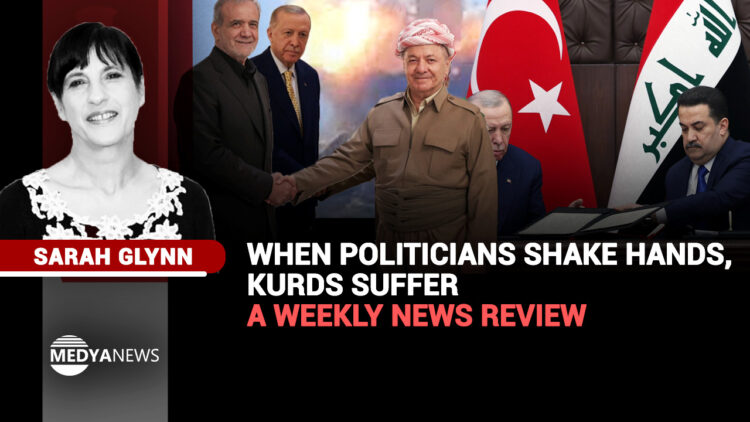
Recently, there have been a lot of pictures of Iraqi politicians shaking hands. Experts are still debating the significance of the recent memorandum with Turkey, and Iran’s newly elected president has visited Baghdad, where he has signed fifteen co-operation agreements with Iraq. These are a product of the 2021 security agreement between the two countries, and “security” was a central focus. Such agreements are rarely good news for Kurds.
Both Turkey and Iran are hostile to the Kurds; and America’s war and its aftermath has left the Iraqi government weak and ready to appease Turkey and Iran at the Kurds’ expense.
Iraq and Turkey
In March, the Iraqi government announced a ban on the Kurdistan Workers’ Party (PKK) – though they stopped short of declaring it a terrorist organisation as Turkey wanted. This was followed by a visit to Baghdad by Turkish President Erdoğan in April, and the signing of a memorandum of agreement with Turkey that includes the development of a major new trading route from the southern port of Basra to Turkey in the north, as well as plans for shared “security”. “Security” in Turkey’s book means destruction of independent Kurdish consciousness and organisation. The agreement affectively formalises Turkey’s military presence in Iraq.
Not everyone is happy with this, notably Iraq’s Asa’ib Ahl al-Haq movement – which is close to Iran and part of the dominant Shiite Coordination Framework, and which calls for complete Turkish withdrawal from their military bases in Iraq – and the Iraqi president – who is a member of the Patriotic Union of Kurdistan. The president similarly condemns Turkey’s attacks, and argues that Turkey must resolve its internal conflict with the PKK through dialogue.
However, the objectors must be well aware that Iraq has few bargaining counters, especially as Turkey controls access to their vital river waters. While the Turkish military has taken effective control of an increasing proportion of the northern mountains, the Iraqi government has never done anything more than issue protests. Now they don’t even do that.
As part of their ongoing intense military attacks in the areas of Iraqi Kurdistan that are effectively controlled by the PKK, Turkey has deliberately driven away the local population and laid waste to forests and agricultural holdings. Turkey has also attempted to interfere in Iraqi politics, promoting the Turkmen parties as well as creating a vassal role for the Kurdistan Democratic Party; and they have repeatedly bombed civilians in the Yazidi region of Sinjar (Şengal) and in Makhmour refugee camp.
Turkey bombed Makhmour again this week, injuring three women. Makhmour was established by families who escaped the destruction of Kurdish villages in Turkey in the 1990s, and now houses some 12,000 people. The camp is run autonomously through bottom-up democracy, according to the philosophy of Abdullah Öcalan. The injured women were members of the Peace Mothers movement, dedicated to a peaceful future for Kurds and Turks, and were sitting outside the Peace Mothers’ building when it was targeted by a Turkish drone. Roj News recalls that Makhmour has now been bombed thirteen times in the last five years; and drones frequently circle overhead to ensure the residents can never relax. The PKK had guarded the hills round the camp since fighting back the advance of ISIS, but they left last autumn. This last attack took place while officials from the United Nations and the Iraqi Government were in the camp carrying out a census and administering ID cards and rations.
Iraq and Iran
Iran’s new President, Masoud Pezeshkian, went to Baghdad on Wednesday, and visited Erbil (Hewlêr) and Sulaymaniyah (Silêmanî) on Thursday. In his meeting with the president of Iraq, he proposed a union of Islamic countries, similar to the European Union.
For Iran, a particular focus of concern is control over the Iranian Kurdish parties that have long taken refuge in Iraq. In September 2022, at the time of the uprising following the death of Jina Amini, Iran bombed some of their camps, and they threatened to attack again if the camps were not disbanded. In March 2023, Iran and Iraq signed an agreement to keep the border free of the Kurdish political parties, and these have been disarmed and relocated to camps in Erbil and Sulaymaniyah. Now, it is reported that Iran is working with Iraq and the United Nations to find a third country to host them. The only Iranian Kurdistani party immune to this is the Kurdistan Free Life Party (PJAK), which, like their sister party, the PKK, operates from remote guerrilla bases in the mountains, and doesn’t allow its members to have families and a domestic life. At the same time, Iran is attempting to draw the two parties that dominate the politics of the Kurdistan Region of Iraq closer to the Iranian political perspective. Mohammad Khakpour, the Commander of Ground Forces of the Revolutionary Guard Corps, is reported as describing the security agreement as “the greatest victory of the Islamic Republic”.
Iran also has control over river water entering Iraq, and despite having close allies in the Iraqi government, has built large numbers of dams to retain the water in recent years.
The role of the KDP
These agreements are bad news for Kurdish revolutionaries, but for the feudal politicians of the Kurdistan Regional Government, they are a source of opportunity. For the Barzani family, who control the Kurdistan Democratic Party (KDP), personal power and wealth is achieved through subservience to Turkey. Despite portraying themselves as the fathers of Kurdish autonomy, they are helping Turkey occupy large parts of the region. They are even doing this as Turkey imports Islamist mercenaries into the region. They are also building ties with Hüda-Par, the reactionary Islamist Kurdish party that is allied to Recep Tayyip Erdoğan’s Justice and Development Party (AKP); and Hüda-Par has recently opened an office in the Kurdistan Region. Hüda-Par evolved from the Turkish Hizbullah (no relation to the Lebanese party), which was responsible for murders of Kurds and Leftists in the 1990s.
Ronahî TV has begun a series looking at the confessions of spies who have been sent into North and East Syria by the intelligence services of Turkey and the KDP, and been arrested by the Autonomous Administration. Reports from these spies, and others like them, have helped Turkey carry out targeted assassinations.
The Geography of the KDP-controlled area allows them to put a stranglehold on North and East Syria by closing or restricting the one crossing that connects it to the world beyond Syria. Last weekend they even prevented the entry of international musicians who had come to play in a festival in Ayn al-Arab (Kobanê).
Turkey in Syria
In North and East Syria itself, Turkey’s attacks never stop. The small part of Afrin (Efrîn) Canton not occupied by Turkey, and the Shahba (Şehba) Canton, which houses the people displaced from occupied Afrin, are both regular targets of Turkish bombardment, which ensures that the residents can never enjoy normal lives. Last week, Turkish attacks fatally wounded a man in Afrin, and injured a woman and two young children in Shahba.
Turkish shelling in villages east of Tell Abyad (Girê Spî) destroyed pipes to a water pumping station that supplied fifty villages – a further example of Turkey’s targeting of basic infrastructure.
The Manbij (Minbic) area is also a favourite target of Turkey’s attacks. It came under attack from Turkey’s mercenaries again last week, but this was successfully repelled by the Autonomous Administration’s Syrian Democratic Forces (SDF), leaving eight mercenaries dead.
The latest report on Syria by the UN’s Syria Commission has criticised Turkey for carrying out illegal attacks against the Kurds. This hasn’t prevented Norway from announcing that they are lifting their ban on arms exports to Turkey, which was instituted when Turkey invaded Syria in 2019.
Erdoğan would like to mend relations with President Assad, and for Turkey to make an agreement with Syria that would see the two countries combine together against the Autonomous Administration; but Assad, strengthened by Russia’s backing, refuses even to meet the Turkish president until Turkey gives plans to withdraw from the parts of Syria they currently occupy. On Tuesday, when Turkey attended the meeting of the Arab League for the first time in thirteen years, the Syrian delegation walked out when Turkey’s foreign minister began his speech.
ISIS
Turkey’s attacks perpetuate the instability and uncertainty that helps ISIS find support, while the Turkish occupied areas provide a sanctuary for Islamist militants of all kinds. In the Deir ez-Zor (Dêrazor) region, instability is ensured by militias supported by the Syrian Government and Iran.
On Monday, the SDF announced the capture of two ISIS militants in the Hasakah (Hesekê) countryside. On Tuesday, two men on a motorbike, presumed to be members of ISIS, attacked oil tankers in Deir ez-Zor. On Wednesday ISIS attacked a Syrian army post, killing one soldier and injuring two more.
The child murder that is gripping Turkey
Meanwhile, Turkish news has been dominated by the murder of eight-year-old Narin Güran, who disappeared after a Quran class in her Diyarbakır (Amed) village on 21 August, and whose body was found in a weighted-down sack in a nearby stream last Sunday. Even before this gruesome discovery, her uncle, Salim Güran, the village headman, had been arrested and accused of her murder. After the discovery, 24 people were detained, and questions are being asked about the earlier death of Narin’s sister. A neighbour has confessed to hiding the body, claiming that the uncle had threatened to kill him and his family if he did not do so. By the time of writing (Friday afternoon), the total number of suspects arrested had reached ten: the uncle and neighbour, Narin’s mother and brother who are accused of participating in the murder, and six others – including another uncle and cousins – accused of destroying evidence.
Stories of missing children always gather interest – or at least some do, the ones that are picked up by the media – and the tragic search for Narin would have caught public attention anywhere. But this is Turkey, and Narin was Kurdish, so her fate inevitably has a political dimension.
In a situation where judicial processes are hugely politicised and the lives of Kurdish children are often treated as though they were of no value, any failures of the search procedure, or any withholding of information or restrictions on access, is naturally regarded with suspicion. There has been no shortage of grounds for concern on those counts – and this case has a further dimension that has set alarm bells ringing and theorists theorising.
Narin’s family and village are conservative and religious and have links with Hüda-Par. There is talk of possible coverups to protect members of the political-religious establishment. There have been big demonstrations in various cities calling for justice and blaming the government for neglecting child protection. Even if it transpires that there is no political element to this murder, it demonstrates the systemic distrust sown by political meddling in the judiciary.
Everyone is now keen to claim Narin – from Erdoğan downwards. He has promised to “pray for God’s mercy on our girl Narin”, even as his forces continue to bomb Kurdish civilians in Iraq and Syria.
On Tuesday, Salim Güran’s lawyer withdrew from the case, stating that, “as a mother, I am no longer able to defend him”. While this feeling is very understandable, Salim Güran needs a defence if there is to be a fair trial, which is why in some legal systems, such as that in the UK, barristers do not have the option of turning down a client.
Jina Amini – two years on
Monday will be the second anniversary of the death of Jina Amini at the hands of Iran’s “morality police”. The Iranian government is preparing for the day by increasing the military presence in her home town, as well as continuing their arrests of Kurdish and other activists. Jina’s family has publicised their intention to hold a commemoration of the death of their daughter tomorrow. When they attempted this last year, police blocked all access to the cemetery. Political parties and civil organisations have called for a general strike tomorrow to shut down workplaces and markets and continue the resistance begun two years ago.
Defending Öcalan’s human rights
Also on Monday, a press statement in Brussels will formally publicise the actions of over 1500 lawyers in over thirty countries, who have applied to visit Abdullah Öcalan and end his 3 ½ year isolation in İmralı Prison. And on Tuesday, the Council of Europe’s Committee of Ministers will finally discuss how to respond to Turkey’s failure to comply with the ruling from the European Court of Human Rights that Öcalan’s life imprisonment without possibility of parole breaches his fundamental “right to hope”. No one can have much faith in the efficacy of our international bodies composed of self-interested nation states, but Kurds have been lobbying hard to make the ministers realise the importance of this opportunity for them to say that – this time, at least – Turkey will not be allowed to get away with impunity.
Sarah Glynn is a writer and activist – check her website and follow her on Twitter


