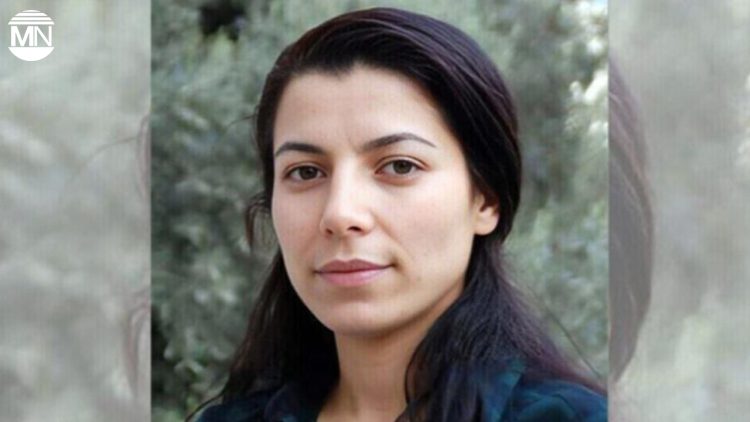
Warisheh Moradi, a Kurdish woman prisoner held in Iran’s infamous Evin Prison and sentenced to death, published a letter on 28 January, reaffirming her unwavering determination to resist. In previous letters from Evin, Moradi has spoken of the mental and psychological torment she has endured for over a year, a consequence of her time in Evin, the brutal interrogations, and the injuries sustained during the battle against ISIS in Kobani.
In her letter, Moradi discusses her death sentence and its broader implications for political prisoners in Iran. She describes the sentence as part of a wider state effort to suppress dissent, stating that she and her fellow imprisoned women represent a broader community facing repression. Moradi references the “No to Execution” campaign, a movement taking place in various Iranian prisons to oppose the death penalty, and highlights acts of civil resistance, such as a recent strike in Kurdistan. She asserts that her imprisonment is tied to a larger struggle against systemic deprivation and human rights violations in Iranian prisons.
Moradi situates her case within a historical and political context, discussing the role of Kurdish women in resistance movements, including their participation in the battle for Kobani. She describes gender inequality as a central issue in social struggles and argues that women’s rights are integral to broader movements for justice. She also refers to past geopolitical events, such as the Sykes-Picot and Lausanne agreements, as shaping the challenges faced by Kurdish communities. Moradi concludes by stating that opposition to her sentence is part of a larger struggle for human rights and social change, emphasising the importance of continued resistance.
A translated copy of Moradi’s letter follows:
The death sentence has been issued for me—for “us”! We, that is, a part of the imprisoned women fighters! My comrades and I have received this sentence on behalf of a community. This is actually a dream that they have seen for the entire community: the Islamic Republic’s government has embarked on a course of suppression (read: execution) of the people. Yet, resistance is inevitable. Domestic and international support has expanded to overturn the death sentences, a tremendous source of strength for us. Internally, we have not yielded to the pressure or the baseless accusations of the “security apparatus”—we have resisted. The community stands with us, and this solidarity is a vital manifestation of the ongoing civil struggle against the oppressive machinery of the state in Iran. The recent strike by the people of Kurdistan was another powerful expression of this civil resistance and deserves great recognition.
Inside prison, struggle and resistance form the very foundation of our existence. Resistance takes precedence, while national and political affiliations remain secondary. Our defiance—an authentic act of resistance—transcends mere awareness of prisoners’ fundamental issues; it assumes a deeper dimension. In response to systemic deprivation and the relentless violation of human rights in Iranian prisons, an unparalleled resistance has emerged—one in which we are actively engaged. As imprisoned women, our resistance simultaneously exposes the dual oppression of a patriarchal and misogynistic system and embodies our unwavering determination to attain freedom.
Every Tuesday, the “No to Execution” campaign unfolds across various prisons in Iran—a unifying act that underscores the fundamental and humane essence of our resistance. This campaign is a “public demand” that asserts the right to life and calls for the abolition of the death penalty in Iran. “No to Execution Tuesdays” is a collective assertion of human values, a direct counterforce to state-sanctioned killings designed to instil fear and terror in society. The issuance of death sentences is a profound injustice, the product of an unrestrained system on a path to destruction—one whose ultimate consequence is the decline of humanity itself. Thus, our struggle is not merely a defence of society but a stand for all humanity and the preservation of social existence. Our position as “women prisoners of war” grants our resistance the strength to voice the demands of an entire people. Taking the right stance bestows the power and determination needed to seek social truth. This is the “free life” that must replace the “wrong life”—a transformation we have already set in motion through our resistance and the launch of this campaign.
The patriarchal system that governs the world, in all its dimensions, stands in fundamental opposition to the essence of human existence and the very notion of life itself. Through our resistance, we have begun to reinterpret this system, liberating ourselves from its sexist, class-based, and ideological frameworks. Our vision, therefore, is fixed on truth. This patriarchal order—rooted in millennia of deviation from humanity’s rightful path—first turned against women, and since “woman” and “life” are synonymous, it effectively waged war on life itself. It then subjugated men and extended its assault on nature. In the Kurdish language, “jin” (woman) and “jiyan” (life) share the same root, yet this system persistently moves against life. And to what end? The relentless pursuit of maximum profit, an insatiable greed that distorts the mind and erodes the very fabric of existence. What is to be done? Without question, we must take up the struggle.
This very struggle has long been a point of divergence. Some have become complicit in the system, justifying their position in pursuit of their own share of its spoils. Others—those who seek freedom—have stood in defiance, working to correct this distorted course. Throughout history, these freedom-seekers have upheld the path of liberation as the true essence of humanity, striving to live in harmony with “Mother Nature”. They have shaped their struggle in response to the conditions of their time, confronting power with unwavering determination. We stand as part of this historical continuum. Our struggle carries forward this legacy, with no other aim but one: a truly human life—just, dignified, beautiful, and free.
Our predecessors, in accordance with their knowledge and circumstances, have sought to define “human life” and to resist the forces that have led it astray. At times, they confronted power with belief and ideology; at others, through epistemological arguments, literature, or class struggle. Yet, throughout history, women—though ever-present in resistance—have remained marginalised, acknowledged only as part of the oppressed, but never as the central victims. They have endured the deepest wounds, yet their struggle has rarely been recognised as its own.
Today, we, women, have transcended these challenges and recognise that the defining struggle of our time is the struggle against gender inequality. Only when this fundamental injustice is dismantled can other societal issues begin to be addressed. Yet, the dominant epistemological system seeks to obscure this reality, distorting the nature of the problem and diverting attention from its true resolution. However, this century belongs to women. Women have cultivated both the intellectual and practical power to challenge oppression and reclaim their rightful place in society. Technological and scientific advancements have further bolstered this fight, equipping women—and all those resisting subjugation—with the means to advance their cause.
Armed with knowledge and a consciousness forged in the crucible of struggle, women have made extraordinary strides towards equality, shattering the chains of subjugation with unwavering determination. From pioneering thinkers, scientists, writers, and artists to the countless women resisting within the fabric of everyday life, their struggle has never been about mere survival—it has been a resolute demand for full and rightful human presence in the world. No longer reduced to objects of commodification, women’s relentless efforts have laid the groundwork for an irreversible transformation. Their hard-won victories form the foundation upon which true liberation can finally be realised.
Kurdish women have unwaveringly stood at the heart of the struggle, drawing from the depth of their cultural and social heritage. They have not merely participated in this “life-struggle” but have profoundly shaped it, exemplifying solidarity and resilience. Today, Kurdish women symbolise unyielding perseverance and resolve. 26 January marks the anniversary of Kobani’s liberation from ISIS, an event widely acknowledged as the “beginning of the end” for ISIS. While the dark shadow of this conflict loomed, it also brought with it a rare spark of hope. Kurdish women played an integral role in this battle, defying the patriarchal norms in full view of the world. They emerged as trailblazers, pushing boundaries and becoming symbols of resistance. Their courage not only fought back the forces of oppression but also showcased the “challenge of the century”—the challenge of women—faced with extraordinary fortitude.
I, too, took part in the struggle for Kobani, suffering injuries that still occasionally serve as a reminder of the price I paid in this fight. The pain remains as a memory, a permanent imprint of the cost I bore in my effort to “protect humanity”. Perhaps my conscience finds some solace in knowing I’ve done my part, however small, in this larger battle for humanity. I stand with those who, at the moment of their martyrdom, uttered: “Write on our tombstones that we are still indebted to our people.” From them, I learned that the fight for “truth” and “humanity” is a debt that can never truly be repaid—one that each of us must strive to honour, without expectation.
Every time Kobani’s victory is commemorated, the pride and fervour born from this glorious triumph only amplify my determination to resist. Now, one of my “crimes” is simply standing firm against the “darkness”, alongside those who have defended humanity. The contrasting views from those who judge me make it abundantly clear which side they align with.
The patriarchal system, which not only rejects women’s resistance but also dismisses their victories and sacrifices, cannot bear the joy of celebrating triumph over such a malevolent and inhuman force. We women were the first to recognise the threat facing humanity and, without hesitation, we rose to confront it, securing a monumental victory for all. Now, those forces of evil seek vengeance for their defeat in various forms. They have chosen this moment intentionally, as it signals the end of a century-old campaign aimed at undermining our region.
We [Kurdish women] bear the deep scars of the Sykes-Picot Agreement. We are the descendants of a people who have endured the most brutal repercussions of the Lausanne Agreement. We have been hanged, shot, and targeted by every weapon imaginable; we have been subjected to chemical attacks, ravaged by the horrors of Anfal, and forced to confront genocide in every corner of our divided homeland. Now, in an era dominated by technology and artificial intelligence, we continue to face a myriad of political and social challenges. Yet, our resolve remains unyielding. In this century, we have not only resisted physical genocide and “cultural genocide”, but we also continue to fight it with every fibre of our being. The slogan “Woman, Life, Freedom” embodies our struggle—it is both a rallying cry and the very core of our intellectual paradigm, a paradigm that speaks directly to the world’s most urgent issues and reflects the struggles of humanity as a whole.
We do not restrict ourselves to national, gender, or class boundaries. We approach the challenges we face with a broad, inclusive vision. As these challenges have taken on a global dimension, we recognise that the fight must transcend borders. Many of the struggles we endure are shared by people across the world, which makes it only natural that our struggle is built upon common, universal demands. The slogan “Woman, Life, Freedom” represents the collective yearning for a free and democratic life—a demand echoed by countless people worldwide. This is why we receive global solidarity for women’s rights prisoners, as the world observes our fight for shared human values. We are not alone in this struggle, and we will continue to move forward with steadfast determination.
As the political [map] of [the Middle East] is redrawn, many forces are actively shaping the region’s future. The absence of the people’s will is evident in this emerging order. However, with the growing strength of popular movements, we now have an opportunity to assert our collective will. Our mission is clear: we must strengthen the front of the people and society. Amid the conflicts that engulf the region, proposals for resolving tensions are emerging. It is crucial that we take decisive steps toward [addressing] the political and social problems that continue to plague us. Our struggle is not a personal matter. Our imprisonment and the looming threat of the death penalty are a result of our commitment to political and social resistance. In this struggle, we find our purpose, moving beyond individual concerns to pursue a collective goal. The “democratic nation” thesis embodies these aims, offering a solution that meets the needs and aspirations of all peoples and segments of society. It is a vision that benefits everyone, leaving no one behind. This is how we find meaning in our lives.
I believe that one must either live life fully, with purpose or not live it at all. Throughout history, those who have sought to give meaning to life have faced relentless opposition, and the pioneers of such movements have given their lives for their beliefs. Yet, instead of instilling fear, these attacks have only fuelled and strengthened our resolve to continue the struggle and embrace life. I, too, have walked this path, and here I stand, facing the consequences.
During my interrogation, the same officer who once interrogated Farzad Kamangar sat before me. He told me that 15 years ago, Farzad had been in my position, but he had failed to act and ultimately brought about his own death. In response, I said: “If I am here today, it is because of Farzad’s efforts and sacrifices. Through his death, he showed us how to live with purpose—he gave us life again. You may have hanged one Farzad, but now you see hundreds who walk the same path.” Farzad, Shirin, Farhad, Soran, and I share the belief that every step we take toward freedom is a test. By sacrificing our lives in its pursuit, we are destined to emerge victorious. Today, my focus is not on the looming threat of execution but on our shared struggle, my people, and the future that lies ahead for our region.
The struggle is our fundamental profession, and in this context, the imposition of the death penalty can also be seen as part of it. Supporting us and opposing this sentence is a valuable part of the struggle that “humanity” can undertake on the path to “living with human values”—a life that is good, beautiful, just, and free. In this struggle, the motto that drives me is: I seek to disrupt the destiny that continually repeats itself in the tragic games of life, in favour of freedom. In this game, whose title is truth and which can only be played through struggle, this time, destiny will be defeated.
Woman, Life Freedom
Resistance is Life
A Prisoner Sentenced to Death – Warisheh Moradi
Evin Women’s Prison
28 January 2025