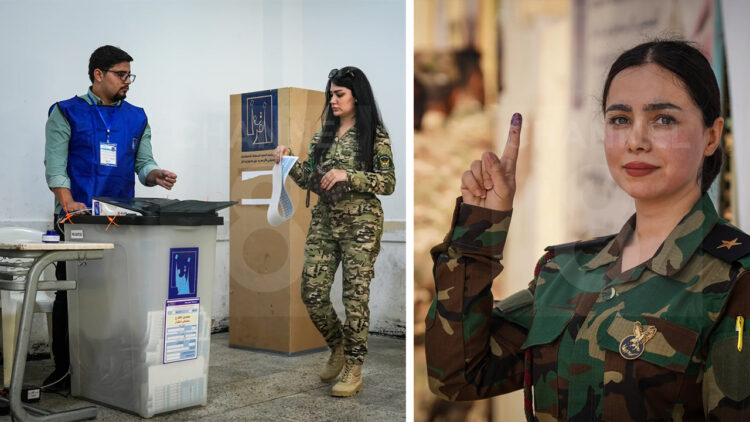
In the latest report from the Iraq’s Independent High Election Commission (IHEC), an impressive 97% of eligible voters took part in the first round of voting, for members of the security forces, for the sixth parliament of the Kurdistan Region of Iraq. On Friday, 208,252 out of 215,960 voters cast their ballots at 165 polling stations across Sulaymaniyah (Silêmanî), Erbil (Hewlêr), Dohuk (Dihok) and Halabja (Helebce).
Election observers noted that the voting process proceeded smoothly in most provinces, with no major incidents or violations reported. “Despite expectations of disruptions due to campaign tensions, we observed a calm and orderly election,” said Hogir Cheto of the Shams Network, an election monitoring group.
Initial results show the Kurdistan Democratic Party (KDP) leading with 82,979 votes, followed by the Patriotic Union of Kurdistan (PUK) with 51,345 votes, and the New Generation Movement receiving 11,207 votes. However, the Islamic Union and the People’s Front have rejected the results in Halabja province, claiming electoral fraud and irregularities.
Political tensions have escalated, particularly in Halabja, where allegations of fraud have been directed against the KDP. Representatives from the Islamic Union, the KDP and the People’s Front have lodged formal complaints with the IHEC. “The process in Halabja is deeply flawed, and we cannot accept these results,” stated Arslan Hassan of the Islamic Union.
Despite the controversy in Halabja, the IHEC has confirmed that voting in the other three provinces was conducted without significant issues. Nonetheless, concerns about potential electoral fraud by the KDP linger, rooted in the party’s history of irregularities and its alignment with Turkish interests in the region. Political analysts warn that these disputes could further deepen divisions within Iraqi Kurdistan.
As the votes are counted, attention is turning to how these disputes will impact the legitimacy of the election. Prior to the elections, US Ambassador to Iraq Elina Romanowski expressed hopes for a transparent and fair process.
Voting in this election was seen as critical in determining the balance of power between the KDP and the PUK, with the latter, led by Bafel and Qubad Talabani, campaigning on a platform of bringing an end to KDP dominance in the region. While the election has concluded peacefully in most areas, the situation in Halabja signals potential challenges ahead.