

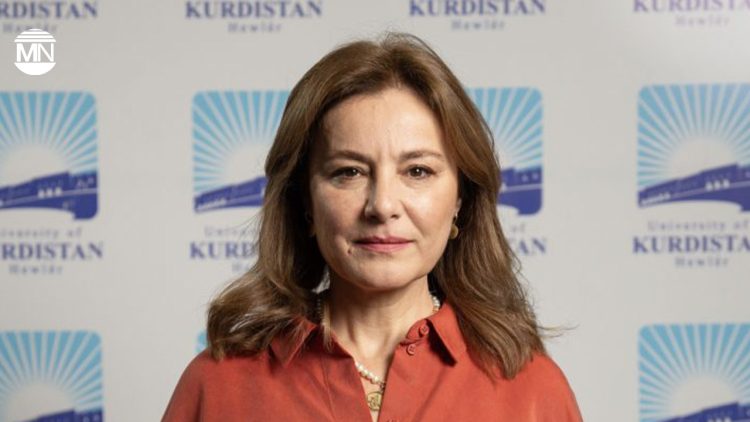
As Israeli airstrikes continue to target Iranian military and intelligence sites, Kurdish political actors across the region are reassessing their position in what experts are calling a pivotal moment in Middle Eastern geopolitics. International Relations scholar Associate Professor Dr Arzu Yılmaz, based in Erbil (Hewlêr), told Roj News on Tuesday that the escalation between Iran and Israel is not only reshaping regional dynamics but also creating a potential opening for Kurds in Iran to pursue rights through a Rojava-style model of autonomous governance.
“This is not just a war,” Yılmaz stated. “It’s the potential collapse of a regional status quo that has been in place since 1979.”
She noted that Iran’s weakening influence—exposed by the neutralisation of its proxy networks in Gaza, Lebanon, and Syria—could now extend into Iraq, where Tehran has traditionally maintained a foothold through Shiite militias and political allies. However, a direct Israeli-Iranian conflict is likely to draw Iraq further into instability.
Since 13 June, the region has seen an uptick in cross-border tension. US military bases in Iraq have come under attempted drone attacks, including one intercepted by American defences in Erbil around 3am on 16 June. The incident has heightened fears of broader conflict, especially if Iran retaliates against US assets.
“The US says it is not involved in Israel’s attacks, but if its bases are hit, it will retaliate. That could lead to a regional war,” warned Yılmaz.
The Kurdistan Region of Iraq (KRI) has found itself caught between Tehran’s accusations of collaboration with Israel and Washington’s military footprint. Yılmaz recalled previous Iranian missile strikes on civilian areas in Erbil, noting Iran’s repeated claims that Israeli intelligence services operate in the region.
Since the most recent strikes, the KRI has entered a near-lockdown: schools are closed, public spaces deserted, and citizens anxious. Though the US appears to be defending its own positions, there is no sign that it is actively protecting Kurdish civilian areas.
Kurdish leaders in Eastern Iran (Rojhilat) have taken an unprecedented step by openly backing the Israeli strikes and expressing support for regime change in Tehran. According to Yılmaz, this signals a strategic pivot: “They are positioning themselves to demand recognition and autonomy in any post-Islamic Republic system.”
She compared the Kurdish strategy in Iran to the self-administration model developed in Rojava, northern Syria, noting that the outcome will depend on whether the conflict results in regime collapse and what political structures emerge.
Meanwhile, Iraq’s own future is uncertain. If Iran’s influence collapses, Shiite political dominance—cemented after 2003 with Tehran’s support—could wane. Sunni forces may seek to reclaim influence, especially as Iraq’s Kurdish leadership strengthens ties with Gulf powers like Saudi Arabia, the United Arab Emirates (UAE), and Qatar.
“Whether or not Iran’s regime falls, the status quo has already cracked,” said Yılmaz. “We are now entering a phase where Kurdish demands are no longer hidden. They are openly seeking their rights.”
With Iraq lacking air defence systems and regional alignments shifting rapidly, Kurdish autonomy, sectarian power struggles, and foreign military responses may redefine the post-1979 order in the Middle East.


