

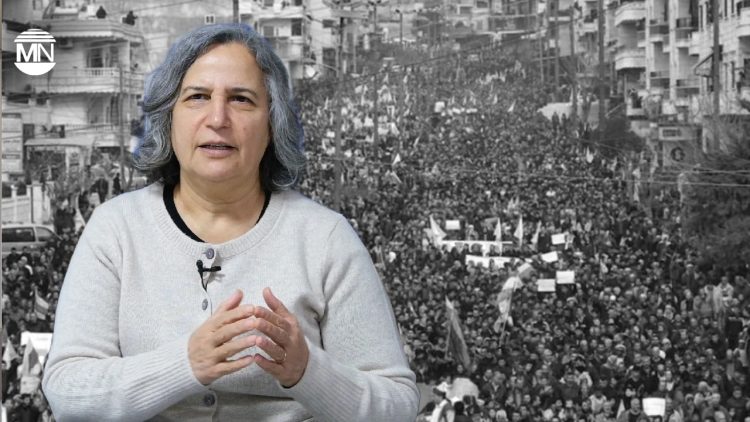
Kurdish politician Gültan Kışanak has said that the political theory developed by Abdullah Öcalan during his long-term imprisonment in Turkey offers one of the most ambitious and urgent responses to the crisis of the Middle East, and that building peace requires active mobilisation by society rather than top-down solutions.
In a wide-ranging interview published on Sunday, Kışanak described Öcalan’s writings as a deep analysis of power, statehood and social organisation, grounded in historical, philosophical and sociological critique. She argued that although Öcalan has been held in solitary confinement on İmralı Island for more than 25 years, his model of “democratic confederalism” continues to provide practical guidance to communities across the region.
“The uniqueness of the Kurdish struggle is the leadership of Abdullah Öcalan,” she said. “He didn’t just offer a political roadmap, he provided a new understanding of society, identity and freedom. And in that sense, the Kurds are fortunate.”
Öcalan’s political sociology is built around three core principles: radical democracy, women’s freedom and ecological sustainability. Kışanak stressed that this model does not seek the creation of new nation-states, but instead envisions a decentralised political structure in which different ethnic, cultural and religious groups can coexist within shared democratic institutions.
“He proposed freedom through coexistence rather than through forming new borders,” she said. “We must move beyond the model of nation-states that divide and dominate. Öcalan’s vision recognises identity but also insists on shared political life.”
This proposal, she said, takes on new relevance as the Middle East faces renewed instability—particularly in light of escalating tensions between Iran and Israel, the fallout of collapsed Western-backed projects, and the growing fragmentation of states across the region. Kışanak argued that Öcalan foresaw many of these developments, particularly the failure of forced homogenisation and the rise of radical non-state groups in the wake of the Arab uprisings.
“These are not just problems for Kurds,” she said. “From Lebanon and Jordan to Palestine and Iran, the entire region is trapped in a crisis caused by borders imposed a century ago. Öcalan called it a Third World War—a collapse of the international order shaped by colonial agreements like Sykes-Picot.”
Kışanak also pointed to the experiment in self-administration in North and East Syria, often referred to as Rojava, as a real-world example of Öcalan’s model in practice. “They didn’t build a Kurdish state there. That’s the whole point. They created a structure that includes Arabs, Assyrians, Armenians and others—where everyone’s language, culture and identity is respected,” she said. “It’s misunderstood as an ethnic project, but it’s about building a democratic nation together.”
Despite this, Kışanak said Öcalan’s proposals remain widely misunderstood—or ignored—especially in Turkey, where political discourse remains dominated by centralised state thinking. “We’ve all fallen into the trap of waiting,” she said. “Waiting for the state to act, for the negotiations to restart, for someone to go to İmralı. But Öcalan has already done his part. The question is: What are we doing?”
She warned against reducing the Kurdish peace process to elite negotiations behind closed doors, arguing instead for a mass-based, participatory approach. “A democratic society isn’t built with permission from above. It’s built by the people themselves. The real [negotiating] table isn’t on the island—it’s in society.”
Kışanak also reflected critically on the feminist movement and broader civil society in Turkey, saying that public initiatives calling for peace—such as the “We Need Peace” platform—must go beyond declarations. “We keep demanding things, but we need to start building. Conferences, meetings and statements are not enough. We need spaces where people ask: ‘How do we want to live together?’”
The interview comes amid growing interest in Öcalan’s recent writings, which have called for a “Communal International”—a global platform bringing together women, workers and other marginalised groups to formulate a new political horizon beyond state socialism and liberal capitalism. Kışanak said Öcalan has identified a growing ideological vacuum in global leftist politics and sought to address it by offering new theoretical tools.
However, she emphasised that this intellectual leadership cannot succeed unless its principles are taken up by broader society. “The challenge is moving from being spectators to being actors,” she said. “People still attend meetings to be told what’s happening, not to ask what we can do together.”
Kışanak concluded by calling for a shift in political culture—one that fosters dialogue across difference and resists the fear of state backlash. “We must stop censoring ourselves out of fear,” she said. “Even in Turkey, even in Gaza, even in Iran—there are millions of people who want a democratic future. But we must build it from the ground up.”


