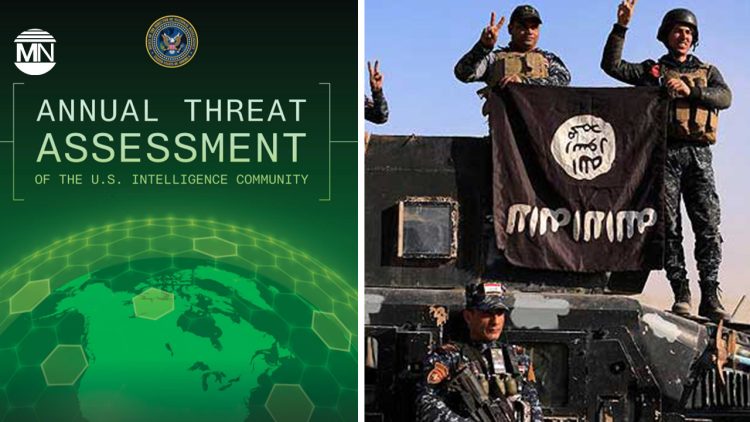
The fall of Bashar al-Assad’s regime in Syria last December has created conditions ripe for a resurgence of the Islamic State (ISIS), the United States intelligence community warned in its Annual Threat Assessment released on 18 March. The report cautions that ISIS is actively seeking to exploit Syria’s deepening instability to rebuild its operational capabilities, free imprisoned fighters, and reassert global influence through propaganda and attacks.
”Syria’s continued instability is likely to provide opportunities for ISIS to reconstitute its attack capabilities, including external plotting,” the report said. It also warned that the extremist group could “free prisoners to rebuild their ranks” and inspire attacks beyond the region, including in the United States.
The report, compiled by the Office of the Director of National Intelligence (ODNI), provides a comprehensive overview of current and emerging threats to US national security. This year’s assessment places significant emphasis on the dangers posed by transnational Islamist groups, particularly ISIS and al-Qaeda, amid Syria’s ongoing power vacuum.
While the United States has led major anti-ISIS operations—including the 2019 destruction of the group’s so-called physical caliphate—the intelligence community notes that ISIS “remains the world’s largest Islamic terrorist organisation”. Despite setbacks, the group continues to draw strength from globally dispersed leadership and several aggressive branches, such as ISIS-Khorasan (ISIS-K), which was responsible for high-casualty attacks in Russia and Iran in 2024.
The threat is not confined to foreign theatres. The report cites the deadly New Year’s Day shooting in New Orleans, which left at least 15 dead and more than 35 wounded, as an example of ISIS-inspired violence within the United States. “The attacker was influenced by ISIS propaganda,” it states, demonstrating the group’s continued reach through online radicalisation.
What the report notably omits is any mention of the Kurdish-led forces that have spearheaded the ground fight against ISIS in Syria. The Syrian Democratic Forces (SDF), including the People’s Protection Units (YPG) and Women’s Protection Units (YPJ), have played a critical role in dismantling ISIS strongholds. Over 11,000 Kurdish fighters have lost their lives in the campaign, according to SDF figures.
A key concern flagged by the assessment is the potential for other extremist factions to fill the void left by Assad’s departure. Hay’at Tahrir al-Sham (HTS), a former al-Qaeda affiliate, has emerged as a powerful actor, claiming to seek “inclusive governance” through recent deals, including one with SDF commander Mazloum Abdi.
However, ISIS is opposed to any such democratic overtures. “ISIS has already signalled opposition to HTS’s call for democracy and is plotting attacks to undermine its governance,” the report warns.
Al-Qaeda’s affiliate in Syria, Hurras al-Din, is also believed to be strengthening its position. Despite public claims that the group was dissolved by senior al-Qaeda leaders, the US report indicates members have been instructed to prepare for future conflict.
The report underscores that these rival jihadist groups may be competing for influence, but all pose severe risks in Syria’s fractured landscape. “The rise of HTS and massacres against Alawite civilians along the Syrian coast—where over 1,000 were killed—are direct consequences of this extended instability,” the assessment says.
Beyond Syria, ISIS is expanding its footprint in Africa. The group’s Somalia branch has doubled in size in the past year, while its West Africa and Sahel factions have led in attack claims.
While the report’s focus is global, its warnings about Syria are urgent. As US military involvement remains under scrutiny and regional actors vie for influence, the intelligence community stresses that “a robust intelligence response” is needed to prevent ISIS from capitalising on the power vacuum.
The future of Syria remains uncertain, but as the report concludes, “Instability provides fertile ground for terrorist groups to regroup, recruit, and reassert global reach.”