

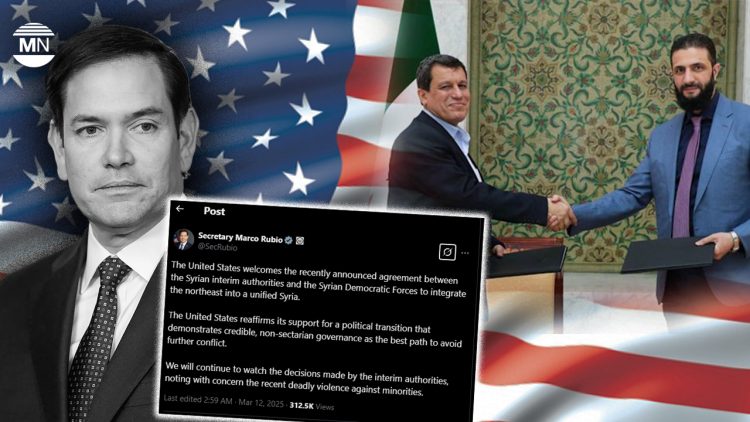
US Secretary of State Marco Rubio issued a statement on 11 March expressing support for the recent agreement between Syria’s interim government and the Kurdish-led Syrian Democratic Forces (SDF), describing it as a constructive step towards the unity of the country. In an official statement on X, Rubio reaffirmed Washington’s backing for a political transition that ensures non-sectarian governance, while raising concerns over recent acts of violence targeting minority groups.
“The United States welcomes the recently announced agreement between the Syrian interim authorities and the Syrian Democratic Forces to integrate the northeast into a unified Syria,” Rubio said.
He further emphasised Washington’s broader policy goal, adding, “The United States reaffirms its support for a political transition that demonstrates credible, non-sectarian governance as the best path to avoid further conflict.”
Rubio’s statement comes amid growing scrutiny over the role of Hay’at Tahrir al-Sham (HTS) and its leader, Ahmed al-Sharaa (al-Julani), within Syria’s interim government. While HTS has attempted to rebrand itself, the group remains a designated terrorist organisation by the US and most European states, with recent developments intensifying concerns over the group’s influence. Rubio’s comments subtly reaffirm Washington’s position, signalling that HTS must end its violent activities against minorities:
“We will continue to watch the decisions made by the interim authorities, noting with concern the recent deadly violence against minorities.”
This reference follows reports of massacres in Latakia and Tartus, northwestern Syria, where over 1,000 civilians, primarily from the Alawite community, were killed in attacks linked to HTS-affiliated groups. Washington’s statement underlines its intent to hold the interim authorities accountable for any further destabilisation.
Rubio’s endorsement of the Kurdish deal with Syria’s interim authorities marks a notable shift in US policy, aligning Washington with efforts to stabilise the country through negotiated agreements rather than prolonged military engagement. The deal between the SDF and the interim government, signed on 10 March, outlines a framework for governance in northeast Syria, integrating Kurdish-led institutions into the broader state structure.
This approach has received international support, with the UN, European Parliament, France, Germany, the Gulf states and the Kurdistan Regional Government (KRG) in Iraq welcoming the agreement. Turkey, initially silent, later issued a statement endorsing the deal while maintaining its counterterrorism rhetoric.
The US position, as articulated by Rubio, reinforces its stance against sectarian divisions while carefully navigating its response to the evolving power dynamics within Syria. As the situation develops, observers will be watching whether the US takes further diplomatic or economic measures to influence the interim authorities, particularly concerning HTS’s continued influence in Syria’s northwest.


